
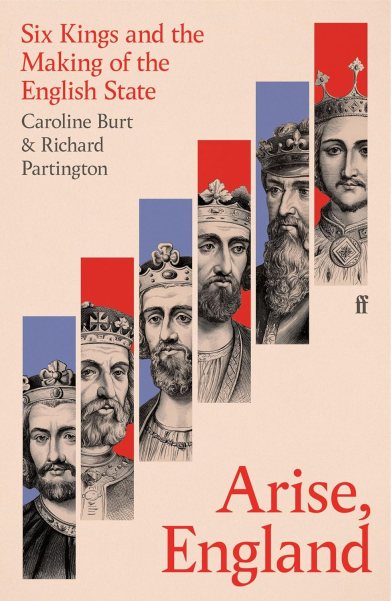
 Like many other countries, England has been through growing pains when it comes to reforming its political, military, and judicial systems. None more so than the pains of the medieval period, specifically from 1199 to 1399. In those two centuries, there were six Plantagenet kings, each with a different style of being king and a different way of changing England with each reign. We often think that the biggest change to England’s political history during this time was the Magna Carta, but in fact, that was only just the beginning. Caroline Burt and Richard Partington have combed the archives to do a deep dive into each reign of these Plantagenet kings, examining the political and judicial changes that happened in a short period. Their comprehensive book is entitled, “Arise, England: Six Kings and the Making of the English State.”
I want to thank Faber & Faber for sending me a copy of this book. I have seen this particular title circulating on social media and after the endorsement it received from Dan Jones, I decided to give it a shot. I am not a huge fan of political history as I find it a tad dry, but I wanted to give myself a challenge.
This book is broken into six different chapters, a chapter for each king and their reign, but the chapters are separated by sections focusing on distinct aspects of their reigns. The six kings that Burt and Partington have chosen to highlight in this book are King John, Henry III, Edward I, Edward II, Edward III, and Richard II. In these two centuries, England experienced so much change, starting with the Magna Carta, the Black Death, plenty of revolts, overthrowing kings, the establishment of what we now consider Parliament, and the relationship between the king and his nobles. That does not include external forces such as Ireland, Scotland, Wales, and France wanting to conquer England as their own. When you consider how much these kings had to face, it is no wonder that they had to change England’s political system gradually.
Personally, this book was a bit of a struggle for me with how dense and the amount of information that was presented. While it offered great insight and was meticulously researched, there were parts for me that were dry to read. If you do want to read this as a casual read, I would suggest taking it slow so that you can fully understand everything that is being presented. If you are someone who likes political history and how it changed over centuries in England, “Arise, England: Six Kings and the Making of the English State” by Caroline Burt and Richard Partington might be the book for you.
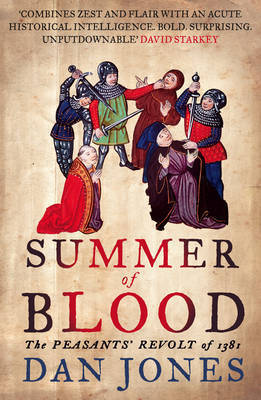 The year was 1381, and England was engulfed in chaos. A band of ruffians and revolters descended on London to achieve political change and a fair chance for the lower classes who suffered greatly from war and plague. The young King Richard II watched as men like Wat Tyler and the preacher John Ball led this ragtag army to his doorstep, fighting against his advisors, like John of Gaunt, to end a poll tax that was their last straw. Why did this ragtag army march on London? How did men like Ball and Tyler convince the masses to march against their sovereign and his government? How did this revolt end, and did the people get what they wanted due to their revolution? Dan Jones brings the bloody story of the first significant revolution by the English people to life in his book, “Summer of Blood: The Peasants’ Revolt of 1381.”
 As the weather gets colder, the leaves turn brilliant colors and fall from their trees, marking the perfect time of the year to snuggle with a blanket, a cup of tea, and a good spooky tale. Many would reach for a modern supernatural story, but ghost tales have been hiding in archives for centuries. One such story comes from the time of King Richard II. It was first found and transcribed from Latin in 1922 by medievalist M.R. James. Dan Jones has taken on the challenge to retell this story for a modern audience. Initially written by an unknown monk of Byland Abbey, this medieval ghost story is called “The Tale of the Tailor and the Three Dead Kings.”
 Adventures of a Tudor Nerd