
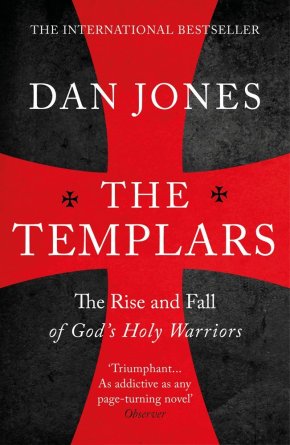
 The Crusades were a series of wars between Christian and Muslim warriors for the right to control the Holy Lands of the Middle East. Many men on both sides earned legacies that would surpass their earthly bodies during bloody battles. It created many bands of knights that would last for generations, such as the Hospitallers and the Teutonic Knights. The Templars were the most famous of these knight groups, who may have lasted only for less than two hundred years, but whose legacy would turn into myth. Dan Jones has taken on the arduous task of discerning fact from fiction about the Templars in his book, “The Templars: The Rise and Fall of God’s Holy Warriors.”
I have heard of the Templars from other books that I have read about the Plantagenets and the Crusades, plus the myths of Templar gold and Friday the 13th, but that was the extent of my knowledge about the knightly order. I am a fan of Dan Jones and his books, so I have wanted to read this book for a while now.
Jones’ tome about the Templar knights is broken down into four sections; the origins of the order, how they earned their reputation as soldiers, how they transitioned to the world of banking, and finally the abrupt fall due to greed and rumors of sexual misconduct. The Order of the Temple of Jerusalem, also known as the Templars, was created by Hugh of Payns in 1119 as an order of warriors who lived in poverty, were strictly celibate, and swore oaths to protect innocent Christian pilgrims. Slowly, this rag-tag group of warriors was recognized by the Pope and began to fight battles during the Crusades.
The Templars were known for their willingness to fight until the last man in brutal battles to defend the pilgrims and regain the holy lands for Christianity. There were men like Richard the Lionheart of England and James of Maille, who gained tremendous reputations for their association with the Templars; then there were men like Frederick II Hohenstaufen, the Holy Roman Emperor, who chose to fight with the Templars and ended up fighting against the knights after disputes. The Templars’ greatest threats during the Crusades were the Mamluk sultan Baybars and the Kurdish sultan of Egypt and Syria Saladin, however, the greatest threat to the order was closer to home.
King Philip IV of France, a man who ruthlessly persecuted the Jews in France and fought against Pope Boniface III, turned his greedy eyes on the Templars. He created false charges against the order over sexual misconduct between the knights and forced members of the order, including James of Molay, the last Templar master, to admit to the charges through torture. The death of James of Molay and his fellow Templar warriors marked the end of the order, but the legacy lived on through the present day.
Jones has done it again and delivered a meticulously researched behemoth of a book that is accessible for novices and experts alike. He truly cared about telling the compelling tale of the Templars, full of bravery amid bloody battles and treachery amongst men that they thought supported their cause. A brilliantly engaging book, “The Templars: The Rise and Fall of God’s Holy Warriors” by Dan Jones is the perfect book for anyone interested in this order of knights and their impact on history.
 When we think of the word “education,” images of sitting in school rooms for hours, listening to lectures, and doing endless homework pop into our minds. Our modern education system tends to focus on math, science, language arts, and history as the core subjects we study, with music and physical education as something that we in America call an “elective.” But have you ever wondered what education looked like in the past? How did the Tudors pass on their knowledge to future generations? What subjects did the Tudors consider essential, and how did the amount of education you received change depending on your class? Amy McElroy explores these questions in her book, “Educating the Tudors.”
 Adventures of a Tudor Nerd