
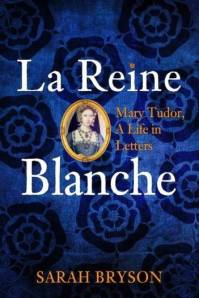
 When we think of the Tudors, we often think of strong women like Katherine of Aragon, Anne Boleyn, Elizabeth I, Margaret Beaufort and Mary I. However, there was another Mary who made an impact during this time. She was the daughter of Henry VII, the sister of Henry VIII, and the wife of King Louis XII of France. She was referred to as one of the most beautiful women in the world. She gave away all of her titles to marry the man she loved, even though he was not a king. She took on debt to have a family and helped those who needed help. This is the life of Mary Tudor. In Sarah Bryson’s debut book, “La Reine Blanche: Mary Tudor, A Life in Letters”, Bryson explores the life of this extraordinary woman through her letters.
Sarah Bryson explains why she decided to include Mary’s letters in this book:
Mary Tudor’s letters are a fascinating and captivating look at how a woman could wield power without publically challenging the patriarchy. They show how Mary was able to manoeuvre those around her to follow her heart- marrying her second husband for love, rather than being dragged back to the international chess game as a marriage pawn. They are also, on occasion, a way of looking into Mary’s life whereby the layers of princess and queen are stripped back and only the woman remain. (Bryson, 11).
Bryson decides to begin her book not with the birth of Mary, but rather with the Wars of the Roses in order to understand how the Tudors came into power and the importance of the marriages that Henry VII established for his children were. She then moves onto the family aspect of the Tudors and the birth of Mary, which to me was fascinating to understand those early years of a young princess. Unfortunately Mary’s world was not a picture perfect one as her father was constantly fighting those who wanted to take his throne, including Lambert Simnel and Perkin Warbeck. Her brother Arthur, Prince of Wales, would marry Katherine of Aragon, but only a few months after they were married, Arthur tragically died. Mary’s mother would also pass away while trying to give birth to a baby girl. In order to build a strong alliance, Henry VII made a marriage treaty between Mary and Archduke Charles (later Charles V, Holy Roman Emperor), but it would eventually fall through.
Henry VII would die on April 21, 1509, leaving the throne to his son Henry VIII; Henry would marry his brother’s widow Katherine of Aragon on June 11, 1509. Henry arranged Mary’s first marriage with King Louis XII with an enormous dowry, but their marriage would not last long as Louis XII would die on January 1, 1515. Mary would retire from public life and would wear the white mourning clothes of a widow, thus the nickname “La Reine Blanche”, the white queen. Mary would not stay single for long as she married Charles Brandon, Duke of Suffolk. Charles Brandon was a notorious ladies’ man and happened to be one of the people who Henry VIII sent over to France to help Mary. To say that Henry was upset would be an understatement; he refused for the couple to return to England, for a time, and ordered that Charles Brandon would pay off Mary’s dowry. It would leave the couple impoverished for the rest of their lives, but they were happy and in love. It was really during this time that Mary’s letters showed her heart and who she truly was. Mary had to be incredibly strong to show the love that she had for her husband to her brother. Henry eventually accepted the couple and they went on to have four children of their own: Henry, Frances, Eleanor and Henry 1st Earl of Lincoln. Their daughter Frances would marry Henry Grey and would become the mother of Lady Jane Grey, Katherine Grey and Mary Grey. Mary Tudor would die on June 25, 1533, shortly after Anne Boleyn was crowned queen.
Mary Tudor’s story is one of tragedy and love. I will be honest and say that I only knew about half of her story, but Sarah Bryson made Mary come alive. “La Reine Blanche: Mary Tudor, a Life in Letters” may be Bryson’s debut book but it feels like she has been writing for a while. This is a lovely book that combines facts and letters in such a way that it is a joy to read. I look forward to reading more from Sarah Bryson in the near future. If you are interested in the life of Mary Tudor, this is a great book about her life through her letters.
 One of the greatest mysteries of all time is what happened to the young princes, the sons of Edward IV, who were held in the Tower of London. Many people believed that they were killed. There are some who believe that Richard III had them murdered and there are some who say that Henry VII ordered the deed to be done. But what if they were never killed? What if they survived? That is the premise of Matthew Lewis’s book “The Survival of the Princes in the Tower: Murder, Mystery and Myth”.
  Perkin Warbeck. These were the most famous pretenders and the ones who challenged Henry VII’s right to the throne. If they were really the princes in the tower, why were they defeated? Why were they considered pretenders? Lewis explores other people who could possibly be the princes, including a theory by amateur art historian Jack Leslau on “The Family of Sir Thomas More” by Hans Holbein the Younger.
  Adventures of a Tudor Nerd