
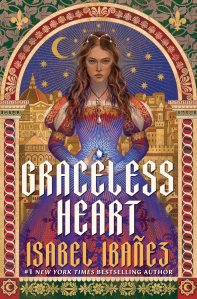
 In the Italian states during the 15th century, a time of war coexisted with a period of art flourishing. But what if magic was thrown into the fray? Sculptress Ravenna Maffei desires nothing more than to create art and to protect her family while keeping her own magical powers a secret. To protect those she holds dear, Ravenna enters an art contest, hosted by the immortal family of Florence, the Luni. Ravenna is taken by the family to complete an important task, but if she fails, she will be killed by the heir of the family, Saturnino Luni. Unfortunately, the greatest danger lurks outside of Florence as the pope is waging war against magic itself. Can Ravenna uncover the secrets of the Luni family and finish their difficult task before war engulfs all of Florence? Ravenna’s story is told in Isabel Ibanez’s latest historical fantasy novel, “Graceless Heart.”
This was a spontaneous buy for me. It was really the cover that caught my eye, and then I read the description. I realized that this was a historical fantasy novel, a genre that I have not dabbled in much, but one that I have heard of before. I decided to go on a whim and give it a shot to see how well she could blend magical elements with historical figures and settings.
Ravenna has always had a gift for art, especially sculpting, but when she was younger and exploring a quarry with her aunt, she soon discovered that she has a darker talent, one that she has to keep secret from the rest of the world. We then jump to Volterra in 1478, Ravenna’s hometown, where she is on a mission to save her brother. She decides to enter a sculpting competition, where the prize is anything she asks for. Obviously, she wins the contest and can release her brother from his prison, but the Luni family, the immortal family of Florence, has decided to use Ravenna’s talent for magic for their own goals. They want her to free five mystic stones from marble, which is more difficult than it sounds. The entire family keeps an eye on her, but her biggest threat is the heir to the family, Saturnino.
While Ravenna believes Saturnino and the Luni family are her enemies, she will soon learn that her greatest threat is Pope Sixtus IV who is wanting to wage a war against the Luni family and magic itself. It was nice to see Leonardo da Vinci, Lorenzo de’ Medici, and Federico da Montefeltro the Duke of Milan featured in this novel. It was a nice touch to add depth to the story and give it a foundation in the past.
The story itself was engaging, so much so that I ended up binge reading quite a bit of it. It was a delightful blend of history and fantasy with a dash of romance. I didn’t know what to expect when it came to reading a historical fantasy, but I had so much fun and I can’t wait to see what Ibanez will write next. If you are someone who enjoys stories set in the Italian Renaissance but you want to dabble in historical fantasy, I think you will enjoy “Graceless Heart” by Isabel Ibanez.
 Florence, Italy, in the 16th century, was a city of opportunity and full of art and architecture. It was also a city on the precipice of great change. The great banking family, the Medicis, holds the reins of government in Florence, and Lorenzo de’ Medici is the family’s current head. However, two bastards will radically change his life and the Medici family. One was a bastard son of a notary who became one of the most famous artists ever. The other was a bastard son who became a priest and the enemy of the Medici family. Their stories of power and ambition intersect in the city of Florence in Phil Melanson’s debut novel, “Florenzer”.
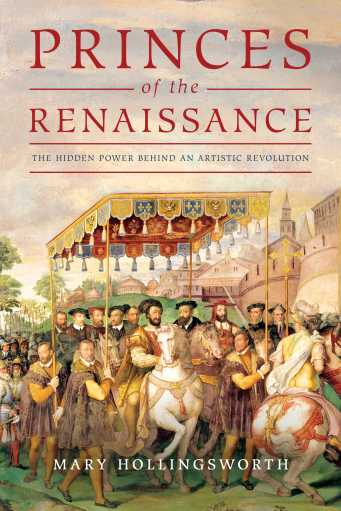 The 15th and 16th centuries were full of dynamic political and religious reforms, but they were also known for cultural changes throughout Europe. The medieval foundations started to crumble, and the early modern age emerged. One of the centers of change was Italy, a series of states with their rulers vying for power and prestige. These rulers would help finance masterpieces in art, literature, and architecture, but it was their rivals that threatened to tear the Renaissance society apart. In “Princes of the Renaissance: The Hidden Power Behind an Artistic Revolution,” Mary Hollingsworth explores the lives of the men and women who helped shape the Renaissance.
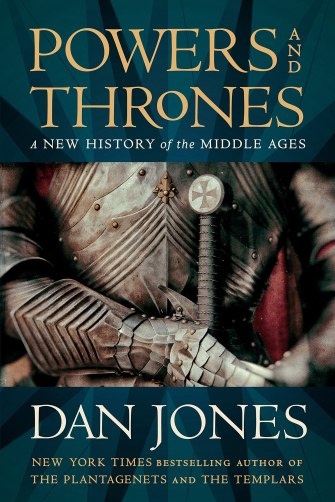 When we study human history, in general, we tend to pick a country and a period to focus on and research. Books on the subject material tend to focus on one land with interactions between other nations. It is infrequent for authors to take on multiple countries unless concentrated on one event that affected numerous locations. Those books often read like textbooks and can be a bit dry. Finding the perfect balance between these elements and engaging with the reader is a monumental task for any author, but Dan Jones has taken on the challenge. His latest behemoth tome, “Powers and Thrones: A New History of the Middle Ages,” takes on the gigantic task of telling the story of the Middle Ages from diverse perspectives.
 A man ahead of his time who never finished the tasks that he was given as his mind was constantly racing, thinking of new ideas. This is what we consider a genius or a Renaissance Man today, but during Leonardo da Vinci’s time, it was just considered odd. Leonardo da Vinci was an enigma. He could make the impossible possible. His art seemed to leap off the canvas with its realism. However, there are still so many mysteries surrounding his life and his works. What made this one artist/inventor so fascinating for centuries? In her book, “The Real Leonardo da Vinci” Rose Sgueglia opens the curtain to reveal Leonardo da Vinci’s truth and inner circle.
 Adventures of a Tudor Nerd