
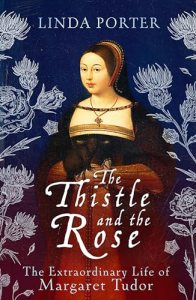
The Tudors have been an area of fascination for historians and history nerds alike for centuries. The attention tends to focus on either Henry VIII and his six wives or his daughter, Elizabeth I, but we need to remember that they were not the only Tudors. In fact, we should remember that Henry VIII had siblings, Arthur, Margaret, and Mary. While Arthur and Mary tend to get more attention due to their proximity to Henry VIII and his marital life, Margaret Tudor had her own eventful life as Queen of Scotland and the mother of King James V. Linda Porter tells Margaret’s story in her latest biography, “The Thistle and the Rose: The Extraordinary Life of Margaret Tudor.”
I had heard that Porter was writing a new biography about Margaret Tudor, so I knew I wanted to read it. I have read a few books about Margaret Tudor, but they have been relatively short, so I wanted to see what new information Porter would include in this book.
Margaret Tudor was the second child of King Henry VII and Queen Elizabeth of York. As such, she was destined to marry a foreign prince and create a strong alliance for the brand-new Tudor dynasty. Since her brother Arthur was betrothed to Catherine of Aragon, Margaret’s parents chose a match with Scotland and King James IV, who was twice the age of Margaret. As Queen of Scotland, Margaret did her best to bridge the gap between England and Scotland, deal with her husband’s mistresses and illegitimate children, and be a mother to her son, King James V.
Everything changed when James IV died at the Battle of Flodden. Margaret was now a widow and regent for the young King James V. To protect her family, Margaret decided to marry Archibald Douglas, 6th Earl of Angus, which turned out to be a trainwreck. Although Archibald did give Margaret her daughter, Margaret Douglas, he was stealing from Margaret’s own properties, which was a jerk move. Margaret wanted a divorce, but her dear brother Henry VIII was against the idea. A bit hypocritical, especially since he would divorce Catherine of Aragon a few years later. Eventually, Margaret would divorce Archibald and marry a third time to Henry Stewart, Lord Methven.
Throughout history, Margaret Tudor has been viewed negatively because she married Archibald so quickly, but Porter showed that Margaret should be applauded for how she survived during difficult circumstances. She fought for herself and her children, even if it meant that she was at odds with her husbands or her brother. Through her letters, we see how Margaret was a diplomat trying to make peace between England and Scotland.
Porter does an excellent job telling Margaret’s story in a respectful manner. This book is extremely well researched and easy to read. If you are a Tudor fan and you want to learn more about Henry VIII’s sister Margaret Tudor, I highly recommend you read “The Thistle and the Rose: The Extraordinary Life of Margaret Tudor” by Linda Porter.
 Throughout history, many civil wars have altered the course of the history of the countries where they occurred. While we think about the American Civil War, the French Revolution, and the Wars of the Roses, another civil war often overlooked outside of England is the English Civil Wars. A series of conflicts between the Parliamentarians and the Royalists led to the execution of King Charles I and the rise of the English Republic under Oliver Cromwell. We often view the conflict from either Charles’ or Oliver’s perspective, but we have to consider the family that Charles left behind. How did the English Civil Wars mold the children of Charles I and his Catholic Queen Henrietta Maria? Linda Porter explores the lives of the royal children in her book, “Royal Renegades: The Children of Charles I and the English Civil Wars.”
 Adventures of a Tudor Nerd