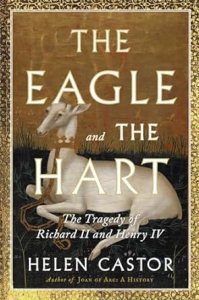
Book Review: “The Eagle and the Hart: The Tragedy of Richard II and Henry IV” by Helen Castor

The story of the Plantagenets is filled with high triumphs and devastating tragedies. It is a story of families torn apart for a crown and the desire to either rule with an iron fist for the glory of England or live a life of luxury at the expense of their citizens. The story explored in this particular book is the tale of two cousins born months apart, Richard of Bordeaux and Henry Bolingbroke. Richard and Henry were not born to become King of England, but Fortune’s Wheel had a different plan for the cousins. So how did these cousins become kings and how did their tale turn to tragedy not only for their relationship but for all of England? Helen Castor tells the tale of these two Plantagenet kings in her latest book, “The Eagle and the Hart: The Tragedy of Richard II and Henry IV.”

I want to thank Avid Reader Press and Net Galley for sending me a copy of this book. I have seen this book on social media and ever since it was announced, I knew I wanted to read it. I have enjoyed Castor’s posts online as well as her documentary on the She-Wolves, based on her book of the same name, so when I heard about this one, it was an intriguing premise and so I jumped at the chance to read it. 

The fact that Richard of Bordeaux and Henry Bolingbroke became King Richard II and King Henry IV respectively is quite the story. Richard was the son of Edward The Black Prince and Henry was the son of John of Gaunt; both of their fathers were sons of Edward III and so the idea was that one of his sons would inherit the throne. However, Edward III had different plans after the death of Edward The Black Prince. It was announced that the young Richard of Bordeaux would be crowned King of England. This should have been the first red flag for England because it means that a Regency council must be formed. There are fights for power and fights over finances that culminate in the Peasants’ Revolt. Richard II doesn’t have much desire to fight for his country on the battlefield against the French or the Scottish, but he does care about favoring his favorites, even if it means turning the government against him. One such group, the Appellant Lords, will prove an extremely dangerous challenge for Richard II, and it will include his cousin Henry Bolingbroke. While many of the Appellant Lords will end up dead, Henry Bolingbroke is merely exiled, which in the long run, was not the best decision for Richard II. 

In 1400, John of Gaunt died and the title as well as the lands of the Duke of Lancaster were turned over to Richard II while Henry Bolingbroke was in exile in France. This marks the turning point for Henry as he decides to invade England while Richard is away dealing with problems in Ireland. It will end with Richard’s abdication and the coronation of Henry Bolingbroke as King Henry IV. However, things are not all sunshine and rainbows for Henry IV, the 1st Lancastrian King of England, as he finds out that it is not easy being a king. 

I must applaud Castor for writing a dual biography that is both balanced and utterly brilliant. It did take me a while to read this book because I was taking so many notes while I was reading and it gave me a better understanding of this tumultuous time. I would suggest that if you do read this book, take your time so that you can understand the complex nature of the conflict between these two cousins. If you are a fan of the Plantagenet dynasty, I highly recommend you read, “The Eagle and the Hart: The Tragedy of Richard II and Henry IV” by Helen Castor.

Biography: King Henry IV (aka Henry Bolingbroke)

(Born April 3, 1367- Died March 20, 1413). Son of John of Gaunt and Blanche of mw03072Lancaster. Married to Mary de Bohun and Joan of Navarre. He had 7 children with Mary, including the future Henry V. He was the 1st king from the house of Lancaster.

Henry was the son of John of Gaunt and Blanche of Lancaster and was born at Bolingbroke Castle on April 3, 1367. Early in his life, he became one of the Lords Appellant who were opposed to the rule of Richard II. He stepped down from this role in 1389 and in 1390, went on his first adventure, journeying with the Teutonic Knights to Lithuania. Two years later, he went on a pilgrimage to Jerusalem. During this time, he visited numerous courts in Europe and was held in high regards. He was a handsome young man, but it was early in life where Henry’s ill health that plagued him during his reign started to appear.

Henry was a good person to help the king, however the only one who failed to realize this was Richard II. He banished Henry in 1398 for ten years, but when John of Gaunt died the following year and Henry became the next Duke of Lancaster, Richard II took all of his lands and banished him forever. This was the last straw for Henry. While Richard was occupied with unrest in Ireland, Henry took his chance and invaded England, forcing Richard to abdicate. The next one in line to the throne was Edmund Mortimer, earl of March, but he was only eight years old, so Parliament agreed that Henry would be a better choice to be king. His reign as Henry IV began on September 30, 1399.

However, not everyone was happy with Henry as king. Henry IV’s first rebellion that he had to deal with was by the earls of Kent, Salisbury and Huntingdon, just a month after he became king. Henry took care of this rebellion quickly and violently. It is also believed that this was around the same time that Henry ordered the death of Richard II. A few months after the first rebellion, Henry IV had to deal with a second rebellion in Wales, where Owain Glyn Dwr was declared Prince of Wales in September 1400. This revolt was quickly put down, but Owain evaded capture for several years, leading to guerrilla style warfare.

Owain’s supporters grew not only amongst Welsh barons, but English ones as well, including the Mortimers who were upset that Henry was king and not Edmund, who was Owain’s son in law after he married Owain’s daughter. Another supporter was Henry “Hotspur” Percy, the son of the earl of Northumberland who believed that he did not get the recognition that he deserved after he fought against the Scots. These forces came together and fought against Henry at the battle of Shrewsbury on July 21, 1403, where Henry defeated Hotspur easily and killed him. Henry was not going to let the rebel army get away and by 1408, they were all but eliminated.

Two years before this, in 1406, Henry IV took James I of Scotland hostage and his young heir was sent to France. James was in the English court for 17 years as a hostage and for that time, the relationships between England, Scotland and France were good. Things were looking up for Henry IV, except for his health. Starting in 1406, his health was in decline and there was a serious concern for his life. He tried to govern, but he became more reliant on his Parliament. In 1409, Henry’s son Prince Henry was made chancellor over Thomas Arundel, archbishop of Canterbury. Arundel returned in 1411 when Henry and his council were debating if he should step down in favor of Prince Henry, which Henry refused to do. Henry died in 1413 from some sort of wasting disease at the age of 45. His son Prince Henry would succeed him as Henry V.

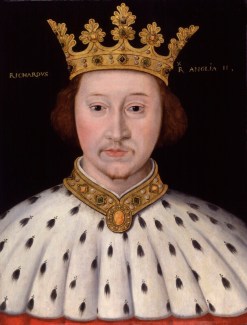
Biography: King Richard II

mw05302(Born January 6, 1367- Died on or about February 14, 1400). Son of Edward the Black Prince and Joan 4th Countess of Kent. Married to Anne of Bohemia and Isabella of Valois. He had no children.

Richard II was the second son of Edward the Black Prince, but when his older brother Edward died when Richard was three, Richard became second in line to the throne after his father. When Edward the Black Prince and Edward III died, Richard II became king at the tender age of 10. There was no formal regent that could help guide Richard II, but his uncle John of Gaunt did the best that he could, taking a more active political role.

Richard II and his government decided to start taxing the people with poll taxes to pay for the wars in France and the campaigns in Scotland. At first, they were tolerated, but then the people got mad. In June 1381, a man named Wat Tyler had enough and killed a tax collector and raised a force of around 100,000 to march against the king. When the two forces finally met, Wat Tyler was killed by the Lord Mayor of London William Walworth. Richard at the age of 14 stopped the Peasants’ Revolt by promising the people reforms that he, in the end,  did not fulfill the reforms.

He was the champion of England, but inside his court, things were more divisive. Richard II had two very close advisors, Robert de Vere earl of Oxford and Michael de la Pole. He granted favors upon the two men, causing anger in the court. Richard also sought military glory in Scotland, which ended up being a disaster. To top it all off in 1386, Richard made Robert de Vere duke of Ireland and Michael de la Pole was made a chancellor, without consulting Parliament first. This was the last straw for those who opposed Richard II. They decided to act. Five of his strongest opponents; Thomas duke of Gloucester,  the earl of Arundel, Thomas Beauchamp, the earl of Warwick, Thomas Mowbray, and Henry Bolingbroke the son of John of Gaunt, became known as the Lords Appellant. They took over the country and they tried to convince Richard to give up his courtiers.

He did comply for a little while, until he became of age. His first wife Anne of Bohemia died in 1394 from the plague, leaving Richard heartbroken. He married his second wife Isabella of Valois as part of a peace treaty with France, strengthening his position in his own country. He went after the Lords Appellant. Most of them were killed, except for Mowbray and Henry Bolingbroke. Mowbray was exiled for life while Henry was exiled for ten years. During his reign “The Canterbury Tales” by Geoffrey Chaucer was published and literature was on the rise.

In 1399, John of Gaunt died and instead of pardoning his son Henry Bolingbroke, Richard banished him for life. Richard left later that same year to quell the unrest in Ireland and Henry Bolingbroke took his chance to invade. Richard’s support dwindled and on August 19, 1399, Richard II forfeited to Henry and he was imprisoned in the Tower of London. The next in line for the throne, since Richard II had no children, was Edmund Mortimer earl of March, who was only 8 years old at the time. Parliament did not want a similar situation than the one that they were in, so they forced Richard II to abdicate and on September 29, 1399, Henry Bolingbroke became Henry IV. Richard II was moved to Pontefract Castle and on or around February 14, 1400, he died. Some believe that he starved to death as there was no evidence of a physical murder.

With Richard II’s abdication and Henry IV’s accession came the rise of the House of Lancaster.