
 Florence, Italy, in the 16th century, was a city of opportunity and full of art and architecture. It was also a city on the precipice of great change. The great banking family, the Medicis, holds the reins of government in Florence, and Lorenzo de’ Medici is the family’s current head. However, two bastards will radically change his life and the Medici family. One was a bastard son of a notary who became one of the most famous artists ever. The other was a bastard son who became a priest and the enemy of the Medici family. Their stories of power and ambition intersect in the city of Florence in Phil Melanson’s debut novel, “Florenzer”.
I would like to thank Liveright Publishing and Net Galley for sending me a copy of this novel. The description of this novel attracted me to it, rather than the cover, as the cover was released after I requested to read this novel. I have slowly been diving into the world of Renaissance Italy, but I have yet to encounter Leonardo da Vinci or Lorenzo de’ Medici in my adventures, so when I saw a novel that featured both and a new historical person to me, Francesco Salviati, I jumped at the chance to read it.
We begin with the funeral of Cosimo de’ Medici, the grandfather of Lorenzo de’ Medici, in 1464. It is the point where all three characters are introduced, and in the case of Leonardo da Vinci, it is the point before his apprenticeship where we begin to see the tumultuous relationship between Leonardo and his father, Piero, the notary. We then jump forward to 1471, when Leonardo is working as an apprentice painter for Andrea del Verrocchio. Around this time, Leonardo meets Lorenzo de’ Medici, a young man who is trying to achieve greatness, but issues arise, such as the death of the Pope and his brother Giuliano not wanting to be part of the family business. Lorenzo desires military glory, but it doesn’t go well. Finally, we have Francesco Salviati, a man who was destined to be a banker, but because he was a bastard son with darker skin, he decided to devote his life to the church, working alongside the new Pope Sixtus IV, also known as Francesco della Rovere.
As the three men grew up, they had obstacles to deal with. Leonardo fell in love with another man, known as Iac in this novel, and his love might cost him everything. While Lorenzo is trying to make sure his family is the most prominent in all of Italy, Francesco Salviati is using his influence at the Vatican to turn the tables on Lorenzo, which culminated in the Pazzi Conspiracy of 1478. The Pazzi Conspiracy was something that I had never heard of before this novel, so it was interesting to see it play out and the aftermath. While I did enjoy reading about Leonardo and Lorenzo, I didn’t feel a connection to Salviati, so when his story concluded, I didn’t feel any sort of way. I think the formatting of the book, almost like a screenplay, was a unique idea, but I don’t think it added anything to the context of the novel.
Overall, I think this was a decent novel. It was a slow start, and it was a bit of a challenge to get used to three different perspectives, but the stories of ambitions, love, and power truly shone. As a debut for someone who does not usually focus on historical fiction, I think Melanson does an admirable job of portraying 15th-century Florence in such a believable way. I think if you want a novel that’s set in 15th-century Italy, you will enjoy “Florenzer” by Phil Melanson.
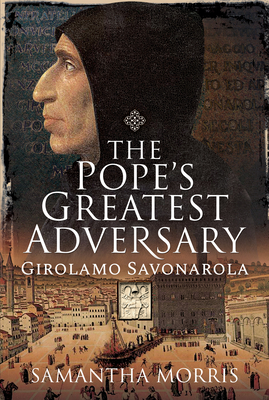 When we think about men who challenged the Church and are known as Reformers, we tend to think of Martin Luther, Jan Hus, and John Calvin. However, a man fought against corruption in his beloved Florence who should be included in the list of great reformers. He was a Dominican monk who was not afraid to preach against sin and took aim at the most powerful men in all of Italy, including Pope Alexander VII. His sermons were so scandalous that they would lead to his demise upon a pyre in the middle of Florence. His name was Girolamo Savonarola, and his story is told in Samantha Morris’s latest biography, “The Pope’s Greatest Adversary: Girolamo Savonarola.”
 Adventures of a Tudor Nerd