
 Have you ever wondered what it might be like to discover a long-lost diary of a historical figure by accident? Archaeologist Giuseppe Campise has already found a diary of Mary Magdalene. Now, the Vatican wants Giuseppe to uncover the tomb of Alexander the Great. However, while on the search for the tomb, Giuseppe finds something even more precious, the diary of Lucrezia Borgia. What secrets does the diary hold? Johnny Teague tells the tale of Lucrezia Borgia through her diary in his latest novel, “The Lost Diary of Lucrezia Borgia.”
I would like to thank Histria Fiction and Net Galley for sending me a copy of this novel. I have been interested in Lucrezia Borgia’s story since reading “Cesare and Lucrezia Borgia” by Samantha Morris, so I wanted to see how her story would translate into a historical fiction novel.
Since this book is actually a novella, I will try to keep this review short. We begin with Giuseppe Campise as he begins his search for the tomb of Alexander the Great. Along the way, he gets lost and finds the tomb of Pope Leo X. By the tomb, he finds a diary that was written by Lucrezia Borgia, so he begins to read.
Lucrezia’s diary begins with her reflecting on her life as she is ill with her final pregnancy. This diary is really her autobiography, beginning in her childhood, when her father was Cardinal Rodrigo Borgia, before he became Pope Alexander VI. We also get to see how close Lucrezia was to her brother Cesare and how it changes over time. Since they are the illegitimate children of a Pope, they are expected to make alliances through marriages and military might. Lucrezia was married three times. Her first marriage was to Giovanni Sforza, but it was quickly dissolved by her father, Pope Alexander VI. Her second marriage, to Alfonso of Aragon, resulted in a son, Rodrigo, before Alfonso died young. Lucrezia’s final husband was Alfonso d’Este, Duke of Ferrara. We get to see how Lucrezia’s life was changed through the chaotic politics of the Italian states, the constant wars, and the schemes of her father and her brother Cesare. Lucrezia was not just a one-dimensional character, but is well developed, and you feel sympathy for what she is going through.
Personally, I think this was a decent novella, but the subplot with Giuseppe did not feel necessary for me. The story of Lucrezia Borgia could stand on its own without the modern bits cutting in. Overall, I enjoyed this novella. If you enjoy reading about Lucrezia Borgia, her life and times, you might enjoy “The Lost Diary of Lucrezia Borgia” by Johnny Teague.
 Throughout history, women have been seen as pious mothers, wives, or daughters who stayed in their lane or vile manipulators who wanted power and were willing to do anything to maintain their status. While the former group of women would be an interesting study, as the saying goes, well-behaved women seldom make history. So why did certain women receive a villainess lens when we look at their lives and what do the historical records tell us about them? Samantha Morris has chosen to take the stories of these misunderstood maidens and tell them in her latest book, “The Most Maligned Women in History.”
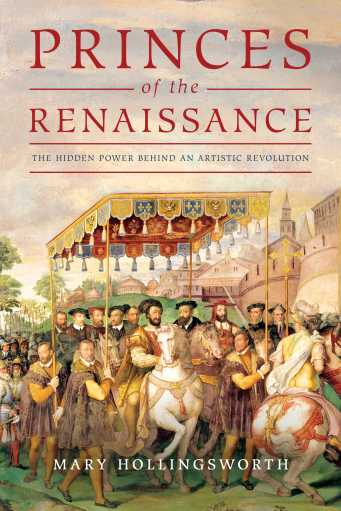 The 15th and 16th centuries were full of dynamic political and religious reforms, but they were also known for cultural changes throughout Europe. The medieval foundations started to crumble, and the early modern age emerged. One of the centers of change was Italy, a series of states with their rulers vying for power and prestige. These rulers would help finance masterpieces in art, literature, and architecture, but it was their rivals that threatened to tear the Renaissance society apart. In “Princes of the Renaissance: The Hidden Power Behind an Artistic Revolution,” Mary Hollingsworth explores the lives of the men and women who helped shape the Renaissance.
 Today, I am pleased to host the final stop in the “Cesare and Lucrezia Borgia” book blog tour. I would like to thank Pen and Sword Books and Samantha Morris for allowing me to finish this delightful tour with a Q and A discussion with Samantha Morris.
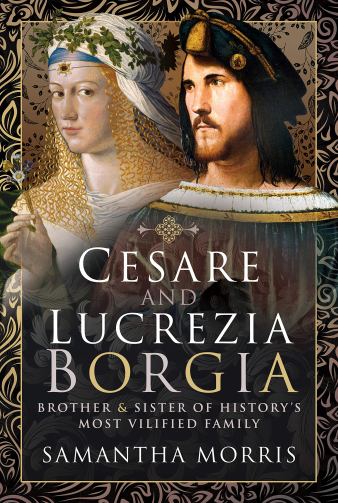 A family mired in myths and rumors of incest, murder, and intrigue for centuries. A brother and sister caught in the middle, attracting the attention of gossips and historians alike. No, I am not referring to a royal family in England. In fact, this story starts in Spain with Alonso de Borja, who moved to Italy and helped create the infamous Borgia family. Caught in the middle were the son and daughter of Rodrigo Borgia, Alonso’s nephew, and his mistress Vanozza Cattanei; Cesare and Lucrezia Borgia. How close were these famous siblings? What were their lives really like? In Samantha Morris’ latest biography, “Cesare and Lucrezia Borgia: Brother and Sister of History’s Vilified Family”, she dives deep into the archives to find out the truth about the legendary Borgia family.
 Adventures of a Tudor Nerd