
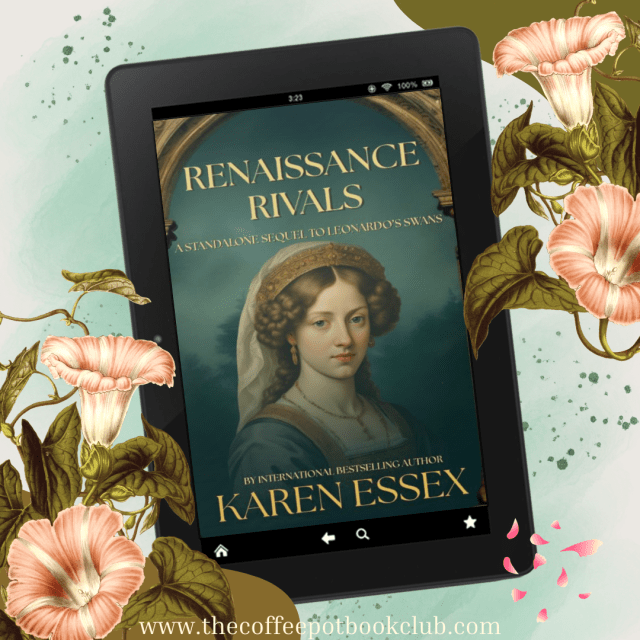
I am pleased to welcome Karen Essex to my blog today to share a guest post to promote her novel, “Renaissance Rivals.” I would like to thank The Coffee Pot Book Club and Karen Essex for allowing me to participate in this blog tour.
Some historical figures refuse to remain inside the books we write about them. For me, Isabella d’Este was one of those figures.

I first encountered Isabella while researching Leonardo’s Swans, my novel about her and her younger sister, Beatrice d’Este. The novel is the prequel to Renaissance Rivals. Both women were princesses born into the ruling family of Ferrara and married into powerful courts in northern Italy. Beatrice became Duchess of Milan, while Isabella became Marchesa of Mantua and, eventually, one of the most celebrated women of the Renaissance, known in her own time as “First Lady of the World.”
She fascinated me from the beginning. Isabella was intelligent, ambitious, politically astute, artistically discerning, and acutely conscious of her place in the world. She collected antiquities and commissioned works from the greatest artists of her age: Leonardo, Titian, Raphael, and others. She cultivated writers, musicians, diplomats, and rulers. Her clothing was imitated across Europe. In fact, she was so popular that Venetian dollmakers created Isabella dolls that circulated around the European courts so that women could see what she’d been wearing.
We could think of her as the first Barbie, but her letters reveal a woman who understood that image, taste, ceremony, and access could function as instruments of power.
Like most aristocratic women of her time, Isabella had been married for political reasons. Her authority depended upon her husband, her children, her birth family, and the alliances she could maintain among Italy’s frequently warring states. She had to negotiate with men who possessed formal power while finding ways to exercise power of her own, which she did. She could flatter, maneuver, charm, command, plead, and threaten, sometimes within the same conversation or letter.
When I finished Leonardo’s Swans, I could not let her go. I continued traveling to Italy, returning to Mantua and following Isabella’s path through Milan, Venice, Ferrara, and Rome. I kept reading her correspondence and remained in touch with the Italian art historians and Renaissance scholars I had met while researching the novel, especially after Leonardo’s Swans became a bestseller in Italy.

Then another woman began to appear in her letters. Lucrezia Borgia. Of course, I already knew the name. Almost everyone does.
For centuries, Lucrezia had been depicted as one of history’s great villains: the depraved daughter of a corrupt pope, the sister and supposed accomplice of the dreaded Cesare Borgia, a seductress, an adulteress, an incestuous monster, and a poisoner who allegedly dispatched her enemies with a mysterious substance concealed inside a ring.
The accusations were irresistible. They were also suspiciously familiar.
While researching my first novel, Kleopatra, I had learned how thoroughly history can malign powerful women. Women who threaten political, sexual, or cultural expectations are often transformed into monsters. Their intelligence becomes cunning. Their sensuality becomes depravity. Their ambition becomes proof of moral corruption. Their influence over men becomes evidence of manipulation.
A successful man gains authority. A successful woman must have bewitched, seduced, or poisoned someone. Knowing this, I could not simply accept the traditional portrait of Lucrezia Borgia. I needed to know who she really was.
The historical Lucrezia was born into one of the most notorious families in Renaissance Europe. Her father, Rodrigo Borgia, became Pope Alexander VI. Her brother Cesare was a cardinal, military commander, and political strategist whose ruthlessness helped inspire Machiavelli’s The Prince. (Yes, Machiavelli is a character in the novel!)
Lucrezia grew up at the center of papal wealth, political ambition, scandal, and danger. Her marriages were arranged and dissolved according to her family’s needs. Her first marriage was annulled when the alliance ceased to be useful. Her second husband was murdered, almost certainly as a result of Borgia political calculations. Lucrezia herself had little control over either event, yet later chroniclers often treated her as though she had orchestrated them.
She was used as a political instrument, but her third marriage changed everything. In 1502, Lucrezia married Alfonso d’Este, heir to the duchy of Ferrara and Isabella d’Este’s brother. The marriage brought the infamous Borgia daughter into one of Italy’s oldest and proudest ruling families.
It also brought her directly into Isabella’s world. From the beginning, the relationship between the two women was complicated. Isabella was the revered daughter of the Este dynasty. Lucrezia was the outsider marrying into it. Isabella possessed lineage, refinement, and an established reputation as a cultural leader. Lucrezia arrived carrying the weight of Borgia scandal and the dazzling wealth of the papal court.
Isabella had every reason to look down upon her new sister-in-law, but she also had reason to fear her. Lucrezia was younger, beautiful, politically valuable, and capable of winning affection. She brought jewels, clothing, servants, money, and papal influence to Ferrara. Once installed there, she became a patron of artists and poets, a capable administrator, a charitable duchess, and a woman trusted to govern Ferrara during her husband’s absences. She managed property, handled petitions, corresponded with political figures, and gained the loyalty of many who had initially opposed her marriage.
The supposed monster proved alarmingly competent, every bit as competent as Isabella herself.
The rivalry between Isabella and Lucrezia was therefore about far more than personal dislike. They competed for precedence within the hugely powerful Este family. They competed for influence over Alfonso and other powerful men. They competed in fashion, ceremony, patronage, reputation, and access. Each woman understood that status had to be performed publicly and defended constantly.
A jewel was never merely a jewel. A gown could announce wealth, rank, fertility, or allegiance. The order in which two women entered a room could become a political statement. An invitation withheld, a gift delayed, or a style copied might communicate rivalry as clearly as any formal declaration.
Their conflict also arose from their similarities. Both women had been shaped by dynastic ambition. Both had endured marriages arranged for political advantage. Both understood the vulnerability of women whose security depended upon producing heirs. Both learned to communicate through letters and intermediaries. Both used art, fashion, family, and personal relationships to exercise and extend their authority.
Lucrezia also possessed something Isabella could not easily forgive: the ability to fascinate the men around her.
One of the most sensitive elements in their rivalry involved Isabella’s husband, Francesco Gonzaga. The surviving correspondence between Francesco and Lucrezia reveals an intimacy and emotional charge that is hard to deny. For Isabella, this was not simply a romantic betrayal. It threatened her dignity, her marriage, and her public authority.
I did not want to write a story with one virtuous heroine and one wicked rival. History had already committed that injustice, particularly against Lucrezia. I wanted to place two intelligent, ambitious women opposite each other and allow each to see the other as a threat. Isabella believes she has earned her position through discipline, lineage, learning, and relentless effort. Lucrezia arrives bearing beauty, notoriety, papal wealth, and an instinct for survival.
Their struggle unfolds amid war, papal intrigue, dynastic marriage, artistic brilliance, and the spectacular courts of Renaissance Italy. Their weapons include letters, jewels, clothing, gossip, pregnancy, patronage, political alliances, and the dangerous affections of men.
Yet beneath the rivalry lies another story: two women attempting to create power in a world determined to use them for its own purposes.
The historical record taught me to question the neat division between admired woman and notorious woman, between princess and poisoner, between cultural icon and scandalous intruder.
Isabella d’Este led me back into the Renaissance. Lucrezia Borgia made me question everything I thought I knew about it.

Blurb:
Renaissance Rivals, the long-awaited sequel to the global bestseller Leonardo’s Swans, tells the story of the brutal rivalry between two of history’s most fascinating power women: Isabella d’Este, Marchesa of Mantua, celebrated in her own lifetime as “The First Lady of the World,” and Lucrezia Borgia, Duchess of Ferrara, daughter of the infamous Pope Alexander VI and one of the most maligned women in history.
Before Maggie O’Farrell’s doomed duchess in The Marriage Portrait, there were the women who built the courts, forged alliances, and commanded works of artistic genius. In both Renaissance Rivals and Leonardo’s Swans, Essex invites readers to step back one generation into the glittering courts of Renaissance Italy, where beauty, intellect, marriage, and ambition could determine the fate of nations.
Buy Links:
Universal Buy Link: https://books2read.com/u/mdpO2E
For paperback orders: https://shop.karenessex.com
This book is available to read on #KindleUnlimited.

Author Bio:
Karen Essex is the national and international bestselling author of RUN, DARLING, KLEOPATRA, PHARAOH, LEONARDO’S SWANS, STEALING ATHENA, DRACULA IN LOVE, AND BETTIE PAGE: LIFE OF A PINUP LEGEND. All feature iconic women—powerful women that seduced the world and ruled it.
Essex is also an active screenwriter and speaker, and an award-winning journalist. She divides her time between Los Angeles, New Orleans, and Europe. Her novels are published in twenty-nine languages.
Leonardo’s Swans, the prequel to Renaissance Rivals, was a runaway bestseller in Italy and won the prestigious Premio Roma for Foreign Fiction.
Author Links:
Website: https://www.karenessex.com
Twitter / X: https://x.com/KarenEssex
Facebook: https://www.facebook.com/KarenEssexAuthor/
Instagram: https://www.instagram.com/karenessex/
Pinterest: https://www.pinterest.com/karenessex/
Book Bub: https://www.bookbub.com/profile/karen-essex
TikTok: https://www.tiktok.com/@karenessexwrites
Amazon Author Page: https://amzn.to/44OrSh5
Goodreads: https://www.goodreads.com/author/show/22528.Karen_Essex
Follow Karen’s Substack newsletter, History. Sex. Power: https://substack.com/@karenessex

 Have you ever wondered what it might be like to discover a long-lost diary of a historical figure by accident? Archaeologist Giuseppe Campise has already found a diary of Mary Magdalene. Now, the Vatican wants Giuseppe to uncover the tomb of Alexander the Great. However, while on the search for the tomb, Giuseppe finds something even more precious, the diary of Lucrezia Borgia. What secrets does the diary hold? Johnny Teague tells the tale of Lucrezia Borgia through her diary in his latest novel, “The Lost Diary of Lucrezia Borgia.”
 Throughout history, women have been seen as pious mothers, wives, or daughters who stayed in their lane or vile manipulators who wanted power and were willing to do anything to maintain their status. While the former group of women would be an interesting study, as the saying goes, well-behaved women seldom make history. So why did certain women receive a villainess lens when we look at their lives and what do the historical records tell us about them? Samantha Morris has chosen to take the stories of these misunderstood maidens and tell them in her latest book, “The Most Maligned Women in History.”
 The 15th and 16th centuries were full of dynamic political and religious reforms, but they were also known for cultural changes throughout Europe. The medieval foundations started to crumble, and the early modern age emerged. One of the centers of change was Italy, a series of states with their rulers vying for power and prestige. These rulers would help finance masterpieces in art, literature, and architecture, but it was their rivals that threatened to tear the Renaissance society apart. In “Princes of the Renaissance: The Hidden Power Behind an Artistic Revolution,” Mary Hollingsworth explores the lives of the men and women who helped shape the Renaissance.
 Today, I am pleased to host the final stop in the “Cesare and Lucrezia Borgia” book blog tour. I would like to thank Pen and Sword Books and Samantha Morris for allowing me to finish this delightful tour with a Q and A discussion with Samantha Morris.
 A family mired in myths and rumors of incest, murder, and intrigue for centuries. A brother and sister caught in the middle, attracting the attention of gossips and historians alike. No, I am not referring to a royal family in England. In fact, this story starts in Spain with Alonso de Borja, who moved to Italy and helped create the infamous Borgia family. Caught in the middle were the son and daughter of Rodrigo Borgia, Alonso’s nephew, and his mistress Vanozza Cattanei; Cesare and Lucrezia Borgia. How close were these famous siblings? What were their lives really like? In Samantha Morris’ latest biography, “Cesare and Lucrezia Borgia: Brother and Sister of History’s Vilified Family”, she dives deep into the archives to find out the truth about the legendary Borgia family.