
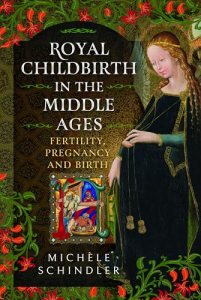
Book Review: “Royal Childbirth in the Middle Ages: Fertility, Pregnancy and Birth” by Michele Schindler

Throughout history, many aspects of life have changed drastically, but one thing has remained the same: the different stages of life—birth, youth, adolescence, adulthood, old age, and death. It is the first stage of life, birth, that tends to get the least amount of attention when it comes to historical research. In recent years, it has been gaining more and more attention, especially when it comes to royal births, which have the most amount of written records. Michele Schindler has chosen to focus on the aspects of medieval childbirth in her latest book, “Royal Childbirth in the Middle Ages: Fertility, Pregnancy and Birth.”

I would like to thank Pen and Sword Books and Net Galley for sending me a copy of this book. I have enjoyed the previous book that I have read by Michele Schindler, and so when I saw that she had a new book about the medieval period out, I was excited to read it. I have read a few books that featured childbirth, primarily in the Tudor period, but never when it comes to the medieval period, so I wanted to learn more.

Schindler has decided to divide her book into sections, each part focusing on a different stage of childbirth: conception, pregnancy, birth, baptism, infant care, and how society as a whole understood childbirth as part of a woman’s life. Each section has sub-sections that explore aspects like miscarriages, twins, confinement, stillbirths, wet nurses, and deaths during infancy. These are very heavy topics, but they are discussed in a respectful manner.

To give context to the topics discussed, Schindler uses examples from multiple centuries to show how royal and noblewomen dealt with childbirth and its struggles. Some of the women featured in this book include Margaret Beaufort, Margaret of Anjou, Eleanor Cobham, Isabella of Castile, Alice Chaucer, Anne Neville, and Elizabeth of York. She also compared these lives and how they experienced childbirth to the common people to show the difference in status and the importance of ceremonies like confinement to the nobility.

Overall, I found this book to be really well researched, as well as being pretty easy to follow along with. I found a deeper appreciation for medieval women and what they had to go through to have a child. If you want to learn more about medieval childbirth practices pertaining to the higher echelons of society, I would recommend you read “Royal Childbirth in the Middle Ages: Fertility, Pregnancy and Birth” by Michele Schindler.
Book Review: “Edward IV & Elizabeth Woodville: A True Romance” by Amy Licence


When we think of a fairy tale romance, we think about stories like Cinderella. A girl of lower status captures the heart of the handsome prince. They overcome the odds and live happily ever after. But that kind of romance only exists in books. The closest story we have to that in medieval English history might be the story of Edward IV and Elizabeth Woodville. A widow who begged the handsome and younger King of England for help, but ended up becoming his wife. It’s a story that any romance-loving history lover will swoon over, but how accurate is that story? What is the real story of Edward IV and Elizabeth Woodville? Amy Licence explores the nature of their relationship in her book, “Edward IV & Elizabeth Woodville: A True Romance.”

I have been reading books by Amy Licence for a few years now, so when I saw this title, I knew I wanted to read it. The Wars of the Roses is one of my favorite areas of history to study, but I have not read a joint biography of Edward IV and Elizabeth Woodville. When I saw this title, I knew that this was a must-read for me.

We begin in 1431 in Rouen, France, where the Maid of Orleans, who we know as Joan of Arc, is about to die on the pyre. In the same town, eleven years later, the future King Edward IV would be born to Cecily Neville and Richard, Duke of York. Edward’s future bride, Elizabeth Woodville, was born around six years after the death of Joan of Arc. Her mother, Jacquetta of Luxembourg, had married below her station after the death of her first husband, John Duke of Bedford passed away; Jacquetta would marry a knight, Sir Richard Woodville, Elizabeth’s father. Jacquetta was close to King Henry VI and Margaret of Anjou, the Lancastrian rulers of England, and Edward IV’s father, Richard, Duke of York, would fight against the Lancastrians for the right to rule England during the conflict that we know today as the Wars of the Roses. To top it all off, Elizabeth was married to Sir John Grey of Groby Old Hall, a man who fought and died for King Henry VI.

In other words, Edward and Elizabeth were on different sides of the Wars of the Roses, but somehow these two found each other after Edward IV became king. The obvious choice for Edward’s bride should have been a foreign princess to create an alliance, but there was something about Elizabeth that convinced Edward to forgo the wisdom of Warwick and marry her. Their court was based on the Burgundian court. They had a large family, but the fight for the crown with the Lancastrian cause and Edward’s own family continued. Just when the throne is secure, Edward passes away. Elizabeth had to fight for her children, fight against her brother-in-law, and join forces with her enemy Margaret Beaufort to help usher in the Tudor dynasty.

Licence was able to present the information not only about this period, but also about Edward and Elizabeth in such a comprehensive way that both novices and experts can understand. She can present theories that she either agrees with or disagrees with respectfully. I thoroughly enjoyed this joint biography as it gave me a better appreciation for the reign of Edward IV and Elizabeth Woodville. If you want to learn more about the Wars of the Roses, the first Yorkist king, and his wife, I highly recommend you read “Edward & Elizabeth Woodville: A True Romance” by Amy Licence.

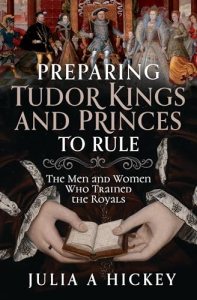
Book Review: “Preparing Tudor Kings and Princes to Rule: The Men and Women Who Trained the Royals” by Julia A. Hickey

In life, when it comes to a new skill or job, you must be trained to become good at it. The same can be said for the monarchy, which in a sense is a job that encompasses one’s entire life. You have to understand different languages, rhetoric, the arts of dancing, and music, as well as diplomacy and physical activities if you want to rule a nation. It may seem like a lot for one person to handle, but from the moment of their birth, a prince or princess has a team of people behind them to make sure that they are ready to either rule their home country or create an alliance with other nations. The Tudors knew how important educating their future monarchs was for the survival of the dynasty. Julia A. Hickey examines the people behind the teams raising the future Tudor monarchs in her book, “Preparing Tudor Kings and Princes to Rule: The Men and Women Who Trained the Royals.”
I want to thank Pen and Sword Books and Net Galley for sending me a copy of this book. The premise of this book was fascinating to me and I wanted to see if Hickey would introduce any new people from the Tudor dynasty in this book.

Hickey begins her book by exploring the origins of the Tudor family, starting with the matriarch herself Margaret Beaufort, followed by Owen, Edmund, and Jasper Tudor, and concluding with how Henry Tudor’s education and his lifestyle shaped him to become the first Tudor king. While I do enjoy a review section about the Wars of the Roses, I felt like this section went a bit too long.

Once we see Henry Tudor on the throne, we get to see how the Tudor dynasty grew with the children of Henry Tudor and Elizabeth of York. We get to see how Arthur Tudor as the heir had a much different education than his brother Henry, who was deemed a spare. The education of the princes was vastly different than the education allocated to the princesses even though it was based on humanism. With the death of Prince Arthur, Henry had to go through a crash course on how to rule a country before his father died in 1509. Hickey also shows her audience how the children of Henry VIII, Mary I, Henry Fitzroy, Elizabeth I, and Edward VI, were raised and educated. She also takes the time to show what happens to his children after Henry VIII’s death. Finally, we do get appendixes that feature mini-biographies for all the men and women who are featured in this book to show a different aspect of the Tudor court.

Overall, I found this a rather nifty little book about the Tudor court. Hickey does a decent job of telling the stories of these men and women who trained the Tudor rulers, both male and female. If you want a book that explores what it takes to rule England during the Tudor dynasty, you should check out “Preparing Tudor Kings and Princes to Rule: The Men and Women Who Trained the Royals” by Julia A. Hickey.

Book Review: “Elizabeth of York and the Birth of the Tudor Dynasty: Uniting the Roses” by Beverley Adams

Throughout English history, some of the most famous queens have been associated with the Tudor dynasty. We have the six wives of Henry VIII (Catherine of Aragon, Anne Boleyn, Jane Seymour, Anna of Cleves, Catherine Howard, and Catherine Parr), Queen Mary I, and Queen Elizabeth I. However, one Tudor queen is often overlooked for her daughters-in-law and granddaughters, the first Tudor queen, Elizabeth of York. So who was Elizabeth of York and what role did she play in the transition between the Plantagenet dynasty and the Tudor dynasty? Beverley Adams hopes to enlighten readers about this remarkable queen in her latest book, “Elizabeth of York and the Birth of the Tudor Dynasty: Uniting the Roses.”

I want to thank Pen and Sword Books and Net Galley for sending me a copy of this book. While I know quite a bit about Elizabeth of York, the Wars of the Roses, and the origins of the Tudor dynasty, I wanted to see how Adams would portray these topics for beginners. 

To begin with, Adams lays out the origins of the conflict that we know today as the Wars of the Roses with Edward III and his sons, John of Gaunt 1st Duke of Lancaster, and Edmund of Langley, 1st Duke of York. This led to a clash between King Henry VI and Richard Duke of York. Elizabeth of York’s father, the future King Edward IV, was the son of Richard Duke of York and he had to fight for his throne. Adams explores Elizabeth’s childhood as the eldest child of Edward IV and his wife Elizabeth Woodville during this tumultuous period of English history, which would form the foundation of what kind of queen she would be in the future.

Everything changed when Edward IV died suddenly, which meant that Elizabeth’s younger brother became Edward V and left Richard Duke of Gloucester as Lord Protector. For some reason, Richard Duke of Gloucester decided to take matters into his own hands, took control of the country, declared the children of Edward IV and Elizabeth Woodville illegitimate (including Elizabeth of York), and was crowned King Richard III in a matter of months. Some resisted the new king including the son of Margaret Beaufort and Edmund Tudor, Henry Tudor. Margaret Beaufort and Elizabeth Woodville arranged a marriage between Henry and Elizabeth that would occur if Henry was able to defeat Richard III and become King of England, which he did at the Battle of Bosworth Field. The rest of this book is dedicated to showing how Elizabeth of York was as a wife, queen, and mother as she dealt with death, treachery from Lambert Simnel and Perkin Warbeck, and triumphs as she was able to see the start of the Tudor dynasty.

I think Adams does a decent job with a book that is an introduction to Elizabeth of York, the Wars of the Roses, and the beginning of the Tudor dynasty. There are some myths that she repeats to debunk, but I feel like, in some places, Elizabeth of York was not the main focus, which was a bit disappointing. Overall, if you want a solid introductory book to the life and times of the first Tudor queen, I would recommend you read, “Elizabeth of York and the Birth of the Tudor Dynasty: Uniting the Roses” by Beverley Adams.

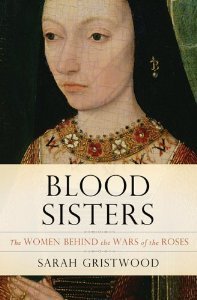
Book Review: “Blood Sisters: The Women Behind the Wars of the Roses” by Sarah Gristwood

Blood SistersWhen it comes to studying wars from the past, we often focus on the men who fought during the battles the strategies that were implemented to win and the plans that backfired spectacularly. So frequently in the study of wars, we forget about the women left behind, but in fact, they had bigger roles to play than sitting on the sidelines. For example, the royal women who lived in England during the conflict known as the Wars of the Roses played an essential role in how the wars concluded. These women are slowly coming into the spotlight in biographies and historical fiction novels, but it is rare to read a book about the Wars of the Roses where the central figures are the women, until now. Sarah Gristwood has taken seven women from this age and weaved their stories into her book, “Blood Sisters: The Women Behind the Wars of the Roses.”

I have been interested in the Wars of the Roses and the women who lived during that period for years. I heard about this book when I started studying this period, but I have never had a chance to read it, until now.

There were so many strong women from this period, but Gristwood narrowed her choices down to seven remarkable women to focus on; Margaret of Anjou, Margaret Beaufort, Elizabeth Woodville, Elizabeth of York, Cecily Neville, Anne Neville, and Margaret of Burgundy. By choosing these women, Gristwood is presenting a story of a conflict that spanned multiple generations, both York and Lancaster, and showing how both the English and Burgundian nobility dealt with the changes that were happening when the Tudors took control.

Gristwood begins with the marriage of Margaret of Anjou and Henry VI. Though she was French by birth, her loyalty was always going to be with her husband’s Lancasterian family. That meant she would eventually become enemies with the proud Cecily Neville, the wife of Richard Duke of York and mother of King Edward IV and King Richard III, but Margaret was allied with Margaret Beaufort, the tenacious mother of King Henry VII, the founder of the Tudor dynasty. The conflict passed onto the daughters of these women, like Anne Neville and Margaret Burgundy, as well as the daughter of Jacquetta of Luxembourg, Elizabeth Woodville. These women would continue the conflict and help seal the fate of the Lancastrians, see the rise and fall of the Yorkists, and the beginning of the Tudor dynasty through the marriage of Elizabeth of York, the daughter of Elizabeth Woodville, and Henry Tudor. This book spans decades and includes events like the disappearance of the Princes in the Tower, well into the Tudor dynasty such as the pretenders, the marriage of Prince Arthur and Catherine of Aragon, the death of Prince Arthur, and the rise of Henry VIII.

This was a delightful look into the Wars of the Roses through the eyes of the women who lived through this period. They were mothers, daughters, wives, queens, fighters, and survivors. They showed that without their tenacity and determination to fight for what they believed was right and for their families. If you are a fan of the women who defined the Wars of the Roses, I highly suggest you read, “Blood Sisters: The Women Behind the Wars of the Roses” by Sarah Gristwood.

Book Review: “Heroines of the Tudor World” by Sharon Bennett Connolly

Heroines of the Tudor WorldThe world of the 16th century was full of change and equally colorful characters. Most of the dynamic figures of this century were women, who were willing to fight in their ways for what they believed in, whether it was family, faith, or their country. They were heroines in different ways, and each had a story to tell. Each woman had to deal with her obstacles to reach their desired goal, no matter what her station was, from queens and great heiresses to nuns, and even a pirate. Sharon Bennett Connolly has decided to include a handful of these stories in her latest book, “Heroines of the Tudor World.”

I would like to thank Amberley Publishing for sending me a copy of this book. I have been a fan of Sharon Bennett Connolly’s books on medieval women, so when I heard that she was going to tackle the 16th-century and the Tudor world, I knew I wanted to read it. I wanted to see what stories she would select and how far into the Tudor world she would explore.

Connolly begins her book by explaining how the 16th century differed from the medieval times as records about women were becoming more accessible. It was also a time of transition, reformation, and the discovery of the “new world.” Each chapter focuses on a different kind of woman; from the ideal to martyrs for their faiths, scandalous heroines, those who were disinherited, pawns in the bigger game of life, warriors, captives, and survivors. Although it can be difficult to place certain tales of women in just one category, Connolly gave her readers a thrilling look into the 16th century.

It was the stories of these extraordinary women who made this book an exceptional read. There are the typical women who are featured heavily in these kinds of narratives; Elizabeth of York, Margaret Beaufort, the wives of Henry VIII, Mary I, Elizabeth I, Mary Queen of Scots, and Catherine de Medici. However, Connolly decided to include lesser-known women. We have mistresses like Diane de Poitiers and spies like Margaret Dymoke, Lady Coffin. Some great heiresses were disinherited like Claude of France and Elizabeth Fitzgerald, as well as pawns like Marguerite de Valois and captives such as Lady Katherine Gordon and Honor Grenville, Lady Lisle. Of course, some women decided to take matters into their own hands and fight for what they believed in, such as Isabella of Castile, Jeanne d’Albret Queen of Navarre, and Grace O’Malley.

I thoroughly enjoyed learning about the heroines that Connolly included in this book, but my only complaint is that it was not a longer book. There are so many interesting women outside of the European world in the 16th century and I wish she would have highlighted them. Maybe Connolly will write a sequel book to this one to include even more Tudor heroines. If you have enjoyed Sharon Bennett Connolly’s previous books and you are a Tudor nerd, I highly suggest you read, “Heroines of the Tudor World.”

Book Review: “On This Day in the Wars of the Roses” by Dan Moorhouse

On this day in the Wars of the RosesThe Wars of the Roses, a conflict that engulfed English politics for over 30 years and heralded a new dynasty, the Tudors. While there were battles and political intrigue galore during this period of unrest, there were also births, marriages, and deaths of powerful figures. Each day during the Wars of the Roses holds significance to nobles and commoners alike. Dan Moorhouse has compiled his years of research into this conflict into his book, “On This Day in the Wars of the Roses.”

I would like to thank Dan Moorhouse for sending me a copy of this book. I have been studying the Wars of the Roses for a few years now and so when I hear about books on the subject, I jump at the chance to read them to see if they bring any new revelations to the period.

Like many other books that focus on historical events of the past, Moorhouse highlights each date, starting from January and ending in December. However, unlike other books, the dates do not go in chronological order by year the entries jump from decade to decade, telling a more comprehensive story of the conflict.

Throughout this book, Moorhouse explores major battles, the disappearances of the Princes in the Tower, the madness of King Henry VI, and plots and executions of nobles and commoners alike. We also get to see how commoners got along during these tumultuous times through advancements in trade, alchemy, military tactics, and marriages. By focusing on the stories of those who were not nobility, Moorhouse is showing that even though this was a conflict for the crown, normal life moved on, as it always does.

Moorhouse is very knowledgeable about the period and can share all that he knows succinctly. He is also able to keep a neutral tone, neither siding with the Lancastrians nor the Yorkists, for the historical facts to speak for themselves. I found myself enjoying this book and the new stories from this conflict that I never knew. If you want a different approach to the Wars of the Roses, I recommend you read, “On This Day in The Wars of the Roses” by Dan Moorhouse.

Book Review: “The Godmother’s Secret” by Elizabeth St. John

62232439When one says “the Princes in the Tower,” a few images pop into our mind. Two young boys were killed in the Tower by their evil uncle, who would become King Richard III. At least, that is the image that the Tudors wanted the world to see, and for centuries, that story has often been told. However, as research has expanded into who Richard III was, the tale of these two boys and their ultimate fate has become even murkier with new suspects and the question of whether the boys were murdered. Elizabeth St. John decided to take on the mystery of the Princes of the Tower with her twist to the tale in her latest novel, “The Godmother’s Secret.”

Thank you, Elizabeth St. John, for sending me a copy of your latest novel. I have found the mystery of the Princes of the Tower fascinating, and when I heard that this novel had a different angle to their tale, I knew I wanted to read it.

We begin our journey by introducing Lady Elysabeth Scrope, the wife of John Scrope and the half-sister to Margaret Beaufort, going into the sanctuary with Elizabeth Woodville. She is there to act as the godmother for Elizabeth Woodville’s first son, the future King Edward V, at the request of King Henry VI. Elysabeth is reluctant to help the Yorkist cause, as she was raised as a Lancastrian, but her husband is loyal to the Yorkists. She promises to keep Edward safe from harm, which would prove more challenging with the death of King Edward IV in 1483.

This should be a happy time for Elysabeth, John, and the new King Edward V, but a sermon and a coup caused everything to come crashing down. Edward and his brother Richard are removed to the Tower of London while their uncle becomes King Richard III. Along the way, Margaret Beaufort schemes to get her beloved son, Henry Tudor, to become the next king of England. Torn between her blood family and her family built by loyalty, Elysabeth must navigate the ever-changing political field of 1483-1485 to protect the princes, no matter the cost.

I thoroughly enjoyed being introduced to Lady Elysabeth Scrope and John Scrope and seeing the events unfold while they weathered the political storm the best they could. St. John has created a believable and compelling story about what might have happened to these two boys whose disappearance has captured our imaginations for centuries. She attempts to answer some age-old questions, like what might have happened to the boys, did Richard III have them killed, and did Margaret Beaufort have something to do with the princes’ disappearance? Suppose you want an engaging novel that gives a different perspective about what might have happened to the Princes in the Tower. In that case, I highly recommend you read “The Godmother’s Secret” by Elizabeth St. John.

Book Review: “The Last White Rose: A Novel of Elizabeth of York” by Alison Weir

58735042During medieval wars, one’s fate is often determined by the spin of the Wheel of Fortune, even for those who did not fight a single battle. One could be living a life of luxury, stability reigning supreme, and is destined to marry a foreign king or prince, but when the wheel begins to spin, all seems lost, and the things that once were as good as guaranteed fall by the wayside. This description could fit any number of stories from the past. Still, the one highlighted in this particular novel is the story of the eldest daughter of King Edward IV and Elizabeth Woodville and the first Tudor queen. In the first book of her latest book series, “The Last White Rose: A Novel of Elizabeth of York,” Alison Weir shows how one woman was able to ride the highs and lows of life to secure her family’s legacy and transform English history forever.

I want to thank Penguin Random House- Ballantine Books and NetGalley for sending me a copy of this novel. I am always thrilled when a new Alison Weir book is announced, whether fiction or nonfiction. I thoroughly enjoyed the Six Tudor Queens series, so when I heard that there would be a new book series with the story of Elizabeth of York being the first novel, I knew I wanted to read it. Of course, I had read her biography of Elizabeth of York, so I wanted to see how her research would translate into a historical fiction novel.

Elizabeth of York was born and raised to be a queen. As the eldest daughter of Edward IV and Elizabeth Woodville, it was her destiny to be married to a king or a prince to strengthen England through a foreign alliance. However, her life took a drastic turn when her father tragically died. Her brothers disappeared when they were in the Tower of London awaiting the coronation of Edward V, which never occurred. Richard III, Elizabeth’s uncle, became king, which forced Elizabeth Woodville to seek sanctuary with her daughters. A daring plan was crafted to unite the houses of York and Lancaster through marriage; Elizabeth of York was to marry a young man in exile, Henry Tudor.

The marriage created the Tudor dynasty, but that does not mean Elizabeth and Henry’s married life was full of sunshine and roses. The road to securing their dynasty was full of heartache and plenty of pretenders. The love between Elizabeth and Henry and Elizabeth’s love for her family allowed the dynasty to survive the turbulent times.

I loved the relationship that Weir was able to craft between Elizabeth, Henry, and her family. However, there were elements of the story that I disagreed with; they were minor, like her portrayal of Elizabeth’s relationship with Richard III and the idea that Arthur had been very ill since his birth. These elements did not take away from the joy I had reading this novel.

Overall, I found the first novel of the Tudor Roses series engaging and a delight to read. Alison Weir has brought the tragic yet triumphant story of the first Tudor queen to life through excellent prose and captivating details. If you are a fan of Alison Weir and her historical fiction novels, or just a fan of Tudor novels in general, you will find “The Last White Rose: A Novel of Elizabeth of York” an enchanting escape into the past.

Book Review: “Tudor Roses: From Margaret Beaufort to Elizabeth I” by Amy Licence

36762189When one studies a specific dynasty, we tend to focus on the stories of those who rule their respective countries and explore the men who influenced the king’s decisions. A dynasty’s legacy tends to be viewed from the military and legal victories of the men, but just as important are the women who stood beside the king. Royal women tend to be considered side characters of the dynasty who were only crucial for their inheritance, who they married, and the children they could produce. But if we focused on the story of the royal women in a specific dynasty, what could we learn about the dynasty? Amy Licence took this concept to explore women’s voices and decided to tackle the Tudor dynasty in her latest book, “Tudor Roses: From Margaret Beaufort to Elizabeth I.”

I want to thank Amberley Publishing for sending me a copy of this book. I am always looking for a new perspective on the Tudor dynasty. Although there is nothing new about exploring the lives of Tudor women, the idea of analyzing the Tudor queens and their reigns in one book is so unique and vital.

Licence starts her book at the very beginning of the Tudor dynasty with the stories of Margaret Beaufort and Elizabeth Woodville. These women are often viewed as enemies on opposite sides of the Wars of the Roses. Still, closer examination shows how alike they were and how they came together to unite the warring factions with the marriage of their children, Henry VII and Elizabeth of York. The first Tudor queen, Elizabeth of York, was seen as the pinnacle of excellence and the ideal queen for those who would try to follow in her footsteps. We also get to see how Margaret and Mary Tudor influenced their family’s legacy, even though they never sat on the English throne like their brother, Henry VIII.

The next group of Tudor queens that we examine are the wives of Henry VIII; Catherine of Aragon, Anne Boleyn, Jane Seymour, Anne of Cleves, Catherine Howard, and Catherine Parr. These queens mark a different aspect of being a royal woman and helped England move forward. Finally, Licence explores the lives of the daughters of Catherine of Aragon, Frances Brandon, and Anne Boleyn, who would become queens themselves; Lady Jane Grey, Mary I, and Elizabeth I.

Licence shows how England and Europe viewed women who wielded power throughout this book. Although the Tudor dynasty only lasted 118 years, the change was significant and impactful. The Tudors queens had to navigate not only their traumas through the most public lens, but they had to balance their own beliefs with the shifting political landscape of Europe. There are also glimpses of how other European queens navigated the tumultuous 16th century and how their lives and women’s education influenced the Tudor queens.