
 Scotland is a land of beauty and a culture all its own, but when it comes to the history of the Scottish monarchy only one word will suffice, messy. The tales of the Scottish monarchy are full of tragedies, violence, and bloody ends. As so often with many other monarchies we tend to focus on the men who wore the crown and those around them, but what about the tales of the queens who stood beside their husbands? The stories of the medieval queens of Scotland have often been overlooked for their more famous husbands, until now. Sharon Bennett Connolly has compiled the stories of these queens in her latest book, “Scotland’s Medieval Queens: From Saint Margaret to Margaret of Denmark.”
I want to thank Pen and Sword Books and Net Galley for sending me a copy of this book. I am a big fan of Sharon Bennett Connolly and her books, so when I heard that she was writing a book about Scottish medieval queens, I knew I wanted to read it. I know very little about Scottish history, other than the Stewarts because of a different book, so I was excited to learn more.
As Connolly states in her introduction, her inspiration for this book was from the Shakespearean play Macbeth, specifically the character of Lady Macbeth. A historical figure who has been much maligned in history, Lady Macbeth’s actual name was Gruoch, and her story and Macbeth’s make a fabulous introduction to her book. We stay in the 11th century with the first queen featured heavily in this text, and that is the only saint, Saint Margaret, the wife of Malcolm III and the one who reformed the Scottish Church.
We get to explore the daughters-in-law of Saint Margaret, Ethelreda of Northumbria, Sybilla of Normandy, and Matilda of Senlis who played more quiet roles than the saintly woman whose shoes they were trying to fill. It should be noted that there were some women like Ada de Warenne who never sat on a throne or wore a crown but were the mother of a future King of Scotland, Malcolm IV the Maiden. Since Malcolm never married or had kids, the throne passed to his brother William the Lion, who was not a huge fan of the English and helped establish the Auld Alliance, with his wife Queen Ermengarde by his side. Although the Scottish did not have the best relationships with the English, it did not mean that they didn’t try to establish peace through marriage with English princesses like Joan of England and Margaret of England. Along the way, a princess of Scotland named Margaret of Scotland married Erik II of Norway, and their daughter Margaret Maid of Norway would become the first Queen Regent of Scotland, albeit for a short period.
After the death of Margaret Maid of Norway, there was to no one’s surprise, a fight for the throne that culminated with John Balliol becoming King of Scotland. The throne would pass to Robert the Bruce, with a feature from a certain rebel named William Wallace. Things were not easy for the Bruce women such as Elizabeth de Burgh and Marjorie Bruce. We also had women like Joan of the Tower and Margaret Drummond who tried to help David Bruce of Scotland rule with different results. Finally, we reach the origins of the House of Stewart with women like Euphemia Ross, Annabella Drummond, Joan Beaufort, Mary of Guelders, and finally Margaret of Denmark. Each woman added something different to the story of Scotland and had to deal with war, executions, childbirth, religious matters, and political intrigue in their unique ways to better Scotland.
I have to applaud Connolly for the amount of history she was able to cover in a single book as she covered four centuries worth of Scottish royal history and made it relatively easy to follow along. I learned so much about Scotland’s royal history and the remarkable women who were queens of Scotland. If you want a fantastic introduction to the turbulent world of medieval Scotland and the women who helped shape the monarchy, I strongly recommend you read, “Scotland’s Medieval Queens: From Saint Margaret to Margaret of Denmark” by Sharon Bennett Connolly.
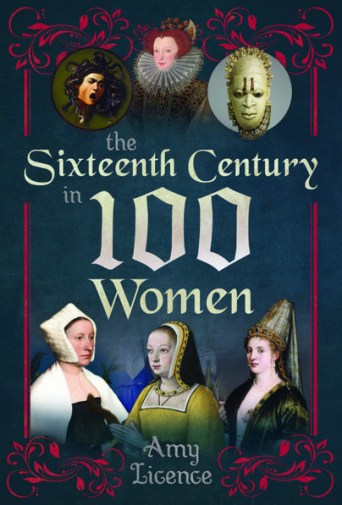 When we think of the phrase “16th-century women,” we often consider those from royal or noble houses throughout Europe. We tend to think of women like the six wives of Henry VIII, Mary I, Elizabeth I, Catherine de Medici, Mary Queen of Scots, and others associated who made an impact during the Renaissance and the Reformation. However, the 16th century did not stop at the borders of Europe; it extended all over the globe. There are many stories of women from all over the world and from different social classes that can help us understand how the world changed in the 16th century. Amy Licence took this concept and decided to write her latest book about a variety of women from around the world who lived in the 16th century, “The Sixteenth Century in 100 Women.”
 Adventures of a Tudor Nerd