
 The Wars of the Roses was a time filled with dynamic figures who fought for the right to restore order to England. We often think about the strong warrior men who marched into battle, facing their inevitable doom just for the chance to wear the crown and rule the land. The women who stood by their husbands’ and sons’ sides were just as strong as their male counterparts, even if they did not wear armor. They were on the sidelines, ensuring that they could create alliances that would prove helpful in future conflicts. The most famous examples of strong women during the Wars of the Roses are Margaret of Anjou, Margaret Beaufort, and Elizabeth Woodville. Yet, there was another woman who stood firmly on the side of the Yorkist cause. She was known as the Rose of Raby and the wife of Richard, Duke of York. Her name was Cecily Neville, and she is the protagonist of Annie Garthwaite’s brilliant debut novel, “Cecily.”
I have been a fan of Wars of the Roses historical fiction for a while now, and so when I heard about this novel, I knew I wanted to read it. I usually don’t comment about the covers of books, but this particular cover was simply gorgeous, which added to my desire to read it. Cecily Neville is one of those characters that is rarely given a chance to shine, so this book was a treat to see how Garthwaite would portray her.
Garthwaite’s novel begins with the execution of Joan of Arc, which was an event that Cecily Neville witnessed with her husband Richard Duke of York. It marked a turning point for the English campaign in France as the young King Henry VI was crowned King of France. Richard Duke of York is a cousin of the young king and is considered next in line to the throne until Henry VI has a son. Richard is given command of the French campaign, with his beloved wife by his side. Cecily and Richard have known the sorrow of losing children, but eventually, their family begins to grow with the birth of their eldest son Edward. More children will follow, including Edmund, George, and little Richard often referred to as Dickon.
The campaign in France does not end well, so Cecily, Richard, and their growing family go back to England. Along the way, Henry VI decides to take Marguerite of Anjou as his bride; Marguerite and Cecily start as friends and allies, but their relationship will eventually sour and turn into rivals. Richard and Cecily will travel to Ireland to help their king to show their loyalty. Still, when Henry VI falls ill, Richard believes that he must protect his king and country from men like Henry Beaufort, Duke of Somerset, who is a favorite of Queen Marguerite.
It was during this conflict that Cecily’s true strength shines through. She not only has to be a mother to her growing family, but she has to act as a political advisor and confidant to her husband while staying loyal to her king and undermining the queen’s authority. It was not a rebellion that Richard and Cecily wanted, but they felt that it was a necessary evil to protect their family and their kingdom. To see Cecily protecting her young children from the Lancastrian as her husband and oldest sons flee to fight another day. When Richard and their son Edmund tragically died at the battle of Wakefield, to see Cecily go through her grief while fighting to give Edward a chance to defend her family’s honor was inspiring.
This novel was a delightful read. Garthwaite portrayed Cecily as a strong, independent wife and mother who would stop at nothing to protect her dear ones. For a debut novel, this is a smash hit. It is unique and tells an engaging story that every fan of the Wars of the Roses will love. I cannot wait for Garthwaite’s next novel. If you want a new book with a heroine that you will adore, check out “Cecily” by Annie Garthwaite.
 A banner decorated with three suns flaps in the wind on the field of battle. The young man behind this emblem is Edward, Earl of March, whose father Richard Duke of York and brother Edmund Earl of Rutland were tragically slain at the Battle of Wakefield. His younger brothers, George Duke of Clarence and Richard Duke of Gloucester, will help Edward carry their father’s cause for the family of York to rule England. When loyalty is questioned even among family members, only one man would truly stand behind Edward until the bitter end. That man would be Richard Duke of Gloucester, or as we know him today, the much-maligned King Richard III. He is often viewed as a treacherous child-killer who coveted the throne after Edward IV’s death, but is that accurately portraying the last Plantagenet king? Who was the real King Richard III? In her magnum opus, “The Sunne in Splendour,” Sharon Kay Penman presents her case for Richard III as a man betrayed, both in life and after his death.
 Medieval kings are often painted as strong, colorful figures in history. They were warriors who fought to protect their families and countries. Often, we tend to think of men like King Henry V and King Edward IV when it comes to the late medieval kings of England. However, there was a man who was sandwiched between these two pillars of strength. He was the son of Henry V, the king who came before Edward IV, and the man who started the conflict known as the Wars of the Roses. Unlike these two men, Henry VI was a pious peacemaker and is often viewed as a mere man in the background who never measured up to the standards his famous father left behind. His story is often incorporated into other biographies of people of his time; Henry VI has not had a solid biography about his life in a long time. That is until now. Lauren Johnson has taken up the challenge of exploring the life of this often-overlooked monarch in her latest biography, “Shadow King: The Life and Death of Henry VI”.
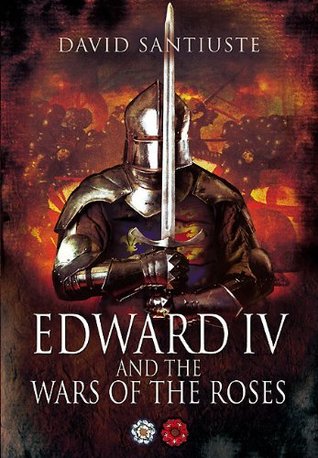 The romanticized conflict that was known as the Wars of the Roses had numerous colorful figures. From the sleeping king, Henry VI and his strong wife Margaret of Anjou to the cunning Kingmaker Warwick and the hotly debated figure Richard III, these men and women made this conflict rather fascinating. However, there was one man who would truly define this era in English history, Edward IV. He was a son of Richard duke of York who fought to avenge his father’s death and the man who would marry a woman, Elizabeth Woodville, who he loved instead of allying himself with a European power. These are elements of his story that most people know, but he was first and foremost an effective general, which is a side that is rarely explored when examining his life. David Santiuste decided to explore this vital part of Edward’s life in his book, “Edward IV and the Wars of the Roses”.
 England throughout the centuries has known internal strife with civil wars to determine who had the right to rule the island nation. None more so than in the fifteenth century when a tug of war for the English crown broke out. Today, we call this time period “The Wars of the Roses”, but what was it all about? Who were the main figures during this time? What were the crucial battles that defined these wars? How did the Plantagenet Dynasty fall and how did the Tudors become the new dynasty to rule England? These questions and more are explored in Dan Jones’ book, “The Wars of the Roses: The Fall of the Plantagenets and the Rise of the Tudors”.
 In history, many people tend to focus on the big names. The kings and queens, the rebels, and those who really made an impact. The political advisors and men of the church tend to get left behind in the dust since they are not seen as “important”. However, it is these men who were the backbone of the monarchy, who helped make the king’s vision come to fruition. They tend to come and go, so that is why John Morton’s story is so extraordinary. John Morton helped three separate kings of England, was the enemy to a fourth king, tried to reform the church, and had numerous building projects. His life tends to be overshadowed by the kings that he served, but his life is brought into the light in this biography by Stuart Bradley, “John Morton: Adversary to Richard III, Power Behind the Tudors”.
 Historically, royal marriages have been viewed with such interest. A king and a queen who can come from either similar or different backgrounds in order to make their country better, or in some cases, worse. During the Wars of the Roses, there were some legendary relationships that shaped the war between the Yorks and the Lancasters. Edward IV and Elizabeth Woodville. George Duke of Clarence and Isabel Neville. Richard III and Anne Neville. Henry Tudor and Elizabeth of York. However, these relationships fail in comparison to the impact that the marriage of Henry VI and Margaret of Anjou had on England during this time. Henry VI was seen as a weak, pious ruler; Margaret was seen as too strong for a woman. They have been viewed separately for a long time, never as a couple. That is until Amy Licence wrote her latest biography, “Henry VI and Margaret of Anjou: A Marriage of Unequals”.
 In recent years, the study of the English conflict known as the “Wars of the Roses” has become rather popular. The Lancasters and the Yorks fighting for the English throne. Only one can be the winner. When we do look at this time period, we tend to focus on the people involved in the battles and the political aspect of the conflict. The battles, how they were fought, and why the conflict started in the first place tend to be pushed to the sideline. That is not the case with this particular book. In Hugh Bicheno’s book, “Battle Royal- The Wars of the Roses: 1440-1462”, the political and military aspects combine with family histories for a comprehensive look into what made this time period so fascinating.
 The deaths of the Duke of York, Earl Salisbury and Edmund Earl of Rutland at the Battle of Wakefield at the end of 1460 marked a changing point for how the Wars of the Roses was fought. Now it was not going to be simply a matter of who was going to be the King of England, but it was a war of revenge. What the Lancastrians did not realize at the time was the fact that these deaths would unleash two men who would mark the destruction of the Lancastrian cause; Edward Duke of York, the future King Edward IV, and Richard Neville Earl of Warwick “the Kingmaker”. In the third book of Conn Iggulden’s Wars of the Roses series called “Bloodline”, Iggulden explores the rise of these two dynamic men and how family matters tore the two best friends apart.
 England is on the brink of civil war. Families with royal blood in their veins are fighting amongst each other as King Henry VI has fallen ill. Mistrust runs rampant and sacrifices are made in order to gain the throne. This is the England of 1454 and the beginning of the period in English history that we know today as the Wars of the Roses. Families like the Nevilles, the Percys, and the houses of York, Lancaster, and Tudor would gain fame and infamy during this time. Conn Iggulden decided to explore this tumultuous time after the Jack Cade rebellion, which he explored in his first book “Stormbird”, in the second book of his “Wars of the Roses” series called “Trinity”.
 Adventures of a Tudor Nerd