
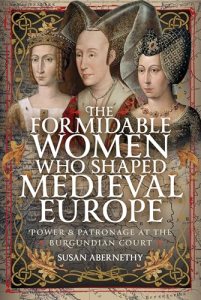
 Throughout European history, we tend to think about the countries as a whole when it comes to the political sphere of influence. We think of the big countries like France, Spain, Italy, Germany, Austria, and England as having the most impact, but we have to consider that during the Middle Ages, duchies held immense power. Take, for example, the Duchy of Burgundy, also known as the Burgundian Empire. It was a part of France, but that does not mean that the dukes stayed on the side of the French. The Burgundians used their influence to expand and marry into the medieval European families, affecting European history as a whole. While we tend to focus on the Dukes of Burgundy, we should be paying attention to the women of this duchy. That is why Susan Abernethy chose to focus on these women in her latest book, “The Formidable Women Who Shaped Medieval Europe: Power and Patronage at the Burgundian Court.”
I would like to thank Pen and Sword Books and NetGalley for sending me a copy of this book. I enjoyed Susan Abernethy’s first book about Catherine of Braganza. When I heard that she was writing a book about medieval Burgundian women, I was intrigued. I know a little bit about historical figures connected to Burgundy, but I didn’t know much about the history of the duchy itself, so I was excited to learn more.
Abernethy begins by giving her readers a brief history of how Burgundy became a kingdom and a duchy of France. While the history of Burgundy is extensive, we are mainly focusing on the Valois Dukes of Burgundy and the women in their lives. The Valois Dukes of Burgundy were Philip the Bold, John the Fearless, Philip the Good, and Charles the Bold. While this is primarily about the women of Burgundy, it is important to understand the political and military landscape that these women had to deal with in Burgundy and other countries during this time.
The bulk of this book focuses on the women of the Burgundian empire, starting with Margaret of England, Duchess of Brabant, in the 13th century, and ending with Queen Juana of Castile, in the 16th century. We get to hear stories about duchesses and queens, countesses and diplomats, and even a saint. They had to deal with wars, international diplomacy, family drama, and husbands who were not faithful. There were some familiar figures like Mary of Guelders, Queen of Scots, Jacquetta of Luxembourg, Margaret of York, Duchess of Burgundy, and Margaret of Austria, but the majority of these women were new to me, which was very exciting.
It’s a lot of ground to cover, but Abernethy has a way of telling the stories of women comprehensively. I thoroughly enjoyed learning about Burgundy and these extraordinary women who made the duchy an empire. If you are someone who wants to learn about the Duchy of Burgundy, I would recommend you read “The Formidable Women Who Shaped Medieval Europe: Power and Patronage at the Burgundian Court” by Susan Abernethy.
 The daughters of Isabel of Castile and Ferdinand of Aragon lived very interesting lives. Of course, we know what happened to Katherine of Aragon, but her elder sister, Juana, has her own tragic tale. She was known as Juana the Mad because the rumors were that when her husband, Philip the Handsome, died, she carried her coffin around for months and would not let him be buried. Was Juana truly mad, or was it all a ruse by powerful men to steal her lands and titles? Lynn Cullen explores Juana of Castile’s life in her novel, “Reign of Madness.”
 The life of a medieval princess was not a life of luxury that we often see in fantasy films. It can be filled with lovely gowns and castles, but it can change in an instance. Take, for example, the lives of the daughters of King Edward IV and Elizabeth Woodville. One minute their father was King of England and life was comfortable; the next minute, they were in the sanctuary, hoping and praying that they would be able to be reunited with their father one day. Their lives were planned out for them when their father was alive, but when Edward IV died unexpectedly in April 1483, the princesses found their world taking another turn. We know what happened with the eldest daughter, Elizabeth of York, as she married Henry VII and became the first Tudor queen, but what about her sisters? In her second book, “The York Princesses: The Daughters of Edward IV and Elizabeth Woodville”, Sarah J. Hodder explores what happened to Elizabeth of York and her sisters once the House of York fell and the Tudors became the new dynasty.
 Adventures of a Tudor Nerd