
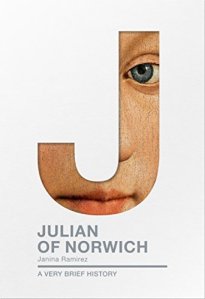
 When we think about the most impactful women authors, we often think about writers like Agatha Christie, Mary Shelley, and Jane Austen. However, when it comes to religious texts, we have to go back in time centuries. We think about nuns like Bridget of Sweden and a mother of 14 children named Margery Kempe. Yet, we must include an anchorite who stayed in her cell for almost thirty years. Her book, Revelations of Divine Love, is considered the first great work of English prose, but many people are not familiar with the author until now. Janina Ramirez tells the story of Julian of Norwich and how impactful her book was in her book, “Julian of Norwich: A Very Brief History.”
I have heard the name Julian of Norwich before in books about the 14th century and church history, but I didn’t know much about her life. I saw this book when I was preordering the latest book by Janina Ramirez, and so I decided to give it a try.
Since this is a short book, I will try to keep this review brief. Ramirez divided this biography into sections: the history and the legacy. In history, we as readers learn about Julian’s life from the limited sources that we have about her, as well as learning about how England and Europe changed during her lifetime. It was a chaotic period in the past with the Bubonic plague, the Hundred Years’ War, the Great Western Schism, the Peasants’ Revolt, and John Wycliffe. Let’s be honest, it’s a lot to deal with, but Julian was positive in her anchorite cell. Ramirez shows how complex yet hopeful and full of love Revelations of Divine Love is while showing the theological arguments Julian of Norwich makes in her work of prose. Finally, we get to see how Julian of Norwich’s story and her writing survived for centuries.
This was a delightful little nugget of a book that was extremely well researched, that shone a light on an obscure medieval woman writer. Reading this book gave me a new appreciation for medieval female authors. If you want to learn more about this remarkable woman, I suggest you read “Julian of Norwich: A Very Brief History” by Janina Ramirez.
 When we think of the phrase “middle ages,” we think of a time of bloody battles and deadly plagues, full of warriors and kings, and a more patriarchal society where women sat on the sidelines. Only the highly pious women or women who tore down barriers genuinely stood out in the history books. At least, that is what we have been told for centuries, but what does archeological research tell us? How about the newly discovered historical records? In her latest book, “Femina: A New History of the Middle Ages, Through the Women Written Out of It,” Janina Ramirez tells the story of the Middle Ages innovatively; through the stories of women who, until recently, were hidden voices from the past.
 Margery Kempe, the only daughter of the mayor of Bishop’s Lynn, England has made a tough decision in 1413. She has decided to leave her home, her husband, and her fourteen children to go on a pilgrimage to the holy city of Jerusalem as a way to honor her late father’s dying wishes. As she begins her journey, she meets the famous anchoress Julian of Norwich, who entrusts Margery with an important mission. She gives Margery her book Revelations of Divine Love and tells her to spread her message throughout the world in secret. Margery’s pilgrimage, her connection to Julian of Norwich, and the aftermath of her journey are intricately woven together in Mary Sharratt’s stunning novel, “Revelations”.
 Adventures of a Tudor Nerd