
 The year is 1535, and Henry VIII is growing bored with his current wife, Anne Boleyn. His eyes are wandering yet again, and this time his sights are set on Jane Seymour. Anne Boleyn had failed to give him his desired son, so Henry decided that it was only fitting for his right-hand man, Thomas Cromwell, to take down a queen. It’s Cromwell’s biggest challenge yet, but it could also become Cromwell’s defining moment. Hilary Mantel explores the pivotal months that pitted Cromwell against the Boleyns in her second book in the Wolf Hall trilogy, called “Bring Up the Bodies.”
Although the first book in the series, “Wolf Hall,” was a challenging read, I still wanted to continue reading the series. We all know Thomas Cromwell’s story, but since I started the Mantel retelling of his life, I wanted to see how she will handle the fall of Anne Boleyn.
We pick up where we left off in the first book, at Wolf Hall in 1535, where Henry VIII meets Jane Seymour and her family. The King is tired of Anne Boleyn, even though she is pregnant with what is hopefully Henry’s heir. Once they get back from Wolf Hall, rumors begin to spread about Anne’s infidelity while Cromwell is working on the dissolution of the monasteries. Anne has alienated so many people at court that they wonder if it’s time for a change and if perhaps Henry will take back Katherine of Aragon.
But it is too little too late. Katherine of Aragon will pass away without seeing her daughter, Mary. Anne believes that she is safe; however, fortune’s wheel is always turning. A jousting accident will rock the court and change the trajectory of Anne’s life forever. After Anne suffers a miscarriage, Henry decides now is the time to send in Cromwell to bring down the queen. We get the opportunity to see the downfall of Anne Boleyn and the men around her through the eyes of the man who brought about her fall from grace and her untimely death.
I enjoyed this novel more than Wolf Hall because there was that sense of drama and danger. We see Cromwell at his most impactful moment, but we also see that he is not some monster, but a human who was following orders. Mantel’s writing style may still be a bit difficult, but I felt this one was easier to follow along with than the first book. I cannot wait to see how Mantel will finish this trilogy. If you want to continue the Wolf Hall trilogy and see how the Cromwell/ Boleyn feud ends, I highly recommend you read “Bring Up the Bodies” by Hilary Mantel.
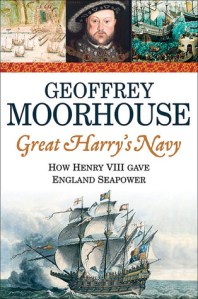 One would assume that, since England is an island nation, its navy has been its strength since its foundation. That, however, was not always the case. While there were naval battles during the Middle Ages, it was not a navy like we know today. The concept of the Royal Navy was founded during the time of the Tudors, especially under the reign of Henry VIII. So, how did Henry VIII turn a navy from 7 ships to over fifty ships that could stand with other European navies? Geoffrey Moorhouse examines the creation of the English navy in his book, “Great Harry’s Navy: How Henry VIII Gave England Sea Power.”
 We all know the gist of the tragic tale of Katharine of Aragon. A Spanish princess who was brought to England to marry the heir of the Tudor throne, Prince Arthur Tudor. When the prince died mere months after their wedding day, Katharine was left in limbo and desolate as the Kings of Spain and England bickered over her dowry. Eventually, she would marry King Henry VIII, was his wife for over twenty years, and have numerous miscarriages before Henry decided to divorce her and marry Anne Boleyn. We know how Katharine’s story ends, but how did the stories of her Trastamara family influence her life and her reign as Queen of England? Heather R. Darsie explores Katharine’s Spanish origins in her latest book, “Katharine of Aragon, Spanish Princess: ‘I Am Not as Simple as I May Seem.’”
 Do you have a favorite historical figure whom you have wondered what would have happened if they survived their dark fate? Have you wondered what would happen if they had fantastical abilities, such as transforming into animals? Maybe the last piece sounds a bit too far-fetched, but it makes for an interesting concept for a novel. What if we took the story of Lady Jane Grey, the Nine-Day Queen of England, and turned the tale into a fantastical comedy full of romance and adventure? Then, you would get the premise of “My Lady Jane” by Cynthia Hand, Brodi Ashton, and Jodi Meadows.
 A princess born to a king and his second wife lost her title and legitimacy when her father decided that her mother, Anne Boleyn, needed to die. Elizabeth Tudor knows the meaning of resilience as she survived her childhood during her father King Henry VIII’s reign. Now that her father is dead Elizabeth is at the mercy of her half-siblings Edward and Mary, plus any scheming man who wants to marry her and get closer to the crown. Can Elizabeth survive her siblings’ reigns or is she destined to be locked in the Tower to await her ultimate fate like her mother? Janet Wertman explores the life of Elizabeth Tudor in her latest series
 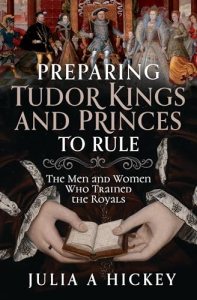 In life, when it comes to a new skill or job, you must be trained to become good at it. The same can be said for the monarchy, which in a sense is a job that encompasses one’s entire life. You have to understand different languages, rhetoric, the arts of dancing, and music, as well as diplomacy and physical activities if you want to rule a nation. It may seem like a lot for one person to handle, but from the moment of their birth, a prince or princess has a team of people behind them to make sure that they are ready to either rule their home country or create an alliance with other nations. The Tudors knew how important educating their future monarchs was for the survival of the dynasty. Julia A. Hickey examines the people behind the teams raising the future Tudor monarchs in her book, “Preparing Tudor Kings and Princes to Rule: The Men and Women Who Trained the Royals.”
 Treason is the crime of betraying one’s country or monarch by trying to overthrow the government or kill a sovereign. While many English dynasties dealt with treason in their ways, the most infamous were the Tudors and how they dealt with the nobility. By the end of 1572, there were no more dukes in England, until 1623 when George Villiers became the Duke of Buckingham. What was classified as treason during the Tudor dynasty and why did the members of the nobility have to die? Helene Harrison hopes to answer these questions in her latest book, “Tudor Executions: From Nobility to the Block.”
 The world of the 16th century was full of change and equally colorful characters. Most of the dynamic figures of this century were women, who were willing to fight in their ways for what they believed in, whether it was family, faith, or their country. They were heroines in different ways, and each had a story to tell. Each woman had to deal with her obstacles to reach their desired goal, no matter what her station was, from queens and great heiresses to nuns, and even a pirate. Sharon Bennett Connolly has decided to include a handful of these stories in her latest book, “Heroines of the Tudor World.”
 Those born of royal blood are either blessed by being able to sit on the throne or cursed to be under intense scrutiny for fears of treason. That is the case for the Grey sisters. Jane, Katherine, and Mary were the daughters of Henry and Frances Grey and the granddaughters of Mary and Charles Brandon. Their bloodline made them cousins to Mary I and Elizabeth I, which meant they threatened the two queens, especially when Edward VI named Lady Jane Grey his heir. After Mary I executes Jane and their father Henry for treason, the remaining Grey sisters, Katherine and Mary, must survive the treacherous Tudor court or end up like their sister. Can Katherine and Mary survive in a court where their royal blood leaves a target on their backs? Elizabeth Fremantle tells the tale of the lesser-known Grey sisters in her novel, “Sisters of Treason.”
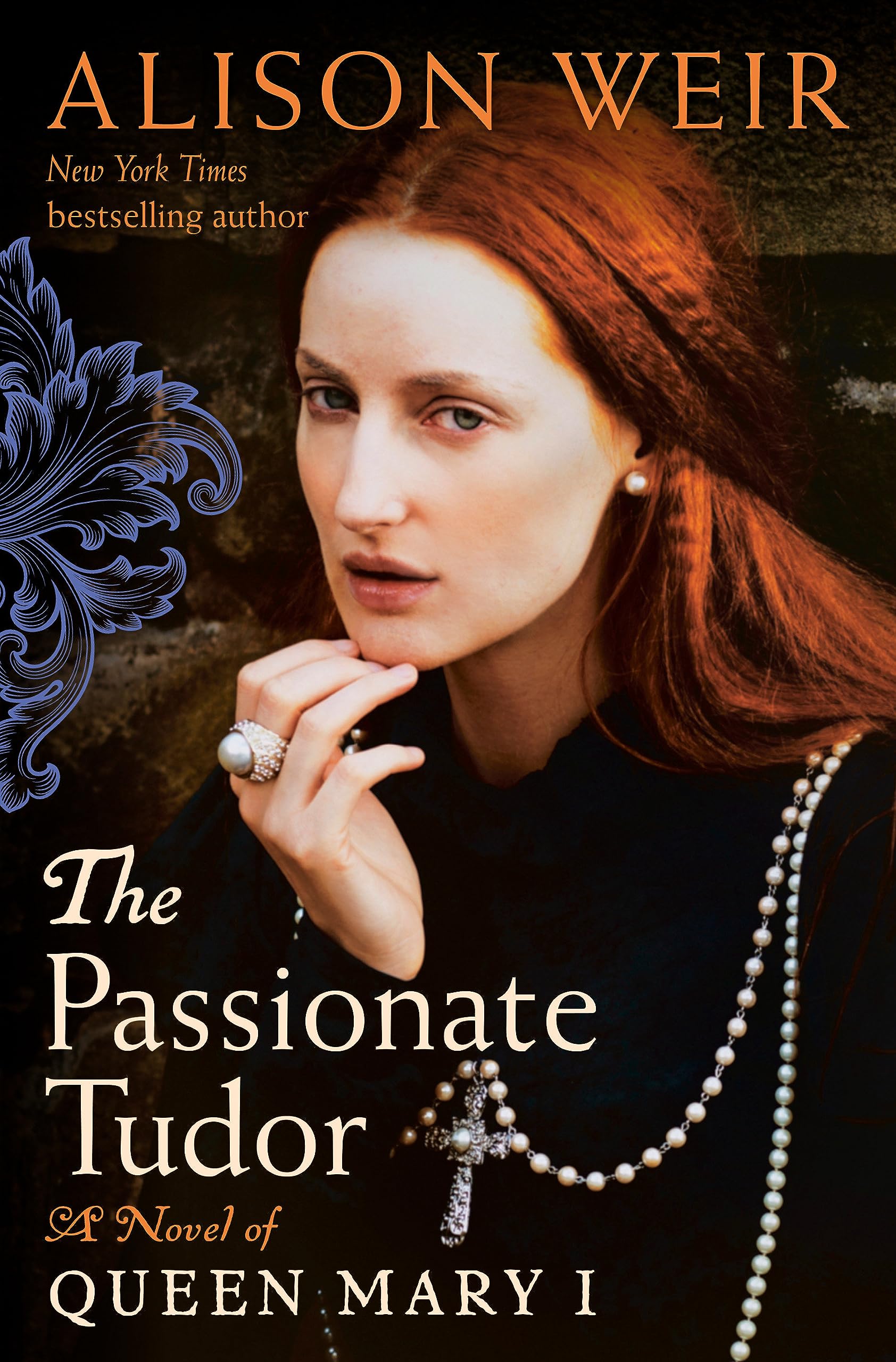 A king’s eldest child is usually the next in line to inherit the throne and become the next ruler. At least that is how the line of succession is supposed to work if the heir is male. Mary I knew this better than anyone. As the eldest daughter of King Henry VIII, she knew that once her mother Katherine of Aragon had a son, Mary would become a pawn in the marriage game. She was willing to accept this fate until her father fell in love with Anne Boleyn. Mary is declared a bastard and must fight for her inheritance and the crown of England while maintaining her Catholic faith. Alison Weir tells the tale of this remarkable woman, from her tumultuous childhood to her short reign that marked her legacy, in her latest novel, “The Passionate Tudor: A Novel of Queen Mary I.”
 Adventures of a Tudor Nerd