
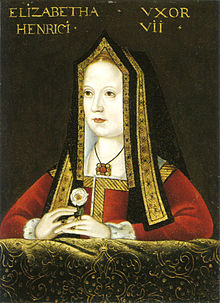
 (Born February 11, 1466- Died February 11, 1503). Daughter of King Edward IV and Elizabeth Woodville. Married to King Henry VII. Mother of Arthur, Prince of Wales, Margaret, Queen of Scots, Henry VIII, King of England and Mary, Queen of France.
Elizabeth of York was the daughter, niece, sister, wife and mother of kings. It was through her marriage with Henry VII that helped create the Tudor Dynasty.
Elizabeth of York was the eldest child of Edward IV and Elizabeth Woodville. She was born at the Palace of Westminster on February 11, 1466. She was christened at Westminster Abbey; her godparents were Jacquetta of Luxembourg, Duchess of Bedford, Cecily Neville, Duchess of York, and Richard Neville 16th Earl of Warwick. When she was three years old in 1469, she was briefly betrothed to George Neville, the nephew of Richard Neville, but it did not go far since his uncle would die two years later. In 1475, Louis XI agreed to arrange a marriage between nine year old Elizabeth of York to his son, Charles, the Dauphin of France; in 1482, Louis decided not to go along with the promised wedding.
Elizabeth’s world drastically changed forever when her father, Edward IV, suddenly died on April 9, 1483. Her young brother Edward V was proclaimed king and her uncle Richard Duke of Gloucester was named Lord Protector. On April 29, as previously agreed, Richard and his cousin, the Duke of Buckingham, met Queen Elizabeth’s brother, Anthony Woodville, 2nd Earl Rivers, at Northampton. The young king himself had been sent to Stony Stratford. Richard had Earl Rivers, his nephew Richard Grey and his associate, Thomas Vaughan, arrested. They were taken to Pontefract Castle, where they were executed on June 25 on the charge of treason against the Lord Protector after appearing before a tribuna. Richard took the young king under his protection, escorted him to London, and placed him in the Tower for his protection. After hearing about what had happened, Elizabeth Woodville took her children, including Elizabeth of York, her other daughters, her youngest son Richard Duke of York, and fled to sanctuary in Westminster Abbey. Elizabeth Woodville tried to keep her son Richard Duke of York away from Richard Duke of Gloucester, but she eventually did give up her son. We do not know how Elizabeth of York reacted to these events.
In early June of 1483, the marriage between Elizabeth’s parents, Edward IV and Elizabeth Woodville, was declared invalid because it is said that Edward IV had entered into a pre-contract marriage with Lady Eleanor Butler before he married Elizabeth Woodville. This meant that any children of Edward IV and Elizabeth Woodville were considered illegitimate, including Edward V, Richard Duke of York and Elizabeth of York. Since the children of George Duke of Clarence were barred from succession because of their father’s treason and execution, the next in line to the throne was Richard Duke of Gloucester. Richard was crowned King Richard III on July 6, 1483 and Elizabeth’s brothers disappeared. Some say that they were murdered, others say they escaped, but at this point we do not know what happened to Edward V and Richard Duke of York.
Elizabeth’s mother Elizabeth Woodville was now known as Elizabeth Grey and she decided to side with the Duke of Buckingham and Margaret Beaufort to put Margaret’s son Henry Tudor on the throne. Henry Tudor was the closest male Lancastrian heir and in order to cement this new alliance, Elizabeth Woodville and Margaret arranged that Henry would marry Elizabeth of York. Buckingham’s rebellion against Richard would fail and he would be killed on November 2, 1483. In December 1483, Henry Tudor made an oath in Rennes, France that he would marry Elizabeth of York when he became King of England. In January 1484, the act known as Titulus Regius was passed by Parliament, which confirmed under law that the marriage between Edward IV and Elizabeth Woodville was invalid.
On March 1, 1484, Elizabeth Woodville and her daughters left sanctuary after Richard III promised not to harm them and to arrange marriages for all of Elizabeth’s daughters. There were rumors that after Anne Neville in March 1485, Richard III’s wife, died that he was seeking to marry Elizabeth of York, but there is no evidence to support this claim. Soon after Anne Neville’s death, Richard III sent Elizabeth away from court to the castle of Sheriff Hutton and opened negotiations with King John II of Portugal to marry his sister, Joan, Princess of Portugal, and to have Elizabeth marry their cousin, the future King Manuel I of Portugal.
These marriage arrangements did not come to fruition. Elizabeth of York stayed at Sheriff Hutton during August 1485, when Henry Tudor invaded England and on August 22, 1485 when Richard III fell at the Battle of Bosworth Field and Henry Tudor became King. Henry did keep his promise and married Elizabeth of York on January 18, 1486. The couple’s first child, Arthur, was born on September 20, 1486.
During 1487, a young man named Lambert Simnel, claimed that he was the earl of Warwick, Elizabeth’s cousin, so Henry VII had the real earl of Warwick taken from the Tower and paraded through London. It was at the last battle of the Wars of the Roses, the Battle of Stoke Field on June 16, 1487 that Lambert Simnel was defeated. Henry decided to let the boy live and gave him a job at the castle. Elizabeth was crowned on November 25, 1487 and she would have seven children total, four survived into adulthood; Arthur, Henry, Margaret and Mary. Although Elizabeth had a strong claim to the throne, she did not seek to become queen regnant.
In the early 1490s, another threat to the peace emerged with the contention that Elizabeth’s younger brother, Richard, Duke of York, was still alive. Her aunt, Margaret of York, Dowager Duchess of Burgundy and James IV of Scotland, were sponsoring a young man, later revealed to be a youth named Perkin Warbeck. Warbeck received wide-spread support from amongst Yorkists, who did not like Henry VII. Ultimately, however, Warbeck could not command enough support at home or abroad, to mount a successful challenge and in 1497, he was captured.
Warbeck’s wife Lady Catherine Gordon was made one of the ladies-in-waiting for Queen Elizabeth of York. In June 1498, Warbeck was forced to make two public appearances at Westminster and Cheapside, where he admitted that he was not Richard Duke of York and that Margaret of Burgundy was to blame for the entire scheme. Henry VII was kind to Warbeck at the beginning, allowing him to live at court, but Warbeck tried to escape and it landed him in the Tower of London, close to Edward Plantagenet, 17th Earl of Warwick, son of the late George, Duke of Clarence. Warbeck and Warwick plotted to escape the Tower, but the plan was uncovered and both men were charged with treason. Perkin Warbeck was hanged at Tyburn on November 23, 1499. We don’t know if Elizabeth of York ever met Warbeck.
Elizabeth was a very pious woman and was very dedicated to her children’s wellbeing. Elizabeth was very involved in the marriage negotiations for her two eldest children, Arthur and Margaret, Arthur to Katherine of Aragon, daughter of Isabella I of Castile and Ferdinand II of Aragon, and Margaret to James IV of Scotland. Elizabeth helped convince Katherine’s parents that she would be well taken care of and with Margaret’s marriage, Elizabeth was concerned that she was getting married at such a young age.
In November 1501, Katherine of Aragon arrived in England and Elizabeth was part of the celebrations of the marriage. The following year, tragedy hit hard as Arthur died on April 2, 1502. This was a tragic loss for Henry and Elizabeth because this meant that there was only one heir to save the Tudor Dynasty, the young Henry Tudor. While Henry was grieving, it is said that Elizabeth comforted him and told her husband that they were still young enough to have more children. Later, Elizabeth would break down and it was Henry who consoled his wife. Elizabeth would have one more child, a girl named Katherine, on February 2, 1503, but the baby would not live long. Elizabeth of York would die on her 37th birthday, on February 11, 1503.
 The Wars of the Roses was a dynastic battle between the houses of York and Lancaster for the throne of England that lasted for 30 years. There were plenty of people who lived during this time that continue to fascinate us even to this day. Men like Richard III, Henry VI, Edward IV, Henry VII, and Richard Neville duke of Warwick to just name a few. There were also women who worked hard on the sidelines to make sure that their sides would win the wars. Women like Margaret of Anjou, Elizabeth Woodville, Cecily Neville, and Margaret Beaufort. However, one of the most important person during this conflict tends to get left behind when discussing the most influential people of this conflict; Elizabeth of York, the wife of Henry VII. She was the mother of the Tudor dynasty, yet she does not get the attention that she rightfully deserves. In Alison Weir’s book “Elizabeth of York: A Tudor Queen and Her World”, Weir explores the life of this influential woman and her impact on the world around her.
 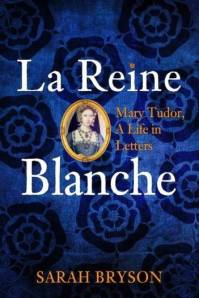 When we think of the Tudors, we often think of strong women like Katherine of Aragon, Anne Boleyn, Elizabeth I, Margaret Beaufort and Mary I. However, there was another Mary who made an impact during this time. She was the daughter of Henry VII, the sister of Henry VIII, and the wife of King Louis XII of France. She was referred to as one of the most beautiful women in the world. She gave away all of her titles to marry the man she loved, even though he was not a king. She took on debt to have a family and helped those who needed help. This is the life of Mary Tudor. In Sarah Bryson’s debut book, “La Reine Blanche: Mary Tudor, A Life in Letters”, Bryson explores the life of this extraordinary woman through her letters.
 Adventures of a Tudor Nerd