
 Civil wars, clashes between cousins, are known to be full of battles between men on foot and horseback, with their eyes set on the throne of their desired country. Many stories of civil wars tend to leave out the women who often were left on the sidelines, ready to pick up the pieces. The story of the Anarchy is a bit different than other civil wars as one of the main figures was not a man, but Empress Matilda, the daughter of King Henry I and the rightful heiress of England facing off against the man who stole the throne from her, her cousin, King Stephen. However, it was not just Empress Matilda who defined what it meant to be a woman during the Anarchy. In her latest book, “Women of the Anarchy,” Sharon Bennett Connolly tells the stories of the mothers, sisters, and wives who defined this turbulent period that saw the end of one dynasty and the beginning of another.
I want to thank Amberley Publishing for sending me a copy of this book. I have enjoyed Sharon Bennett Connolly’s previous books that I have read, “Ladies of the Magna Carta,” “Silk and Sword,” “Defenders of the Norman Crown,” and “King John’s Right Hand Lady.” When I heard that Connolly was writing about the women who were involved in the Anarchy, I was excited because it is one of my favorite conflicts in history to study. I wanted to see what new information Connolly would present in her book.
Connolly begins by explaining how the conflict around the Anarchy arose and how Empress Matilda and Queen Matilda became the female faces of opposing sides of this civil war. Empress Matilda, the daughter of King Henry I, was the wife of the Holy Roman Emperor Henry V. However, her life took a dramatic turn when her only legitimate brother William Aetheling died on November 25, 1120, when the ship he was on, the White Ship, sank after a night of drunk sailing. As King Henry I’s last living legitimate child, Empress Matilda was the rightful heir to the English throne, even though she was a woman and she was willing to fight with everything in her power to sit on the throne. On the other side of the conflict was Queen Matilda of Boulogne, the wife of King Stephen. Although Queen Matilda or Empress Matilda could not wield a sword in battle, they showed that they were capable of fighting in their own unique ways.
Empress Matilda and Queen Matilda had grandmothers and mothers who showed them what it meant to be a queen and a mother who was willing to fight for their family. Women like Matilda of Flanders, Saint Margaret of Scotland, Matilda of Scotland, and Adeliza of Louvain showed the two Matildas how to help their husbands run a country while maintaining their strong identities as women rulers. However, Connolly does not stop just at the two Matildas when discussing royal women who had to navigate the Anarchy. We are introduced to interesting characters like Isabel de Vermandois, Ada de Warenne, Lucy Countess of Chester, Ela de Talvas, Mary of Boulogne, Isabel Countess of Warenne and Surrey, culminating with the story of Eleanor of Aquitaine.
While other books focus on the Anarchy, by focusing on the two Matildas and other women affected by this conflict, Connolly brings something fresh to this story that is centuries old. It shows how their actions to protect their families brought forth change in England through the birth of the Plantagenet dynasty. This book is rich in details and is so well written as Connolly takes the time to distinguish between the Matildas, which there are quite a few in this book, and explain how the conflict started and finally how it was concluded. I think if you want a fabulous book about the Anarchy and the women who defined this period, I highly recommend you check out, “Women of the Anarchy” by Sharon Bennett Connolly.
 A life of luxury from birth, destined to be crowned King or Queen of England. This is what we often think life must have been like for royal heirs who reached the ultimate destination of a crown and a throne. However, the stories of those who failed to reach the throne are mired in tragedy and heartache. The question of royal succession in England is a complex issue, especially when the heir to the throne dies unexpectedly, leaving doubts on whether a dynasty will survive through blood or dissolve in conflict. How did the deaths of these potential rulers radically transform the fabric of English history as a whole and what can their lives tell us about what kind of rulers they might have been? Ashley Mantle hopes to answer all of these questions and more in his latest book, “Uncrowned: Royal Heirs Who Didn’t Take the Throne.”
 One of the most critical years in English history was 1066, when William Duke of Normandy invaded England in the Norman Conquest. Known as William the Conqueror, his strength and ruthlessness made him a legend, but William would not have been the Duke or King of England without his equally formidable wife. Matilda of Flanders stood her ground, became the Duchess of Normandy, had a large family with William, and would become the first crowned Queen of England. Although much has been written about William the Conqueror and the Norman Conquest, Matilda of Flanders has not received the same attention until now. Tracy Borman has written the first biography dedicated to this remarkable woman entitled, “Matilda: Wife of the Conqueror, First Queen of England.”
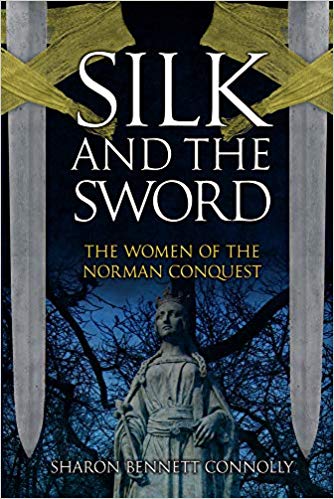 There are quite a few events that one can name that radically shaped the course of British history. None more so than the events of 1066, the year that saw Norman, Breton, Flemish, and French forces, led by the Duke of Normandy, William the Conqueror, invaded England in what we know today as the Norman Conquest. Most history books tend to focus on the men who lived before, during, and after the Norman Conquest: Aethelred the Unready, Edward the Confessor, Cnut, Harold II, Harald Hardrada, and of course William the Conqueror just to name a few. What the history books tend to gloss over is the strong women who stood by their husbands, brothers, and sons during this conflict. Who were these women? What were their stories? How did they help their families before, during and after 1066? These questions are answered in Sharon Bennett Connolly’s delightful book, “Silk and the Sword: The Women of the Norman Conquest”.
 Adventures of a Tudor Nerd