
 In human history, when citizens have disagreed with a new law or those in charge, they often stage a protest to show their frustration. When their voices are not heard, people often turn to rebellions and revolts to make sure their opinions matter. We might think that revolution and rebellion as a form of protest are modern ideas, but they go back for centuries. Revolutions and rebellions shaped history, no more so than in the middle ages. In his latest book, “Rebellion in the Middle Ages: Fight Against the Crown,” Matthew Lewis examines the origins of the most famous rebellions in medieval England and how they transformed the course of history.
I want to thank Pen and Sword Books and Net Galley for sending me a copy of this book. I have been a fan of Matthew Lewis’ books for years now, and I wanted to read his latest book. The topic appealed to me, and I wanted to see something new about these rebellions.
Lewis begins with the Norman invasion and those who resisted William the Conqueror as king to understand the vast history of rebellions in middle ages England. The most famous of these rebels was a man named Hereward the Wake. We then move to the Anarchy, a battle between cousins, Empress Matilda, the rightful heir, and Stephen of Blois, her cousin and the one who would inevitably be King of England. Empress Matilda’s son Henry II would become King Stephen’s heir, but the first Plantagenet king had to endure numerous rebellions from his friend Thomas Becket and his sons.
Moving into the halfway point of the middle ages, Lewis explores how the first and second Barons’ Wars were fought over the rights of the average citizen kings like John were put in their place with the Magna Carta. Some rebellions had other goals, like the deposition of Edward II in favor of his son Edward III and Henry of Bolingbroke’s revolt against his cousin Richard II, and of course, the Wars of the Roses with the deposition of Henry VI. It was not just the nobility that decided to rebel against the monarchy, as we see with the Peasants’ Revolt, led by Wat Tyler, and the Jack Cade Rebellion. The cost for rebellions could be extremely high, as men like Simon de Montfort, Hugh Despenser the Younger, and Richard Duke of York would find out.
Individually, every one of these rebellions would have numerous books dedicated to deciphering the intricacies of why the rebels did what they did. However, Lewis has taken on the mammoth task of combining these tales into one comprehensive nonfiction book easy to read for novices and experts alike. This book is another triumph for Matthew Lewis. If you want an excellent book that examines the origins of medieval rebellions and how they impacted English history, “Rebellion in the Middle Ages: Fight Against the Crown” by Matthew Lewis is the ideal book for your collection.
 If you go to Fontevrault Abbey in France, you will find two rather extraordinary tombs. These tombs belong to King Henry II and Queen Eleanor of Aquitaine, the first King, Queen of the Plantagenet Dynasty, and the Angevin Empire. Their effigies tell us a lot about the couple that was buried side by side. The husband was restless; his model shows him ready to take action at any moment, with his crown upon his head and a scepter in his hand. His queen lays beside him, reading an unknown book. They seem to be prepared to watch over their kingdom and their family even beyond the grave. Those who know English history recognize their names and understand the family drama behind the scenes. We think we know the truth about Henry and Eleanor, but is there more to their story and their feuding family? In Matthew Lewis’s latest dual biography, “Henry II and Eleanor of Aquitaine: Founding an Empire,” he explores the relationship between this dynamic king and queen and how it shaped European and English history forever.
 Civil wars between cousins have had many names in the past, notably in England, the Wars of the Roses. However, there was a civil war that pre-dates the colorful contest known as The Anarchy. Two cousins fighting against one another from the throne of England, but what makes this contest unique was the main protagonists caught in the middle. One was the only legitimate child of King Henry I, Empress Matilda. The other was Henry I’s favorite nephew, Stephen of Blois. This conflict stretched for decades and has fascinated historians for centuries. It is complex and at times, a bit confusing, but Matthew Lewis has chosen to shed some light on what happened during this period in history in his latest book, “Stephen and Matilda’s Civil War: Cousins of Anarchy”.
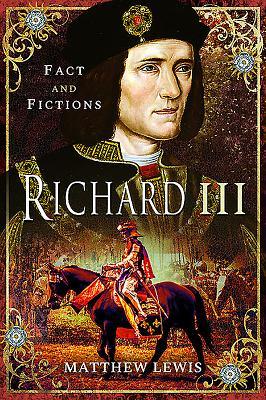 When one looks at the study of history as a whole, the traditional way to look at a person as either good or bad through a combination of facts and fictional tales of their supposed exploits. None so much so as King Richard III, one of the most controversial English monarchs. Fictitious tales, like William Shakespeare’s play
 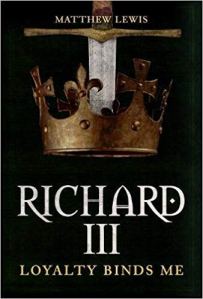 When we study history and look at certain people, we often have a tendency to treat them almost like fictional characters. They are either the hero, all good with no flaws, or villains, all bad where we only focus on their flaws. We don’t see the person as “human”, neither good nor bad, just someone who tried their lives to the best of their abilities. One such person who tends to get either the hero or the villain treatment is King Richard III of England. To some, he is “white knight”, a man who was wrongly accused and who was faultless. To others, he was a “black legend”, a dastardly villain who wanted power and did not care who he stepped on in order to achieve his goals. With these two different portrayals of Richard III, we often forget that he was just an ordinary man who became king. Matthew Lewis has decided to strip away both the white and black portrayals of Richard III and explore who Richard III the man was in his latest book, “Richard III: Loyalty Binds Me.”
 One of the greatest mysteries of all time is what happened to the young princes, the sons of Edward IV, who were held in the Tower of London. Many people believed that they were killed. There are some who believe that Richard III had them murdered and there are some who say that Henry VII ordered the deed to be done. But what if they were never killed? What if they survived? That is the premise of Matthew Lewis’s book “The Survival of the Princes in the Tower: Murder, Mystery and Myth”.
  Perkin Warbeck. These were the most famous pretenders and the ones who challenged Henry VII’s right to the throne. If they were really the princes in the tower, why were they defeated? Why were they considered pretenders? Lewis explores other people who could possibly be the princes, including a theory by amateur art historian Jack Leslau on “The Family of Sir Thomas More” by Hans Holbein the Younger.
  Adventures of a Tudor Nerd