 I am pleased to welcome Anna Belfrage to my blog today to share a guest post to promote her novel, “Their Castilian Orphan.” I would like to thank Anna Belfrage and The Coffee Pot Book Club for allowing me to be part of this blog tour.
I write Historical Fiction. While my protagonists are entirely fictional, they now and then have to interact with “real” people who’ve existed, lived, and died for real. This can be a bummer – especially when your perfectly crafted timeline suddenly crashes headlong into the wall of historical facts. That conversation your protagonist was to have with the wife of the 14th-century Earl of Lancaster can no longer happen, seeing as the lady died some months before the planned meeting. The touching scene in which Philippe Augustus of France reconciles with his Danish wife, Ingeborg, must be scrapped – the king would no more reconcile with his wife than he would have a crocodile in his bed (which would not only be very weird but also anachronistic, as there were no crocodiles in medieval France. As an aside, no one knows just why Philippe Augustus stormed out of the chamber in which he’d just spent his wedding night said Ingeborg, determined to never, ever have her near him again). See? These real-life characters are hard to deal with. In actual fact, so are the invented characters, as all of a sudden they start developing opinions of their own and generally refuse to cooperate when they don’t agree with the overall plotline, but that is neither here nor there – not in this post.
Including real characters in the story adds a certain nerve. People can read the book, become intrigued, and spend some time googling the real characters. Hopefully, they come away with the impression that the author has done a good job adhering to the overall facts. If not, there may be a problem, as readers of historical fiction tend to be sensitive to incorrect information.
The further back in history you write, the more leeway you have when utilizing real-life characters. Also, I think it important to underline that Historical Fiction is precisely that: fiction. Even when writing about real historical people, we must keep in mind that we don’t know these shadowy ghosts from the past. What we have are fragments of their lives (at best), mentions in this roll or the other, acidic comments in one chronicler’s version of events, and praise in another’s. So what any good historical fiction author does is that he/she constructs a picture – fleshes out the spare bones we have left to create a living, breathing character (in as much as characters can breathe, of course). Every such representation is incorrect in that it does not – cannot – be a fair representation of the person who lived and died all those years ago.
This is why we get such varied depictions of historical people. Authors may start with the same bare facts, but then they’ll add biases and personal values, which is why Henry Tudor comes across as the villain in one book, as an earnest man with a mission in another. The thing is, we have no idea what he was really like. Was he passionate in bed? Did he have the enervating habit of sucking his teeth as he thought? Did he take reading matter with him to the garderobe? Did he eat the veggies first? Did he now and then curse that meddlesome mother of his to hell and back? We simply don’t know. What we do know is that he won at Bosworth – and that, according to some, is down to pure luck, while others will argue for divine intervention.
I guess the long and short of all this is that a historical fiction author must know his/her period, and must be familiar with customs and foods, clothes, and values. Of course, when writing about real people, the author needs to have read up on the facts that exist. But these are just the building blocks. A historical fiction author wants to tell a story, and sometimes those real-life characters have to be tweaked – a bit – to create the required tension. And so Henry Tudor is at times represented as diabolical, at others as an ambitious man who truly believes he deserves the English crown. A skilled author will have the reader accepting either or – for the sake of the story as such.
In my recent release, Their Castilian Orphan, I am writing about a very, very bad year for Edward I. 1294 is probably one of his least favourite years, even if nowhere close to that most awful year, 1290 (when his wife died. And see what I am doing here? I am imbuing Edward with romantic traits by indicating he never, ever got over the loss of Eleanor. While there seems to be plenty of evidence this was the case, we do not know. Not really. . .) In 1294, Philippe IV of France more or less tricked Edward into turning over parts of Gascony to him, and, as icing on the cake, the Welsh seized the opportunity offered by Edward’s conflict with France to rebel.
Obviously, Edward plays an important role in my novel. While he is not one of my protagonists, most of my invented peeps live in his shadow, some in closer proximity to him than others, but none untouched. As Edward was king, we know more about him than about other players in the period. We can, for example, track his itinerary through his rolls—and boy did the man move about a lot! But the documents offer little insight into his mind and innermost thoughts.
My Edward is a man determined to come across as powerful. Being humiliated by the much younger Philippe must hurt, as does, in all likelihood, his gouty toe. But Edward would refuse to show weakness in public—it suffices that some of his more vociferous nobles are insinuating he was tricked by Philippe because Philippe promised him his young sister, Marguerite as a new bride. Ugh, his nobles exclaim, a king ruled by his lusts! My Edward doesn’t want to wed again—but he knows he has no choice, not really, seeing as he only has one surviving son, and everyone knows a king needs at least one spare. My Edward is temperamental and at times he unfairly subjects those who serve him to his anger. I have no idea if the real Edward would ever throw a heavy candlestick at a boy, but my Edward does—and is incapable of bending his pride sufficiently to apologise for it afterwards.
Many would probably portray Edward as more demonic—especially those writing about his campaigns against the Scots. And yes, to them he probably was the devil in disguise, but like every other person in the world, Edward was a multifaceted person, even if he does seem to have had a propensity for ruthless violence when riled. On the other hand, he was a medieval king, and such kings ruled through the force of their swords.
In conclusion, as I said right at the beginning, I write fiction. I have the joy of constructing a plot that weaves its way through the tapestry of known history, my invented leads interacting freely with the people who populate the history books – as I see them. Lucky me, hey?
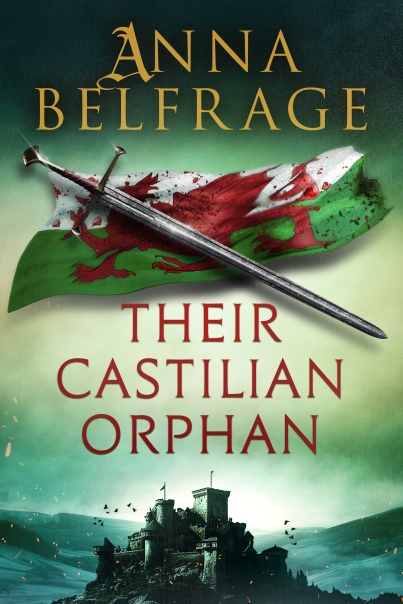 Blurb:
It is 1294 and Eustace de Lamont is back in England after five years in exile. He will stop at nothing to ruin Robert FitzStephan and his wife, Noor d’Outremer.
Robert’s half-brother, Eustace de Lamont, has not mellowed during his absence. He is more ruthless than ever, and this time he targets Robert’s and Noor’s foster son, Lionel.
Lionel is serving King Edward as a page when Eustace appears at court. Not only does Lionel become the horrified witness to Eustace’s violent streak, Eustace also starts voicing his suspicions about Lionel’s parentage. The truth about Lionel’s heritage is explosive—should King Edward find out, all would be lost for Robert and Noor.
In October of 1294, Wales rises in rebellion. Robert must leave his family unprotected to fight the Welsh rebels on the king’s behalf, comforted only by the fact that Eustace too is called to fight.
Except that Eustace has no intention of allowing his duty to his king—or a mere rebellion—come between him and his desire to destroy Robert FitzStephan . . .
Buy Links:
This title is available to read on #KindleUnlimited.
Universal buy link: https://mybook.to/TCO
 Author Bio:
Had Anna been allowed to choose, she’d have become a time traveler. As this was impossible, she became a financial professional with three absorbing interests: history, romance, and writing. Anna has authored the acclaimed time travelling series The Graham Saga, set in 17th-century Scotland and Maryland, as well as the equally acclaimed medieval series The King’s Greatest Enemy which is set in 14th-century England. Anna has just released the final installment, Their Castilian Orphan, in her other medieval series, The Castilian Saga, which is set against the conquest of Wales. She has recently released Times of Turmoil, a sequel to her time travel romance, The Whirlpools of Time, and is now considering just how to wiggle out of setting the next book in that series in Peter the Great’s Russia, as her characters are demanding. . .
All of Anna’s books have been awarded the IndieBRAG Medallion, she has several Historical Novel Society Editor’s Choices, and one of her books won the HNS Indie Award in 2015. She is also the proud recipient of various Reader’s Favorite medals as well as having won various Gold, Silver, and Bronze Coffee Pot Book Club awards.
“A master storyteller”
“This is what all historical fiction should be like. Superb.”
Find out more about Anna, and her books and enjoy her eclectic historical blog on her website, http://www.annabelfrage.com
Sign up for Anna’s newsletter to keep up with new releases, giveaways, and other fun stuff: http://eepurl.com/cjgatT
Author Links:
Website: http://www.annabelfrage.com
Twitter: https://twitter.com/abelfrageauthor
Bluesky: https://bsky.app/profile/abelfrageauthor.bsky.social
Facebook: https://www.facebook.com/annabelfrageauthor
Instagram: https://instagram.com/annabelfrageauthor
Book Bub: https://www.bookbub.com/profile/anna-belfrage
Amazon Author Page: http://Author.to/ABG
Goodreads: https://www.goodreads.com/author/show/6449528.Anna_Belfrage

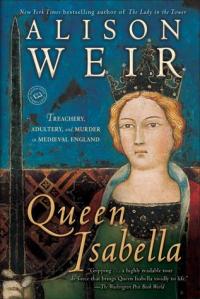 Throughout medieval English history, there have been some famous queens who left their marks. Empress Matilda, Eleanor of Aquitaine, Eleanor of Castile, Philippa of Hainault, and Margaret of Anjou each left an impression on English history, either good or bad. However, there was one queen whose negative reputation came with the nickname “She-Wolf of France,” and her name was Queen Isabella of France. The wife of Edward II and mother of Edward III, she left her husband for Roger Mortimer and overthrew her husband in favor of her son. For centuries, she has been viewed as a horrible villainess, but is that a fair assessment of her life? Alison Weir dives into the archives to find the truth about Isabella of France, and she presents her findings in her biography, “Queen Isabella: Treachery, Adultery, and Murder in Medieval England.”
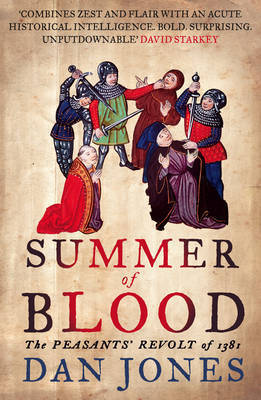 The year was 1381, and England was engulfed in chaos. A band of ruffians and revolters descended on London to achieve political change and a fair chance for the lower classes who suffered greatly from war and plague. The young King Richard II watched as men like Wat Tyler and the preacher John Ball led this ragtag army to his doorstep, fighting against his advisors, like John of Gaunt, to end a poll tax that was their last straw. Why did this ragtag army march on London? How did men like Ball and Tyler convince the masses to march against their sovereign and his government? How did this revolt end, and did the people get what they wanted due to their revolution? Dan Jones brings the bloody story of the first significant revolution by the English people to life in his book, “Summer of Blood: The Peasants’ Revolt of 1381.”
 Adventures of a Tudor Nerd