Book Review: “Wortes and All: Medieval Cooking” by Emma Kay

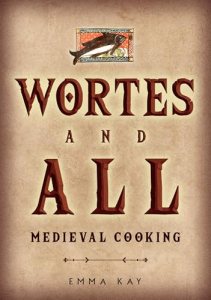
History is not just dates and conflicts with men and women sprinkled in, so we can learn a lesson. It’s not just births, conflicts, triumphs, marriages, and deaths. The people of the past are similar to us in so many ways, and it is through the field of study known as Living History or Experimental Archeology that we can understand the past through a more hands-on approach. One of the most popular methods of studying living history is cooking recipes from the past. But one must wonder how our tastes and understanding of the benefits of food change over time. Emma Kay takes the question of how eating and drinking changed over the medieval period in England and explores it in her book, “Wortes and All: Medieval Cooking.”

I would like to thank Amberley Publishing for sending me a copy of this book. The study of Living History/Experimental Archeology has been an area of interest for me for a couple of years now, especially cooking, as it gives the past a bit more substance. When I heard about this book, it was a compelling concept to me, and I wanted to read it and see if Kay would provide new insight into this field of study.

This book is broken down into chapters where different foods are highlighted: soups and stews, bread and dough, meat, fish, sauces, dairy, eggs, fruits, vegetables, sweet treats, and drinks. Each chapter explores these topics through the early medieval period (4th-13th centuries) and the later medieval period (14th-16th centuries). While we do have manuscripts that have recipes written down, Kay also highlights leechdoms, which are medical remedies or medicinal tomes. She also explores how the theory of the four humors affected the diets of those living in the medieval world.

What I appreciate about this book is the diverse resources that she compiled for her research. It is not just English cookbooks and manuscripts, but Anglo-Saxon tomes on medicine, Scandinavian sagas, French cookbooks, and even Middle Eastern manuscripts. It shows how interconnected the medieval world was, even with all the conflicts and distances between nations. Kay goes a step further by including not only the original recipes in their original languages, but also her translations and even images of her recreating the recipes.

Overall, I did enjoy this book and the information that was provided. I learned quite a lot of new information about cooking and drinking in the medieval world, but part of me wishes it were a bit longer, as this is only about a hundred pages. I think I will explore other books written by Emma Kay. If you want a book that explores how the culinary arts changed over the medieval period, I recommend you read “Wortes and All: Medieval Cooking” by Emma Kay.

Guest Post: “Research of the Locations Featured in Sword Brethren” by Jon Byrne

I am pleased to welcome Jon Byrne to my blog today to share information about his research for the locations in his novel Sword Brethren.  I would like to thank The Coffee Pot Book Club and Jon Byrne for allowing me to participate in this blog tour.

Detailed research is important for all writers – but for those writing historical fiction, it is vital. While much can be gained by researching information on the internet or reading books on the subject, one of the best things for me is the chance to visit the locations depicted in the book. Sometimes it is only by going to a place that you can really get a feel for how it might have been. Having said that, all of the places depicted in Sword Brethren have changed so much over the last 800 years that it is still difficult to imagine how a location would have looked so long ago, especially as there is so little remaining from this period. 

The story begins in Cranham, a fictional village in East Anglia in England, located somewhere between Bury St Edmunds and Thetford. I traveled the area a few years ago, visiting the local castles like Framlingham and Orford, as well as the village of Lavenham – one of the best-preserved medieval villages in England. This helped to get an idea of what the area might have been like in the High Middle Ages, but even here most of the buildings date from the late medieval and Tudor periods.  

One of the places that I found particularly helpful was Eye Castle – originally a motte and bailey fortress built during the reign of King William I. This is even earlier than the timeframe of the book, which made it far more relevant, but the castle is ruined, and a house was built on the motte in 1844, which has since decayed and collapsed. Nevertheless, the fictional village and castle of Cranham would not have been dissimilar. 

Lübeck, in northern Germany, is now a UNESCO World Heritage Site and the location for approximately a third of the book. I spent a very satisfying weekend walking the cobbled streets and visiting the historical sites it has to offer – made considerably easier for me because at the time I lived in Berlin, which is only 280 km (approx. 170 miles) away.  


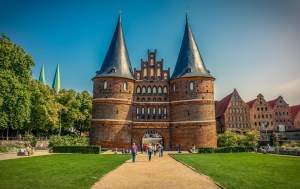
Caption: The Holsten Gate in Lübeck (built between 1464 to 1478). On the right can be seen some of the buildings of the Salzspeicher – a row of historic salt warehouses. On the left, the spires of St Mary’s Church (Marienkirche) pokes above the trees. 

Founded in the mid-12th century, Lübeck became known as the Queen of the Hanseatic League (originally a powerful trading network of merchant communities in Northern Germany) and was the main point of departure for the Northern Crusades. Unfortunately, most of the late medieval buildings that the city is famous for – the Holsten Gate (Ger. Holstentor), St Mary’s Church (Ger. Marienkirche), St Peter’s Church (Ger. Petrikirche), the Salzspeicher (salt warehouses) and the famous brick-built gable houses – were not constructed at the time of this book. Only the cathedral that still stands (Ger. Dom zu Lübeck) existed in the early 13th century, and it was under construction, although it has been modified many times since and was almost completely destroyed in the Second World War. Much of the half-island that today makes up the old town was undeveloped and prone to flooding in the period of the book. The Holstenbrücke (Holsten Bridge) was first mentioned in 1216 but it is conceivable that a bridge existed beforehand. This would have been constructed from wood. 

One of the highlights of researching Sword Brethren was a week-long trip I spent in Latvia with my family. We were based in Riga, which is a fascinating city that I would recommend anyone visit. Again, most of the architecture is later than the events in my book. In the early 13th century, Riga was made almost entirely of wood (including the churches), and despite being the largest city in the eastern Baltic at this time, it was little more than a village when compared to cities in Western and Central Europe. 

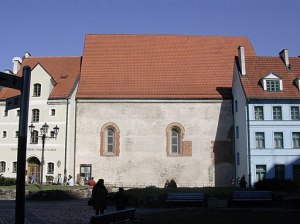
One of the first buildings made of stone in Riga was the original St George’s Castle, the first headquarters of the Livonian Brothers of the Sword, an order of warrior-monks, similar to the Knights Templar, who were formed to protect the fledgling German colony. It is the oldest surviving stone building in Riga. The only part still surviving is the chapel, now used by the Latvian Museum of Decorative Arts and Design. 

(Wikimedia Commons):  

Caption: St George’s Chapel – the oldest stone building in Riga and the original headquarters of the Livonian Brothers of the Sword.  

Outside of Riga, the only buildings that still remain from the period of the book are the stone castles built by the Brothers of the Sword and the Livonian Order of the Teutonic Knights that followed them. Most of these are either ruins or in various states of repair. Many of these castles were built on the banks of the River Daugava (Ger. Düna) by the German settlers and crusaders, using the river to improve their defenses. Sadly, today many are submerged beneath the waters of the Daugava that engulfed them when the Riga Hydroelectric Power Plant was built. 

Nevertheless, two castles that remain in good condition lie northeast of Riga, only 23 miles or so from each other. The first is at Sigulda (Ger. Segewold), which was first constructed in 1207 and later rebuilt into a convent-type fortress. From its elevated position on a steep slope above the Gauja River, you can see another castle at Turaida across the water, built on the remains of an old pagan hillfort. It is a beautiful location, with the thick forest around it, and it gives a good flavor of how it might have felt to live here in the early 13th century. 


 Turaida castle (Ger. Treiden) (taken by author):  

Caption: The view from Sigulda castle. 

The second castle, one of the best preserved in all of Latvia, is at Cēsis (Ger. Wenden). This is a huge castle, much of it still complete, with several relatively intact towers and walls. This is the castle that later became the main seat of the Brothers of the Sword and the Teutonic Order afterward. It is an impressive fortress that features more in the next book of the series, Soldier of Christ

 (taken by author):  

Caption: Cēsis castle – probably the best-preserved castle in Latvia from the early 13th century 

However, it is only possible to learn a certain amount from visiting sites in the book personally. The bulk of research – for me at least, is reading some of the excellent books and research papers concerning the Northern Crusades. 

The principal first-hand source is The Chronicle of Henry of Livonia, which was written by a priest, Henricus des Lettis, probably around 1229. The chronicle deals with events in the eastern Baltic between 1180 to 1226. Hardly surprisingly, it is written from the German point of view and describes the role of the Latin Church in colonizing and spreading Christianity to the local pagan tribes.  

His chronicle is a highly detailed account, rich in human history, and he provides eye-witness testimony of the events at this time, depicting not only the military campaigns but interesting facts about the local people themselves. This is particularly valuable as there is practically no other first-hand evidence of the events of the early Christian settlement in what is now Latvia and Estonia. 

Blurb:

1242- After being wounded in the Battle on the Ice, Richard Fitz Simon becomes a prisoner of Prince Alexander Nevsky of Novgorod. Alexander, intrigued by his captive’s story, instructs his scholar to assist Richard in writing about his life. 

Richard’s chronicle begins in 1203 when his training to be a knight is disrupted by treachery. He is forced to flee England for Lübeck, where he begins work for a greedy salt merchant. After an illicit love affair, his new life is thrown into turmoil, and he joins the Livonian Brothers of the Sword as they embark on imposing the will of God on the pagans of the eastern Baltic. Here, he must reconcile with his new life of prayer, danger, and duty – despite his own religious doubts, with as many enemies within the fortified commandery as the wilderness outside. However, when their small outpost in Riga is threatened by a large pagan army, Richard is compelled to make a crucial decision and fight like never before. 

Buy Links:  

Universal Ebook Buy Link: https://books2read.com/u/boVKlV  

Barnes and Noble: https://www.barnesandnoble.com/w/sword-brethren-jon-byrne/1146519606?ean=2940184429601 

Waterstones: https://www.waterstones.com/book/sword-brethren/jon-byrne/9781835740798 

Author Bio

Jon Byrne, originally from London, now lives with his German family by a lake in Bavaria with stunning views of the Alps. As well as writing, he works as a translator for a local IT company and occasionally as a lumberjack.  

He has always been fascinated by history and has studied the Medieval world for over twenty years, building up a comprehensive library of books. In his research, he has traveled to all of the locations mentioned in the book (East Anglia, Bremen, Lübeck, Latvia, etc).  

Sword Brethren (formerly Brothers of the Sword) made it to the shortlist of the Yeovil Literary Prize 2022 and the longlist of the prestigious Grindstone International Novel Prize 2022. It is the first book in The Northern Crusader Chronicles

Author Links

Website: https://www.jonbyrnewriter.com/ 

Facebook: https://www.facebook.com/JonByrneAuthor 

Amazon Author Page: https://www.amazon.co.uk/stores/Jon-Byrne/author/B0DJC6PL8D 

Goodreads: https://www.goodreads.com/author/show/52458339.Jon_Byrne  


Book Review: “Medieval Cats: Claws, Paws, and Kitties of Yore” by Catherine Nappington

For centuries, man’s best friend has been the dog, but don’t tell your feline friends that. In ancient times, cats were revered as idols, but something changed during the medieval period. For a thousand years, from 500 to 1500, cats were vilified and believed to be working with witches and the devil—a harsh assessment for small, fluffy cats, which we consider pets nowadays. So how were cats portrayed in medieval art and literature? Catherine Nappington hopes to give her readers a glimpse of feline art and literature in her book, “Medieval Cats: Claws, Paws, and Kitties of Yore.”

I want to thank Ten Speed Press and Net Galley for sending me a copy of this book. I have been a cat owner most of my life; my current cat is an orange tabby named Colby, so when I saw this book title and subject, I thought it might be a light-hearted read.

Since this book is relatively short, I will keep this review short. In essence, this is a picture book full of illuminated manuscripts, witty sayings, and some interesting facts. While I did find the images interesting, the captions tended to be a bit distracting, and the fact that it was not in chronological order irked me (a personal pet peeve).

Overall, it was a fun read. I feel like it’s not really a nonfiction book that you are used to, but it would make a great gift for a medievalist who is a cat lover in your life. If this sounds like you or a loved one, I would suggest you read, “Medieval Cats: Claws, Paws, and Kitties of Yore” by Catherine Nappington.

Guest Post: “Audiobook Extract from ‘A Woman’s Lot’ by Carolyn Hughes

I am pleased to welcome Carolyn Hughes back to my blog to share an audiobook extract from her novel, “A Woman’s Lot.” I want to thank The Coffee Pot Book Club and Carolyn Hughes for allowing me to be part of this blog tour.

Audiobook Extract

The following link is the extract for the audiobook for “A Woman’s Lot” by Carolyn Hughes, narrated by Alex Lee. 

https://soundcloud.com/cathie-dunn/a-womans-lot-agnes-by-carolyn-hughes

Blurb: 

How can mere women resist the misogyny of men?

1352. In Meonbridge, a resentful peasant rages against Eleanor Titherige’s efforts to build up her flock of sheep. Susanna Miller’s husband, grown melancholy and ill-tempered, succumbs to idle gossip that his wife’s a scold. Agnes Sawyer’s yearning to be a craftsman is met with scorn. And the village priest, fearful of what he considers women’s “unnatural” ambitions, is determined to keep them firmly in their place. 

Many men hold fast to the teachings of the Church and fear the havoc the “daughters of Eve” might wreak if they’re allowed to usurp men’s roles and gain control over their own lives. 

Not all men in Meonbridge resist the women’s desire for change – indeed, they want it for themselves. Yet it takes only one or two misogynists to unleash the hounds of hostility and hatred… 

If you enjoy immersive historical fiction with a strong authentic feel, set in a time of change and challenge, especially for women, you’ll love A Woman’s Lot, the second MEONBRIDGE CHRONICLE. Find out for yourself if Meonbridge’s “unnatural” women stand up to their abusers! 

Praise: 

This book exceeded all my expectations. I did not read this story. I lived it!”  

~ The Coffee Pot Book Club 


“A treat for all the senses…totally true to its time and setting…”  

~ Being Anne  


I didn’t so much feel as if I were reading about medieval England as experiencing it first hand.” 

~ Linda’s Book Bag 


An absorbing account of the times.” 

~ Historical Novel Society 

Buy Link: 

Universal Buy Link: https://books2read.com/u/4jzKJY  

This title is available to read on #KindleUnlimited. 

Audiobook Links: 

Audible: https://buff.ly/4gw1xs3  

Audible UK: https://www.audible.co.uk/pd/A-Womans-Lot-Audiobook/B0DW4HR5HW  

Audible US: https://www.audible.com/pd/A-Womans-Lot-Audiobook/B0DW4FZLCZ  

Author Bio

Carolyn Hughes has lived much of her life in Hampshire. With a first degree in Classics and English, she started working as a computer programmer, which was a very new profession. But it was technical authoring that later proved her vocation, word-smithing for many different clients, including banks, an international hotel group, and medical instruments manufacturers. 

Although she wrote creatively on and off for most of her adult life, it was not until her children flew the nest that writing historical fiction took center stage. But why historical fiction? Serendipity! 

Seeking inspiration for what to write for her Creative Writing Masters, she discovered the handwritten draft, beginning in her twenties, of a novel, set in 14th-century rural England… 


Intrigued by the period and setting, she realized that, by writing a novel set in the period, she could learn more about the medieval past and interpret it, which seemed like a thrilling thing to do. A few days later, the first Meonbridge Chronicle, Fortune’s Wheel, was underway. 


Six published books later (with more to come), Carolyn does now think of herself as an Historical Novelist. And she wouldn’t have it any other way… 


Author Links


Website: https://carolynhughesauthor.com  

Twitter: https://x.com/writingcalliope  

Facebook: https://facebook.com/CarolynHughesAuthor  

Bluesky: https://carolynhughes.bsky.social  

Book Bub: https://www.bookbub.com/authors/carolyn-hughes 

Amazon Author Page: https://www.amazon.co.uk/stores/Carolyn-Hughes/author/B01MG5TWH1  

Goodreads: https://www.goodreads.com/author/show/16048212.Carolyn_Hughes  


Guest Post: “The Percies and the Battle of Shrewsbury” by Mercedes Rochelle

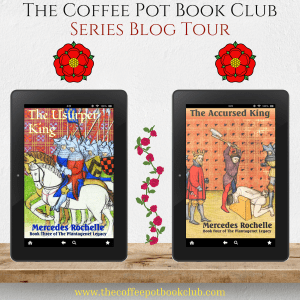
I am pleased to welcome Mercedes Rochelle back to my blog to share an article about the Percy family and the Battle of Shrewsbury as part of the blog tour for her novels The Usurper King and The Accursed King. I want to thank Mercedes Rochelle and The Coffee Pot Book Club for allowing me to be part of this blog tour.

The Percies were such a powerful force in the North they practically acted like rulers in their own kingdom. For much of Richard II’s reign and the beginning of Henry IV’s, Earl Henry Percy and his son, Sir Henry (nicknamed Hotspur) alternated between the wardenships of the East Marches and the West Marches toward Scotland. They were experienced in dealing with the tempestuous Scots, and their retainers were fiercely loyal. When Henry IV returned from exile and began his campaign that led to the throne, the Percies were his staunchest supporters; they provided a large portion of his army. Henry Percy was directly responsible for persuading King Richard to turn himself over to Henry Bolingbroke—the beginning of the end of Richard’s fall. 
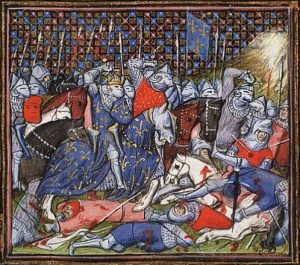
Caption: Froissart Chronicles by Virgil Master, Source: Wikimedia 

Naturally, this was not done out of sheer kindness. Henry Percy expected to be amply rewarded for his services, and at the beginning he was. But the king was uncomfortable about the potential threat of this overweening earl. He soon began to promote his brother-in-law, Ralph Neville the Earl of Westmorland as a counterbalance, chipping away at Percy’s holdings and jurisdictions. Additionally, the Percies felt that they were not being reimbursed properly for their expenses; by 1403 they claimed that the king owed them £20,000—over £12,000,000 in today’s money. But even with all this going on, it’s likely that the earl may have contained his discontent, except for the belligerence of his impetuous son.  

One possible catalyst was Hotspur’s refusal to turn over his hostages taken at the Battle of Homildon Hill. This battle was a huge win for the Percies in 1402, where so many leaders were taken—including the Earl of Douglas—that it left a political vacuum in Scotland for many years to come. Once he learned of this windfall, King Henry insisted that the Percies turn over their hostages to the crown. It was his right as king—even if it was against the code of chivalry— though his highhanded demand was probably not the wisest choice, considering the circumstances. There were many possible reasons he did so. He was desperately short of funds—as usual. It’s possible he may have wanted to retain the prisoners as a means of ensuring Scottish submission. Earl Henry agreed to turn over his hostages, but Hotspur absolutely refused to surrender Archibald Douglas, letting his father take the king’s abuse. One can only imagine that all was not well in the Percy household, either. 

There was more at stake. The king had just returned from a humiliating fiasco in Wales, where he had campaigned in response to the English defeat at Pilleth, where Edmund Mortimer was captured by the Welsh. Mortimer was the uncle of the eleven-year-old Earl of March, considered by many the heir-presumptive to the throne (and in Henry’s custody). Edmund was also the brother of Hotspur’s wife. By the time Henry demanded the Scottish hostages, it was commonly believed that the king had no intention of ransoming Mortimer; after all, he was safely out of the way and couldn’t champion his nephew’s cause. This rankled with Hotspur, and it is possible that he thought to use Douglas’s ransom money to pay for Mortimer’s release himself. 

Hotspur finally rode to London in response to the king’s demands, but he went without Douglas. Needless to say, this immediately provoked an argument. When Hotspur insisted that he should be able to ransom his brother-in-law, Henry refused, saying he did not want money going out of the country to help his enemies. Hotspur rebutted with, “Shall a man expose himself to danger for your sake and you refuse to help him in his captivity?” Henry replied that Mortimer was a traitor and willingly yielded himself to the Welsh. “And you are a traitor!” the king retorted, apparently in reference to an earlier occasion when Hotspur chose to negotiate with Owain Glyndwr rather than arrest him. Allegedly the king struck Percy on the cheek and drew his dagger. Of course, attacking the king was treason and Hotspur withdrew, shouting “Not here, but in the field!” All of this may be apocryphal, but it is certainly powerful stuff. 

The whole question of Mortimer’s ransom became moot when he decided to marry the daughter of Glyndwr and openly declare his change of loyalties on 13 December 1402. No one knows whether Hotspur’s tempestuous interview with King Henry happened before or after this event; regardless, a bare minimum of eight months passed before Shrewsbury. Were they planning a revolt all this time? It is likely that early in 1403 one or both of the Percies were in communication with the Welsh. Owain Glyndwr was approaching the apex of his power, and a possible alliance between him, Mortimer, and the Percies could well have been brewing. It would come to fruition later on as the infamous Tripartite Indenture (splitting England’s rule between them), but by then Hotspur was long dead. 

Caption: BnF MS Franc 81 fol. 283R Henry IV and Thomas Percy at Shrewsbury from Jean de Wavrin- Creative commons license 

No one has been able to satisfactorily explain just why the Percies revolted against Henry IV. Most of the evidence points to their self-aggrandizement. And looking at the three years following his coronation, it became evident that King Henry was not willing to serve as their puppet, nor was he willing to enhance their power at the expense of the crown. The Percies’ ambitions were thwarted by the king’s perceived ingratitude, and the consensus of modern historians is that they hoped to replace him with someone more easily manipulated. 

There was one more Percy involved in all this: Thomas, younger brother of Earl Henry and uncle to Hotspur. He was probably the most able—if the least flamboyant—member of the Percy clan in this period. From soldier to commander, Admiral of England to Ambassador, Captain of Calais, Justiciary of South Wales, he made it all the way to Steward of the Royal Household. And that wasn’t all. He was also Earl of Worcester, which almost made him an equal to his brother, the great Earl of Northumberland.  

His involvement in the Shrewsbury uprising was puzzling. He had much to lose and nothing to gain. Shakespeare notwithstanding, I don’t really think Thomas was the motivating force behind the rebellion that led to the Battle of Shrewsbury. It’s true that his fortunes were waning; the king had recently replaced him as Lieutenant of Wales with the sixteen-year-old Prince Henry. Whether the Percies won or lost the battle, there’s a better-than-even chance that he would rise and fall along with them, whether he participated in the rebellion or not. Was that enough to push him over the edge? I suspect that his affection for Hotspur had a lot to do with it, and in the end, it’s likely he couldn’t conceive of fighting against his own kin. Poor Thomas lost his head the day after the battle, paying a high price for his loyalty. 

THE USURPER KING by Mercedes Rochelle 

Book 4 of The Plantagenet Legacy 

Blurb: 

From Outlaw to Usurper, Henry Bolingbroke fought one rebellion after another. First, he led his own uprising. Then he captured a forsaken king. Henry had no intention of taking the crown for himself; it was given to him by popular acclaim. Alas, it didn’t take long to realize that having the kingship was much less rewarding than striving for it. Only three months after his coronation, Henry IV had to face a rebellion led by Richard’s disgruntled favorites. Repressive measures led to more discontent. His own supporters turned against him, demanding more than he could give. The haughty Percies precipitated the Battle of Shrewsbury which nearly cost him the throne—and his life. 

To make matters worse, even after Richard II’s funeral, the deposed monarch was rumored to be in Scotland, planning his return. The king just wouldn’t stay down and malcontents wanted him back. 
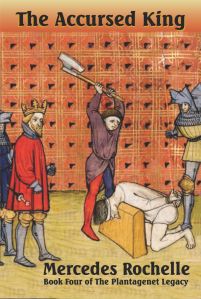
THE ACCURSED KING by Mercedes Rochelle 

Blurb: 

What happens when a king loses his prowess? 

The day Henry IV could finally declare he had vanquished his enemies, he threw it all away with an infamous deed. No English king had executed an archbishop before. And divine judgment was quick to follow. Many thought he was struck with leprosy—God’s greatest punishment for sinners. From that point on, Henry’s health was cursed and he fought doggedly on as his body continued to betray him—reducing this once great warrior to an invalid. 

Fortunately for England, his heir was ready and eager to take over. But Henry wasn’t willing to relinquish what he had worked so hard to preserve. No one was going to take away his royal prerogative—not even Prince Hal. But Henry didn’t count on Hal’s dauntless nature, which threatened to tear the royal family apart.

Buy Links: 

Universal Buy Links: 

The Usurper King: https://books2read.com/u/3nkRJ9  

The Accursed King: https://books2read.com/u/b5KpnG  

The Plantagenet Legacy Series Links: 

Amazon US Series Link 

Amazon UK Series Link 

All titles in the series are available to read on #KindleUnlimited. 
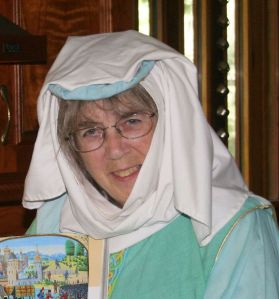
Author Bio

Mercedes Rochelle is an ardent lover of medieval history and has channeled this interest into fiction writing. She believes that good Historical Fiction, or Faction as it’s coming to be known, is an excellent way to introduce the subject to curious readers. 

Her first four books cover eleventh-century Britain and events surrounding the Norman Conquest of England. Her new project is called “The Plantagenet Legacy” taking us through the reigns of the last true Plantagenet King, Richard II, and his successors, Henry IV, Henry V, and Henry VI. She also writes a blog: HistoricalBritainBlog.com to explore the history behind the story.  

Born in St. Louis, MO, she received by BA in Literature at the University of Missouri St.Louis in 1979 then moved to New York in 1982 while in her mid-20s to “see the world”. The search hasn’t ended! 

Today she lives in Sergeantsville, NJ with her husband in a log home they had built themselves. 

Author Links

Website: https://mercedesrochelle.com/   

Twitter: https://x.com/authorrochelle  

Facebook: https://www.facebook.com/mercedesrochelle.net  

Book Bub:  https://www.bookbub.com/authors/mercedes-rochelle  

Amazon Author Page:  https://www.amazon.com/stores/Mercedes-Rochelle/author/B001KMG5P6  

Goodreads: https://www.goodreads.com/author/show/1696491.Mercedes_Rochelle

Book Review: “Oathbreakers: The Wars of Brothers that Shattered an Empire and Made Medieval Europe” by Matthew Gabriele and David M. Perry

The life of an empire is very cyclical: the birth of a people group united under one ruler, the empire’s expansion through conquest, and ultimately its demise. When we think of empires, we often think about the Roman and British empires, but another significant one in medieval Europe is the Carolingian Empire. It was an empire that hit its zenith with the reign of Charlemagne in the 9th century, but within two generations, it fell due to forces inside its court. What happened to this once glorious empire that fell after the Carolingian Civil War? Matthew Gabrielle and David M. Perry tell how a once glorious empire fell quickly after its height in their latest book, “Oathbreakers: The Wars of Brothers that Shattered an Empire and Made Medieval Europe.”

I want to thank David M. Perry and Harper for sending me a copy of this book. I don’t know much about the Carolingian Empire other than Charlemagne and his coronation on Christmas day in the year 800, so when I saw the premise of this book, it was intriguing to me.

Before we have the fall of an empire, we must understand the rise of the empire and how the empire worked. Gabriele and Perry begin their book by explaining the origins of the empire starting with the Franks and how they gained power. It starts with a legendary hero named Merovech, the Merovingians, and his grandson King Clovis I who converted to Christianity around the year 500. The Merovingians did not last long because Charles Martel would begin the reign of the Carolingians with a battle, which is almost a bit of foreshadowing of how the Carolingians fell. After Charles Martel came Pepin III and after the death of Pepin III, the kingdom was split between two co-emperors, Carolman and Charlemagne; ultimately Carolman died leaving Charlemagne to be the sole Roman emperor and was crowned on Christmas Day in the year 800.

Charlemagne’s reign was by no means perfect as his son Pepin I the Hunchback, staged a failed rebellion. Like Pepin III before him, Charlemagne decided to divide the empire between his three legitimate sons because sharing is caring. His son Louis the Pious would succeed his father and this is where the troubles ramped up to a civil war between Louis’s sons, Lothar I, Louis the German, and Charles the Bald. It was a time full of chaos, revolts, the Battle of Fontenoy, and oaths that could not save an empire.

As someone relatively new to this subject material, I thought it was a decent read. It took me a while to figure out which Pepin was which (because, shockingly, there are multiple Pepins as well as Louises and Charles all in one family, not confusing at all). I think it was interesting to read about a dynasty that I have heard mentioned in passing in other historical books about great kings, but I never personally dived into until now. In short, the Carolingians were a messy empire and I think they should get more attention. If you want a solid nonfiction book that tells the tale of one of the major empires of Europe, I suggest you read, “Oathbreakers: The Wars of Brothers that Shattered an Empire and Made Medieval Europe” by Matthew Gabriele and David M. Perry.

Book Review: “Embers of the Hands: Hidden Histories of the Viking Age” by Eleanor Barraclough

When we think of the term “Viking”, we often get images of battle-harden warriors, covered in guts and dirt, with horned helmets. We also believe that Vikings are warriors primarily from the Scandinavian world and that the Viking age ended in 1066 with the Norman Invasion of England. Our assumptions, thanks to television and a certain operatic cycle, are wrong. The Viking Age is a complex period of the past that spans centuries over half the known world. Using archeological evidence and written records, Eleanor Barraclough tells the tale of the Viking Age in her book, “Embers of the Hands: Hidden Histories of the Viking Age.”

I want to thank W.W. Norton & Company and Net Galley for sending me a copy of this book. I enjoy reading books about archeological discoveries, so when I heard about a book about the Viking Age and archeology, I jumped at the chance to read it. I have read a few historical fiction novels about the Viking Age and a few about the Anglo-Saxons, so I was curious what new information Barraclough would present in her book.

The short answer to that question is that Barraclough provided a plethora of information about the Viking Age. As she explains in her prologue, we try to compartmentalize history, but history flows like a river. Just because we label a period like the Viking Age does not mean that it ends at a certain date. We have artifacts from other parts of the world, including Russia and the Middle East, that would be dated to the 1500s. So what can the artifacts from the past tell us about this diverse age?

To tell the story of this age, Barraclough breaks her book into sections that focus on different elements such as beginnings, love, travel, slavery (known in this book as unfreedom), and endings. Each section focuses on not only the artifacts, like a comb, a chess piece, or a runestone with a love story, but also what these pieces can tell us about the average citizens who lived during this period. We can learn about their grooming habits, how they lived, how they traveled, their ever-changing beliefs from Norse mythology to Christianity, and how they approached issues like slavery and childbirth. Barraclough also takes the time to show what the chronicles and sources tell us about this period while showing how to understand what the runes on artifacts can tell us. I think my one concern about this book is that because it was not in chronological order, it was a bit hard to follow and there were points where it was a bit dry for my taste.

Overall, I found this book fascinating and a difficult read. It took me a long time to understand how complex the Viking Age was as I am not as familiar with the language and historical accounts. I think Barraclough does a decent job of presenting the information to not only those who are familiar with the era but to complete novices. If you want to understand the Viking Age through archeological research, I suggest you read, “Embers of the Hands: Hidden Histories of the Viking Age” by Eleanor Barraclough.

Book Review: “When Christ and His Saints Slept” by Sharon Kay Penman

When we consider the issue of succession, we often imagine the crown being passed to the next legitimate heir, regardless of gender, but that was not always the case. We think about the struggles that women like Mary I and Elizabeth I endured to secure and stay on the throne, but one woman came before them so close to becoming England’s first ruling queen. She was the daughter of King Henry I and the next in line to the throne after her brother tragically died, but after her father passed away, it was her cousin Stephen who usurped the throne. The war for the crown which would last decades would be known as The Anarchy is the primary focus for Sharon Kay Penman’s novel, “When Christ and His Saints Slept.”

I found this particular novel when I was going used book shopping and after so many people said that it was their favorite novel by Penman after “The Sunne in Splendour,” I knew that I wanted to buy and read it. I have been a fan of books about the struggle between Empress Matilda and King Stephen and the birth of the Plantagenet dynasty, so I wanted to see what kind of spin Penman would give to this story.

Penman begins her novel with a flashback to the last time Stephen saw his father before he went on Crusade in 1101, which was an influential moment in his young life. We then jump forward to Barfleur, Normandy in November 1120, which is where the legitimate male heir of Henry I, William, boarded the White Ship on a voyage he would not survive. The only legitimate child of Henry I, because the man had quite a few illegitimate children, was Empress Matilda (Maude). Her 1st husband, the Holy Roman Emperor died and since they did not have any children, Henry decides that she needs to remarry and his choice for her next husband is Geoffrey of Anjou. To say their relationship was tempestuous would be an understatement, but they were able to have a large family including Henry Plantagenet, the future King Henry II.

It seemed like all Matilda (known as Maude in this novel) had to do in order to secure the crown was sail to England for her coronation. But that’s not what happened. Instead, her dear cousin Stephen and his wife Matilda, stole her crown. If you think Maude is going to let Stephen do what he wants with her inheritance left to her by her father, you thought wrong because instead Maude decides to fight for her rights in the conflict known as the Anarchy. It was a bloody couple of decades for England full of betrayals and sieges. It will soon turn to not only a fight between Maude and Stephen but between their sons Henry and Eustace. This was not just a battle between nobility but, as we see with one of my favorite characters Ranulf Fitz Roy (a fictional character), it was a battle between barons and the illegitimate children of the old king for the future of England.

This was another absolutely brilliant book by Penman. The way she was able to craft such believable characters based on the historical records is nothing but awe-inspiring. It was a mammoth tome but it needed every single page to develop this rich story that I did not want to end. If you are like me and you crave a thrillingly vivid historical fiction novel, you must check out “When Christ and His Saints Slept” by Sharon Kay Penman.

Book Review: “Henry V: The Astonishing Triumph of England’s Greatest Warrior King” by Dan Jones

English history is filled with kings who had to fight for their crown, both at home and away in foreign lands. Men like William the Conqueror, Henry II, Henry IV, Edward IV, and Henry VII can be considered warrior kings, but one stands above them all. He only ruled for a little over nine years, but he proved his worth time and time again, especially against his French adversaries, and secured the crown of France for his young son. He was the son of Henry Bolingbroke, King Henry IV, and the grandson of John of Gaunt. He was Henry V and his story is one of the most remarkable tales in English medieval history, told masterfully in Dan Jones’ latest book, “Henry V: The Astonishing Triumph of England’s Greatest Warrior King.”

I have been a fan of Dan Jones and his books for a few years now and always jump at the chance to read his latest book. When I heard that he was writing a biography about Henry V, it was an instant pre-order for me because it is Dan Jones’ first biography and I did not know much about Henry V minus the main points about his life and reign.

It was a miracle that Henry V became King of England. Henry was the son of Henry Bolingbroke and Mary de Bohun, the grandson of John of Gaunt, and cousin to King Richard II. He was the son of an Appellant lord who was banished from England for opposing Richard II, so the likelihood that he would even be the next Duke of Lancaster was significantly small. Jones shows his audience what Henry’s childhood was like before his father was banished and after he returned and took the throne from Richard II. It was a dramatic change for the young man as it meant that he had to adapt to life as the Prince of Wales, which meant that he had to fight for English control of Wales and against those who also claimed his title, primarily Owain Glyndwr and the Percy family (including Henry Hotspur Percy). The fight for Wales culminated in the Battle of Shrewsbury where Henry Percy died and the army of Henry IV was victorious. Henry V was shot in the face with an arrow and almost died, but Doctor John Bradmore saved his life.

After the arrow incident, we see a different side of the young Prince as he is more mindful of religious matters. When his father Henry IV falls ill, we also see Prince Henry take more of a leading role in politics as part of a council meant to help the king rule England. When Henry IV died on March 20, 1413, the young King Henry V was ready to rule. He believes that to be a strong ruler, he must show it by facing the English’s mortal enemies, primarily France, in battle. He led England to great victories against the French, including the Battle of Agincourt, which was marked as one of the greatest victories for the English during the Wars of the Roses. Henry V was a competent ruler who made England a powerhouse in European history. He was able to secure the French throne for his young son Henry VI, the only child of Henry V and his wife Catherine of Valois before the great warrior king died on August 30, 1422.

I was thoroughly impressed with this biography and I am surprised that it took Dan Jones this long to write a biography. You can tell his passion for the life of Henry V through every page. I hope Jones will write another biography soon. If you are a Dan Jones fan, a medievalist, or just a fan of fantastic biographies, I highly suggest you read, “Henry V: The Astonishing Triumph of England’s Greatest Warrior King” by Dan Jones.

Book Review: “Queen Macbeth” by Val McDermid

When we think of the name Macbeth, we often imagine the play by William Shakespeare of a power-hungry man and his equally vicious wife willing to do whatever it took to become King and Queen of Scotland. It is a play about revenge and murder, but Shakespeare did not pull these characters out of thin air. He took these characters from the annals of history, such as a man named Macbeth and his wife, a Lady Macbeth named Gruoch. However, the names are about as much as Shakespeare gets right regarding the story of one of the first Kings of Scotland. Val McDermid tells her version of Macbeth and Gruoch’s story in her latest novel, “Queen Macbeth.”

I want to thank Atlantic Monthly Press and Net Galley for sending me a copy of this novel. It has been a minute since I read the Shakespearean play of Macbeth, but I did know that it was a story based on history. When I saw that this was specifically about Macbeth’s wife, it was intriguing to me and I knew I wanted to give it a try.

We begin with a sense of panic and dread. Reports have reached Gruoch that her husband Macbeth was slain at the Battle of Lumphanan and now Gruoch is on the run from his enemy Malcolm. Their son, Lulach, is on his way to be crowned King of Scotland while Gruoch, her ladies (Ligach, Aife, and Eithne), and Macbeth’s man Angus wait for the opportune moment to escape the monastery they are staying in before Malcolm catches up to them.

Sprinkled in between events in the modern day, McDermid included flashbacks to how Macbeth and Gruoch met and fell in love. At the time of their first meeting, Gruoch was the wife of Gille Coemgain, the Mormaer of Moray. Macbeth believes that Gille was responsible for the death of his father, Findlaich, and Gruoch fears that Macbeth is only visiting Gille to seek his revenge. However, this unexpected encounter between Macbeth and Gruoch turns into love and they have a child while Gruoch is still married to Gille. A rather awkward situation, but eventually, Macbeth and Gruoch are united to become King and Queen of Scotland.

As someone who is not familiar with the historical story of Macbeth and Gruoch, I found this novella engrossing and thrilling. This version of Macbeth and his Lady Macbeth was much more believable with danger around every corner and I did not know where the story was heading. It did not feel like a novella and I did not want it to end. If you are a Shakespeare fan or someone who loves a good medieval tale, I highly recommend you read, “Queen Macbeth” by Val McDermid.