Guest Post: “The Percies and the Battle of Shrewsbury” by Mercedes Rochelle

I am pleased to welcome Mercedes Rochelle back to my blog to share an article about the Percy family and the Battle of Shrewsbury as part of the blog tour for her novels The Usurper King and The Accursed King. I want to thank Mercedes Rochelle and The Coffee Pot Book Club for allowing me to be part of this blog tour.

The Percies were such a powerful force in the North they practically acted like rulers in their own kingdom. For much of Richard II’s reign and the beginning of Henry IV’s, Earl Henry Percy and his son, Sir Henry (nicknamed Hotspur) alternated between the wardenships of the East Marches and the West Marches toward Scotland. They were experienced in dealing with the tempestuous Scots, and their retainers were fiercely loyal. When Henry IV returned from exile and began his campaign that led to the throne, the Percies were his staunchest supporters; they provided a large portion of his army. Henry Percy was directly responsible for persuading King Richard to turn himself over to Henry Bolingbroke—the beginning of the end of Richard’s fall. 
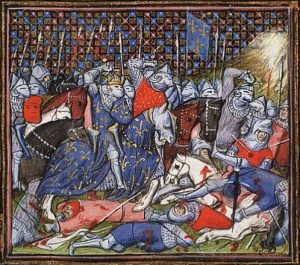
Caption: Froissart Chronicles by Virgil Master, Source: Wikimedia 

Naturally, this was not done out of sheer kindness. Henry Percy expected to be amply rewarded for his services, and at the beginning he was. But the king was uncomfortable about the potential threat of this overweening earl. He soon began to promote his brother-in-law, Ralph Neville the Earl of Westmorland as a counterbalance, chipping away at Percy’s holdings and jurisdictions. Additionally, the Percies felt that they were not being reimbursed properly for their expenses; by 1403 they claimed that the king owed them £20,000—over £12,000,000 in today’s money. But even with all this going on, it’s likely that the earl may have contained his discontent, except for the belligerence of his impetuous son.  

One possible catalyst was Hotspur’s refusal to turn over his hostages taken at the Battle of Homildon Hill. This battle was a huge win for the Percies in 1402, where so many leaders were taken—including the Earl of Douglas—that it left a political vacuum in Scotland for many years to come. Once he learned of this windfall, King Henry insisted that the Percies turn over their hostages to the crown. It was his right as king—even if it was against the code of chivalry— though his highhanded demand was probably not the wisest choice, considering the circumstances. There were many possible reasons he did so. He was desperately short of funds—as usual. It’s possible he may have wanted to retain the prisoners as a means of ensuring Scottish submission. Earl Henry agreed to turn over his hostages, but Hotspur absolutely refused to surrender Archibald Douglas, letting his father take the king’s abuse. One can only imagine that all was not well in the Percy household, either. 

There was more at stake. The king had just returned from a humiliating fiasco in Wales, where he had campaigned in response to the English defeat at Pilleth, where Edmund Mortimer was captured by the Welsh. Mortimer was the uncle of the eleven-year-old Earl of March, considered by many the heir-presumptive to the throne (and in Henry’s custody). Edmund was also the brother of Hotspur’s wife. By the time Henry demanded the Scottish hostages, it was commonly believed that the king had no intention of ransoming Mortimer; after all, he was safely out of the way and couldn’t champion his nephew’s cause. This rankled with Hotspur, and it is possible that he thought to use Douglas’s ransom money to pay for Mortimer’s release himself. 

Hotspur finally rode to London in response to the king’s demands, but he went without Douglas. Needless to say, this immediately provoked an argument. When Hotspur insisted that he should be able to ransom his brother-in-law, Henry refused, saying he did not want money going out of the country to help his enemies. Hotspur rebutted with, “Shall a man expose himself to danger for your sake and you refuse to help him in his captivity?” Henry replied that Mortimer was a traitor and willingly yielded himself to the Welsh. “And you are a traitor!” the king retorted, apparently in reference to an earlier occasion when Hotspur chose to negotiate with Owain Glyndwr rather than arrest him. Allegedly the king struck Percy on the cheek and drew his dagger. Of course, attacking the king was treason and Hotspur withdrew, shouting “Not here, but in the field!” All of this may be apocryphal, but it is certainly powerful stuff. 

The whole question of Mortimer’s ransom became moot when he decided to marry the daughter of Glyndwr and openly declare his change of loyalties on 13 December 1402. No one knows whether Hotspur’s tempestuous interview with King Henry happened before or after this event; regardless, a bare minimum of eight months passed before Shrewsbury. Were they planning a revolt all this time? It is likely that early in 1403 one or both of the Percies were in communication with the Welsh. Owain Glyndwr was approaching the apex of his power, and a possible alliance between him, Mortimer, and the Percies could well have been brewing. It would come to fruition later on as the infamous Tripartite Indenture (splitting England’s rule between them), but by then Hotspur was long dead. 

Caption: BnF MS Franc 81 fol. 283R Henry IV and Thomas Percy at Shrewsbury from Jean de Wavrin- Creative commons license 

No one has been able to satisfactorily explain just why the Percies revolted against Henry IV. Most of the evidence points to their self-aggrandizement. And looking at the three years following his coronation, it became evident that King Henry was not willing to serve as their puppet, nor was he willing to enhance their power at the expense of the crown. The Percies’ ambitions were thwarted by the king’s perceived ingratitude, and the consensus of modern historians is that they hoped to replace him with someone more easily manipulated. 

There was one more Percy involved in all this: Thomas, younger brother of Earl Henry and uncle to Hotspur. He was probably the most able—if the least flamboyant—member of the Percy clan in this period. From soldier to commander, Admiral of England to Ambassador, Captain of Calais, Justiciary of South Wales, he made it all the way to Steward of the Royal Household. And that wasn’t all. He was also Earl of Worcester, which almost made him an equal to his brother, the great Earl of Northumberland.  

His involvement in the Shrewsbury uprising was puzzling. He had much to lose and nothing to gain. Shakespeare notwithstanding, I don’t really think Thomas was the motivating force behind the rebellion that led to the Battle of Shrewsbury. It’s true that his fortunes were waning; the king had recently replaced him as Lieutenant of Wales with the sixteen-year-old Prince Henry. Whether the Percies won or lost the battle, there’s a better-than-even chance that he would rise and fall along with them, whether he participated in the rebellion or not. Was that enough to push him over the edge? I suspect that his affection for Hotspur had a lot to do with it, and in the end, it’s likely he couldn’t conceive of fighting against his own kin. Poor Thomas lost his head the day after the battle, paying a high price for his loyalty. 

THE USURPER KING by Mercedes Rochelle 

Book 4 of The Plantagenet Legacy 

Blurb: 

From Outlaw to Usurper, Henry Bolingbroke fought one rebellion after another. First, he led his own uprising. Then he captured a forsaken king. Henry had no intention of taking the crown for himself; it was given to him by popular acclaim. Alas, it didn’t take long to realize that having the kingship was much less rewarding than striving for it. Only three months after his coronation, Henry IV had to face a rebellion led by Richard’s disgruntled favorites. Repressive measures led to more discontent. His own supporters turned against him, demanding more than he could give. The haughty Percies precipitated the Battle of Shrewsbury which nearly cost him the throne—and his life. 

To make matters worse, even after Richard II’s funeral, the deposed monarch was rumored to be in Scotland, planning his return. The king just wouldn’t stay down and malcontents wanted him back. 
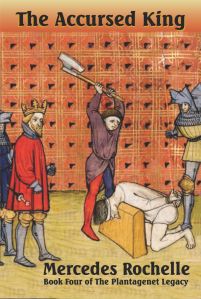
THE ACCURSED KING by Mercedes Rochelle 

Blurb: 

What happens when a king loses his prowess? 

The day Henry IV could finally declare he had vanquished his enemies, he threw it all away with an infamous deed. No English king had executed an archbishop before. And divine judgment was quick to follow. Many thought he was struck with leprosy—God’s greatest punishment for sinners. From that point on, Henry’s health was cursed and he fought doggedly on as his body continued to betray him—reducing this once great warrior to an invalid. 

Fortunately for England, his heir was ready and eager to take over. But Henry wasn’t willing to relinquish what he had worked so hard to preserve. No one was going to take away his royal prerogative—not even Prince Hal. But Henry didn’t count on Hal’s dauntless nature, which threatened to tear the royal family apart.

Buy Links: 

Universal Buy Links: 

The Usurper King: https://books2read.com/u/3nkRJ9  

The Accursed King: https://books2read.com/u/b5KpnG  

The Plantagenet Legacy Series Links: 

Amazon US Series Link 

Amazon UK Series Link 

All titles in the series are available to read on #KindleUnlimited. 
Author Bio

Mercedes Rochelle is an ardent lover of medieval history and has channeled this interest into fiction writing. She believes that good Historical Fiction, or Faction as it’s coming to be known, is an excellent way to introduce the subject to curious readers. 

Her first four books cover eleventh-century Britain and events surrounding the Norman Conquest of England. Her new project is called “The Plantagenet Legacy” taking us through the reigns of the last true Plantagenet King, Richard II, and his successors, Henry IV, Henry V, and Henry VI. She also writes a blog: HistoricalBritainBlog.com to explore the history behind the story.  

Born in St. Louis, MO, she received by BA in Literature at the University of Missouri St.Louis in 1979 then moved to New York in 1982 while in her mid-20s to “see the world”. The search hasn’t ended! 

Today she lives in Sergeantsville, NJ with her husband in a log home they had built themselves. 

Author Links

Website: https://mercedesrochelle.com/   

Twitter: https://x.com/authorrochelle  

Facebook: https://www.facebook.com/mercedesrochelle.net  

Book Bub:  https://www.bookbub.com/authors/mercedes-rochelle  

Amazon Author Page:  https://www.amazon.com/stores/Mercedes-Rochelle/author/B001KMG5P6  

Goodreads: https://www.goodreads.com/author/show/1696491.Mercedes_Rochelle

Guest Post: “Excerpt from ‘The Agincourt King’ by Mercedes Rochelle”

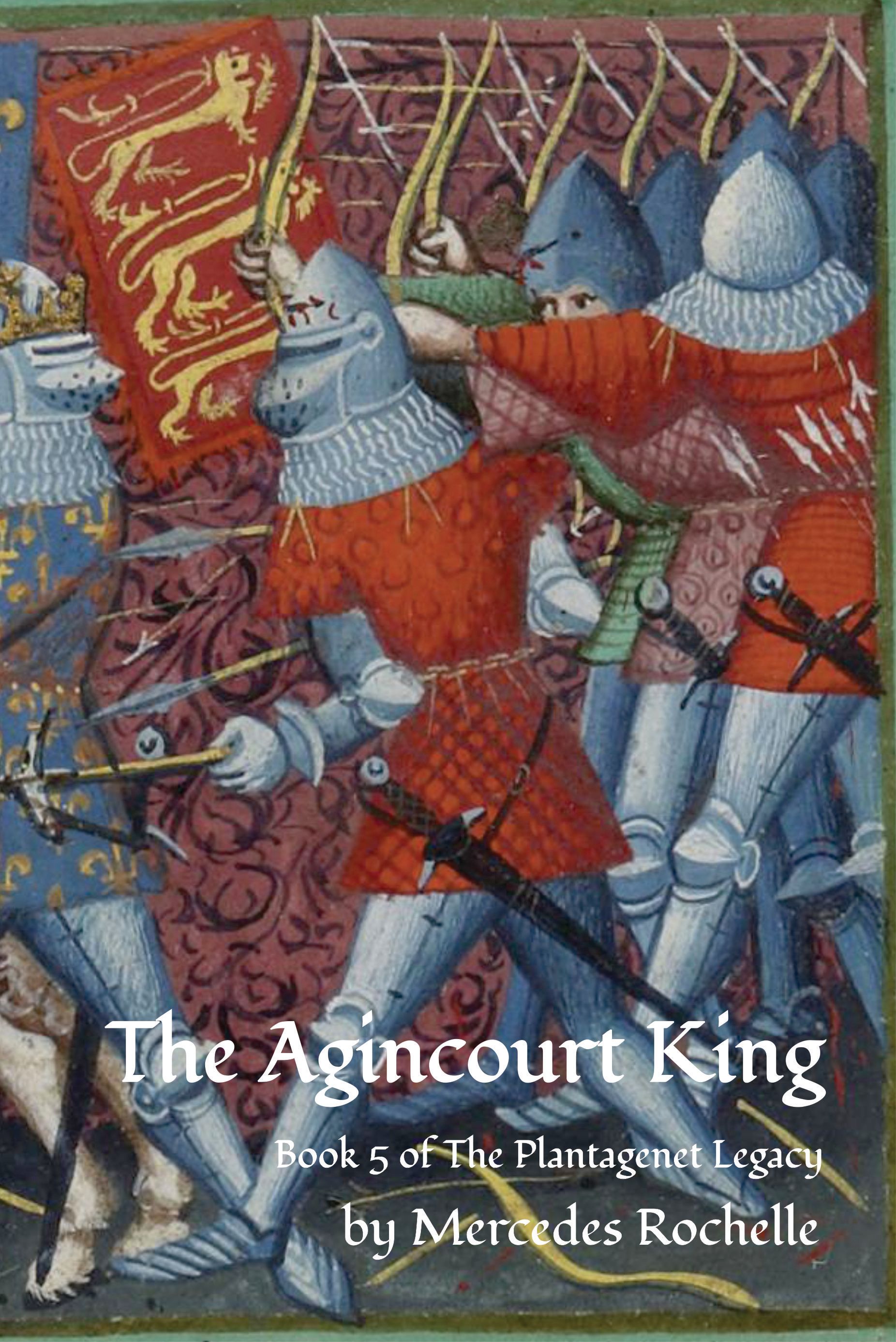
PWIzRwyKI am pleased to welcome Mercedes Rochelle back to my blog to share an excerpt from her novel, “The Agincourt King.” I would like to thank Mercedes Rochelle and The Coffee Pot Book Club for allowing me to be part of this blog tour.
THE CABOCHIEN REVOLT IN PARIS 

There was no doubt that France was in turmoil. King Henry IV of England wasn’t even cold in his grave at Canterbury Cathedral when a fierce rebellion broke out in Paris. As usual, King Charles VI had sunk into insensibility and the city simmered uneasily, agitated by John the Fearless, the Duke of Burgundy. Private and public accusations were aimed against the king’s ministers, and the most threatened among them started to leave town for the safety of the provinces. But another consideration had arisen to complicate matters. Louis the Dauphin had reached his sixteenth year and was poised to take on the regency while his father was incapacitated. Already he was chafing under Burgundy’s authority… 

Although today Burgundy was in charge, he was concerned about Louis the Dauphin. To control the heir to the throne, he had arranged a marriage between Louis and his daughter Margaret. Unfortunately, the union was not working out. The lad showed a disturbing independence and tended to reject his wife whenever possible. It was time to teach him a good lesson.  

It didn’t take long to devise a plan. Duke John secretly conversed with Governor Jacqueville (who happened to be the chamberlain) and others of his household. As he conveniently withdrew, the citizens worked themselves into another frenzy under the urging of their governor. Jacqueville mounted a platform and held up his hands for attention. 

“I have a list of traitors the Dauphin harbours under his protection,” he shouted. “They seek to strip you of your rights and privileges. We must take them prisoner! See here, the Duke of Bar is your enemy, and the Dauphin’s chancellor Jehan de Vailly. We must arrest the queen’s brother Duke Louis of Bavaria, members of her household, and her ladies in waiting. I have the list here!”  

Jacqueville waved a paper over his head. He was about to say more when a burly citizen mounted the platform. The crowd cheered and he recognized this man, a well-known mischief-maker who was popular with the people. He was dressed as a common workman, with a swarthy face and hair that stuck up like a brush. He strutted across the platform like he owned the place. 

“I am Simon Caboche, to those who do not know me,” the newcomer called out to much laughter. “I am a skinner of the ParisBoucherie and leader of our butcher’s guild. Follow me to the Hôtel de Guyenne, where we will have a parley with the Dauphin.” He pulled out a white hood—chaperon—from under his belt. “All those who are with me, here is our badge!” And to the governor’s amazement, most of the Parisians had a white hood, too. Who was playing into whose hand?   

Giving Jacqueville a meaningful look, Caboche took charge and led a shouting mob to the Dauphin’s hôtel. By the time they reached the Rue St. Antoine, they were six thousand strong and growing. The men guarding the door didn’t even try to interfere. While the Parisians surrounded the hôtel, the leaders pushed their way inside.  

“Where is he?” bellowed Caboche at the first servant he saw. The man backed against the wall. “Where is the Dauphin?” 

The poor servant blubbered in terror, and Caboche growled at him before continuing down the hall. Two old women carrying linens were just coming out a door when the butcher pointed at them. “Take us to the Dauphin!” he demanded. Looking at each other, the servants froze. 

“Come, friends,” he said more gently. “We won’t hurt you. We need to speak to the Dauphin.” 

One of the women pursed her lips and then gave her bundle to her companion. Jerking her head, she led the intruders to the Dauphin’s private apartment. Nodding his thanks, Caboche shoved open the door with a slam, surprising Louis while he was conversing with the Duke of Bar. 

Louis sprang awkwardly to his feet. “What is the meaning of this?” he cried in an unsteady voice. Unfortunately, the Dauphin did not inspire confidence and he knew it. His short frame was overweight, heavy, and slow. He was already known for keeping late hours and general laziness. Fond of excessive jewellery and rich clothing, he relied on the trappings of royalty to sustain his fragile dignity.  

Caboche stepped forward, flanked by his closest associates. He did not remove his white hood. “Our most redoubted lord,” he said, his voice barely respectful, “I have come with my fellow Parisians, who require, for your welfare and your father’s, that you deliver up certain traitors who are now in your hôtel.”  

Recovering his nerve, the Dauphin was filled with anger. “This is absurd. What you demand is impossible. There are no traitors in this hôtel.”  

“That is not true. I see them right before me.” Caboche nodded toward his victims and some of his men leapt across the room, grabbing the Duke of Bar by the arm; others seized the Dauphin’s chancellor. While Louis turned around in apprehension, his wife screamed. She had thrown her arm around one of his valets, trying to hold him back from two of the butchers who yanked him loose. Another servant was thrown to the floor.  

“Stop this!” cried Louis.  

Caboche gave him a sideways grin. “If you are willing to give them up,” he said, “well and good. Otherwise, we will take them right before your face and punish them as they deserve.” 

“I command you to let them go!” shouted the Dauphin. “My affairs are none of yours.” 

Jacqueville stepped up beside the butcher. “Monseigneur, this is very much our business. You have been badly misled, and your behaviour is that of a spoiled young man. You are sorely in need of correction.” 

“Get out of my sight!” cried the Dauphin. “Guards, help me! Guards!” 

Alerted by the shouting, several of the Dauphin’s men rushed into the room and threw themselves onto the intruders, who enthusiastically fought back. But no sooner had the scuffle begun when the Duke of Burgundy pushed his way into the room, shouting for order. His own men bore halberds and quickly interceded, pushing the antagonists apart. The Cabochiens, as they already called themselves, grouped together, still hanging onto their prisoners.  

Louis whirled around, pointing at his father-in-law. “This is your doing,” he growled. “These are your men. One day you will regret this. I won’t always be under your thumb.” 

LgQJ75mEBlurb:  

From the day he was crowned, Henry V was determined to prove the legitimacy of his house. His father’s usurpation weighed heavily on his mind. Only a grand gesture would capture the respect of his own countrymen and the rest of Europe. He would follow in his great-grandfather Edward III’s footsteps, and recover lost territory in France. 

Better yet, why not go for the crown? Poor, deranged Charles VI couldn’t manage his own barons. The civil war between the Burgundians and Armagnacs was more of a threat to his country than the English, even after Henry laid siege to Harfleur. But once Harfleur had fallen, the French came to their senses and determined to block his path to Calais and destroy him. 

By the time the English reached Agincourt, they were starving, exhausted, and easy pickings. Or so the French thought. Little did they reckon on Henry’s leadership and the stout-hearted English archers who proved, once again, that numbers didn’t matter when God was on their side. 

Buy Links: 

This title is available to read on #KindleUnlimited. 

Universal Buy Link: https://books2read.com/u/mq70Ze  

0S8YcxEYAuthor Bio:  

Mercedes Rochelle is an ardent lover of medieval history and has channeled this interest into fiction writing. Her first four books cover eleventh-century Britain and events surrounding the Norman Conquest of England. The next series is called “The Plantagenet Legacy” and begins with the reign of Richard II.  

She also writes a blog: www.HistoricalBritainBlog.com to explore the history behind the story. Born in St. Louis, MO, she received by BA in Literature at the Univ. of Missouri St.Louis in 1979 then moved to New York in 1982 while in her mid-20s to “see the world”. The search hasn’t ended! 

Today she lives in Sergeantsville, NJ with her husband in a log home they had built themselves. 

Author Links

Website: https://mercedesrochelle.com/  

Blog:  https://historicalbritainblog.com/  

Twitter / X: https://x.com/authorrochelle  

Facebook:  https://www.facebook.com/mercedesrochelle.net  

Book Bub: https://www.bookbub.com/authors/mercedes-rochelle  

Amazon Author Page:  https://www.amazon.com/stores/Mercedes-Rochelle/author/B001KMG5P6  

Goodreads: https://www.goodreads.com/author/show/1696491.Mercedes_Rochelle  

Guest Post: “Viking England during the life of Earl Godwine” by Mercedes Rochelle

The Last Great Earls Tour Banner 1I am pleased to welcome Mercedes Rochelle to my blog today to discuss Viking England during the life of Earl Godwine, as part of the blog tour for her novel, “Godwine Kingmaker” of The Last Great Saxon Earls series. I would like to thank Mercedes Rochelle and The Coffer Pot Book Club, for allowing me to be part of this tour.
During Godwine’s rise to power, England lived under Danish rule from 1016-1042, though for some reason we rarely talk about it. That’s a whole generation! Sweyn Forkbeard conquered England in 1013 and was declared king, sending Aethelred the Unready into exile to Normandy along with his sons Edward and Alfred. But mysteriously, Sweyn died after only five weeks on the throne, and the Danelaw immediately declared his second son Canute king of England. However, the southerners had other ideas and recalled Aethelred, who gladly returned and drove the usurper out. This didn’t last long!

By late 1015, Canute came back with a large mercenary army and Wessex submitted to him, although Aethelred was still alive and sulking in London, leaving his son Edmund Ironside to fight his battles. This, too, didn’t last long; King Aethelred took his last breath on 23 April 1016, and London declared Edmund king. Now England had two kings, and so began a treacherous struggle marked by five major battles, men changing sides, a siege of London—where Canute was said to have dug a trench around the city—and many, many dead warriors.

Although Edmund stoutly aided London in its defense against the Danes, he frequently left the city in order to draw Canute away from his siege. It is said Ironside raised five armies that year–one for each battle. The last and most important, the Battle of Assandun took place on October 18 and ended in disaster for the Saxons because of the treachery of Eadric Streona, who took to flight with his forces and turned the tide against Edmund.

This time Canute was determined to end the conflicts. The Saxons withdrew but the Danes followed them up the Severn River into Gloucestershire, finally stopping at an island called Olney (or Alney). There, in deference to the chieftains of the land who had had enough (led by Eadric Streona, who somehow retained the goodwill of Edmund Ironside), the two Kings decided to solve the issue by single combat. This legend comes down to us through the chroniclers, as unlikely as it sounds.

canute the dane
Combat between Canute the Dane and Edmund Ironside, Matthew Paris, Chronica Maiora, Cambridge, Corpus Christi, 26, f. 160 (Wikipedia)

The Saxon King was said to have been the stronger fighter and soon hammered the Dane, breaking his shield and beating him down when Canute called a stop to the fight. “Bravest of youths,” he cried out, “why should either of us risk his life for the sake of a crown?” Edmund paused, considering. “Let us be brothers by adoption,” the Dane continued, “and divide the kingdom, governing so that I may rule your affairs, and you mine.” (Florence of Worcester). 

The single combat story is probably apocryphal, but the ensuing treaty is not. According to their agreement, Canute was to rule Northumbria and Danish Mercia, while Edmund was the ruler of Wessex, Essex, East Anglia, and English Mercia. It’s unclear who was supposed to rule London (I found it stated both ways), but in the end, the Londoners were obliged to come up with their own tribute payment to Canute and permit him to anchor his ships in the Thames for the winter, so I guess the result speaks for itself.

Most importantly, it was stated that this treaty excluded brothers and children of the two Kings; if either was to die, all the possessions would revert to the other. And so when Edmund Ironside died suddenly in the winter of 1016, Canute took the crown and made sure to bring the witnesses forward to confirm the terms of the treaty. An exhausted England accepted his claim without demurring. Canute sent Edmund’s children, Edward and Edmund Aetheling, to the King of Sweden in the hopes that they would be murdered, but instead, they were whisked away to Hungary for safekeeping. Then, in a gesture calculated to appease his new countrymen, Canute married Aethelred’s widow, Emma, making a deal with her that their children from previous marriages would be passed over in favor of any issue of their own. This agreement disinherited Edward and Alfred (safely in Normandy) and Canute’s son Harold Harefoot by his handfasted wife Aelfgifu of Northampton. Emma gave birth to Harthacnut, who was sent to Denmark when he was only eight years old as Canute’s representative under a council led by his brother-in-law Ulf. We don’t see him in England again until 1040.

Godwine Kingmaker CoverBlurb:

They showed so much promise. What happened to the Godwines? How did they lose their grip? Who was this Godwine anyway, the first Earl of Wessex and known as the Kingmaker? Was he an unscrupulous schemer, using King and Witan to gain power? Or was he the greatest of all Saxon Earls, protector of the English against the hated Normans? The answer depends on who you ask.

He was befriended by the Danes, raised up by Canute the Great, and given an Earldom and a wife from the highest Danish ranks. He sired nine children, among them four Earls, a Queen, and a future King. Along with his power came a struggle to keep his enemies at bay, and Godwine’s best efforts were brought down by the misdeeds of his eldest son Swegn.

Although he became father-in-law to a reluctant Edward the Confessor, his fortunes dwindled as the Normans gained prominence at court. Driven into exile, Godwine regathered his forces and came back even stronger, only to discover that his second son Harold was destined to surpass him in renown and glory.

Buy Links:

This series is available on Kindle Unlimited

Universal Link: https://books2read.com/u/38VrJZ

Amazon UK:  https://www.amazon.co.uk/dp/B0BRQMHYWB

Amazon US: https://www.amazon.com/dp/B0BRQMHYWB

Amazon CA:  https://www.amazon.ca/dp/B0BRQMHYWB

Amazon AU:  https://www.amazon.com.au/dp/B0BRQMHYWB

Audio:  https://www.audible.com/pd/Godwine-Kingmaker-Audiobook/B09JFJCY3G

Mercedes RochelleAuthor Bio

Mercedes Rochelle is an ardent lover of medieval history and has channeled this interest into fiction writing. She believes that good Historical Fiction, or Faction as it’s coming to be known, is an excellent way to introduce the subject to curious readers. She also writes a blog: HistoricalBritainBlog.com to explore the history behind the story.

Born in St. Louis, MO, she received her BA in Literature at the Univ. of Missouri St. Louis in 1979 then moved to New York in 1982 while in her mid-20s to “see the world”. The search hasn’t ended!

Today she lives in Sergeantsville, NJ with her husband in a log home they had built themselves.

Social Media Links:

Website: https://mercedesrochelle.com/

Twitter:   https://twitter.com/authorrochelle

Facebook: https://www.facebook.com/mercedesrochelle.net

Book Bub:   https://www.bookbub.com/authors/mercedes-rochelle

Amazon Author Page:   https://www.amazon.com/stores/Mercedes-Rochelle/author/B001KMG5P6

Goodreads:   https://www.goodreads.com/author/show/1696491.Mercedes_Rochelle

Guest Post: “The Accursed King (The Plantagenet Legacy Book 4 )” Blurb by Mercedes Rochelle

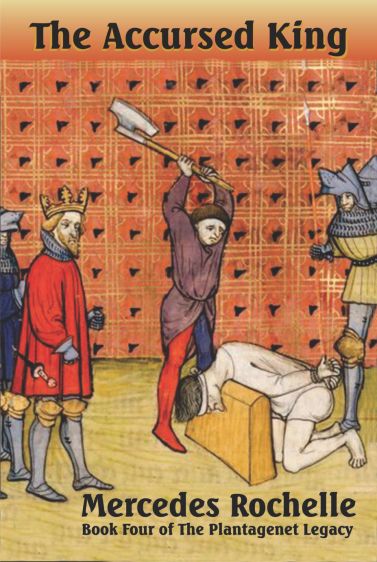
The Accursed King Tour BannerToday, I welcome Mercedes Rochelle to my blog to promote her latest novel, “The Accursed King ( The Plantagenet Legacy Book 4)”. I want to thank Mercedes Rochelle and The Coffee Pot Book Club for allowing me to be part of this tour.
Blurb

What happens when a king loses his prowess? The day Henry IV could finally declare he had vanquished his enemies, he threw it all away with an infamous deed. No English king had executed an archbishop before. And divine judgment was quick to follow. Many thought he was struck with leprosy—God’s greatest punishment for sinners. From that point on, Henry’s health was cursed, and he fought doggedly on as his body continued to betray him—reducing this once great warrior to an invalid. Fortunately for England, his heir was ready and eager to take over. But Henry wasn’t willing to relinquish what he had worked so hard to preserve. No one was going to take away his royal prerogative—not even Prince Hal. But Henry didn’t count on Hal’s dauntless nature, which threatened to tear the royal family apart. 

HenryAccursedCover-MediumBuy Links:

This book is free to read with a #KindleUnlimited subscription.

Series Links:

A King Under Siege (Book 1): https://books2read.com/u/mKdzpV

The King’s Retribution (Book 2): https://books2read.com/u/mBzGwA

The Usurper King (Book 3): https://books2read.com/u/b6RZMW

The Accursed King (Book 4): https://books2read.com/u/3RLxZL

Amazon UK: https://www.amazon.co.uk/Accursed-King-Plantagenet-Legacy-Book-ebook/dp/B09X89CMLC

Amazon US:  https://www.amazon.com/Accursed-King-Plantagenet-Legacy-Book-ebook/dp/B09X89CMLC

Amazon CA:  https://www.amazon.ca/Accursed-King-Plantagenet-Legacy-Book-ebook/dp/B09X89CMLC

Amazon AU: https://www.amazon.com.au/Accursed-King-Plantagenet-Legacy-Book-ebook/dp/B09X89CMLC 

MercedesBookCloseAuthor Bio:

Mercedes Rochelle

Mercedes Rochelle is an ardent lover of medieval history and has channeled this interest into fiction writing. Her first four books cover eleventh-century Britain and events surrounding the Norman Conquest of England. The next series is called The Plantagenet Legacy, about the struggles and abdication of Richard II, leading to the troubled reigns of the Lancastrian Kings. She also writes a blog: HistoricalBritainBlog.com, to explore the history behind the story. Born in St. Louis, MO, she received her  BA in Literature at the Univ. of Missouri St.Louis in 1979, then moved to New York in 1982 while in her mid-20s to see the world.” The search hasnt ended! Today she lives in Sergeantsville, NJ, with her husband in a log home they had built themselves.

Social Media Links:

Website: https://www.MercedesRochelle.com

Twitter: https://www.Twitter.com/authorRochelle

Facebook: https://www.facebook.com/mercedesrochelle.net

BookBub: https://www.bookbub.com/authors/mercedes-rochelle

Amazon Author Page: https://www.amazon.com/Mercedes-Rochelle/e/B001KMG5P6

Goodreads: https://www.goodreads.com/author/show/1696

Guest Post: Excerpt from “The Usurper King: The Plantagenet Legacy Book 3” by Mercedes Rochelle

The Usurper King Tour BannerToday, I am pleased to welcome Mercedes Rochelle to my blog to share an excerpt from her book “The Usurper King: The Plantagenet Legacy Book 3”. This passage is when Prince Hal has to tell Queen Isabella about Richard’s death. I would like to thank Mercedes Rochelle and The Coffee Pot Book Club for inviting me to partake in this blog tour. 

Excerpt

Isabella of Valois was probably the only person in England who did not know about Richard’s funeral. She was fourteen now and kept in close confinement at Havering-atte-Bower, where she was taken after the failed rebellion. Her prison was an old royal palace to the northeast of London, modest but comfortable. She knew Richard’s life was in danger and was worried sick about him. Alas, no matter how much she cried and demanded to visit her husband, she was politely refused. So she was relieved when the Prince of Wales was announced, for of all King Henry’s children he was closest to her in age and they had gotten along well before he went to Ireland. Before her life fell apart.

Hal came in by himself and knelt before her—a gesture sorely lacking these many months. He had grown much taller since she last saw him, and his shoulders had filled out from training. Unsurprisingly, his stiff posture had not relaxed, nor had his eyes softened; they were guarded as usual. 

Blinking back tears, she held out her hands. “You are a welcome sight, my lord. Thank you for visiting me.”

Slowly he stood and together they walked over to a window seat. Tucking a lock of hair behind her ear, she smiled self-consciously. It had been so long since she had a visitor, she was not dressed like a princess. Hal didn’t seem to care. 

“Do you have everything you need?” he said, trying to find a good place to start a conversation.

Isabella nodded. She knew that’s not why he was here. “I had hoped to see my husband,” she said softly. She knew this was none of his doing, but she had to make her feelings known to somebody.

At least Hal had the grace to look embarrassed. “I loved King Richard like a father,” he said earnestly, trying to take her hand. “He was very good to me.”

“Loved?” Her eyes narrowed. “You love him no longer?”

He sighed. There was no easy way to say this. “My lady, there is something I must tell you.”

She pulled her hand away, panic spreading over her face. “What has happened to him?”

As he struggled to find the words, Isabella broke into tears. “He’s dead, isn’t he?” She covered her face with her hands. “My poor Richard. How could you do this to him?”

Stricken, Hal fell to his knees. “I swear to you, I am overcome with anguish. I didn’t even know where he was kept.”

Lowering her hands, she looked at him doubtfully. “Do you expect me to believe that?”

Hal shook his head. “I am not privy to my father’s decisions.”

“How can that be?”

He hesitated, biting his lip. “It seems my father trusts no one, except for the archbishop. And perhaps his inner circle. We were never close.”

She was not convinced. However, there was no point in arguing. “How did Richard die?” Her voice was so soft he barely heard her. 

“It is said that after the rebellion, he stopped eating. This went on for almost two weeks when they sent a confessor to reason with him. Relenting, he tried to eat but by then he was unable to swallow. Sadly, he expired shortly thereafter.”

“Dear God, he starved to death?”

“That is what I am told.” This sounded weak, even to him. What could he do? Richard’s death was shrouded in mystery. 

“Do you believe this?” Isabella’s voice was harsh. 

“Of course I do.” Hal tried to sound sincere. 

“I expect to attend his funeral,” she said firmly. Once again, he hesitated and she couldn’t restrain her tears. “You wouldn’t stop me, would you?”

Hal had to fight back his rage at his father. He was furious to discover Isabella hadn’t been told about the funeral and insisted he be the one to break the tidings to her. Now he regretted it. 

“It’s too late, Isabella. The king thought it best for you not to attend.”

“Not to attend?” Her voice rose to a shriek. 

Hal stood, stepping back. “He sent me to tell you. He thought it would be best for you to hear from my lips.” 

Did she even heed him? Turning away, she threw herself onto the cushion, crying uncontrollably. Looking around the room, Hal went over to a sideboard and poured a cup of water. He knelt by her side, holding it out.

“Here, drink this.”

Hiccoughing, she sat obediently, accepting the water. 

“I promise you, I will do my best to see you are well taken care of,” he said.

She stopped drinking. “What does it matter? I’ve lost everything I care about.”

Defeated, Hal got up to leave.

“Wait.” 

He stopped, his back to her.

“When?”

He was hoping she wouldn’t ask. Turning, Hal wiped his hands on his sides. “The funeral was the twelfth of March.” 

“That was months ago!” 

He waited for her to start wailing again and she surprised him by her restraint. “I see how it is,” she said sadly. “Once again I am a pawn in your game. I am not supposed to have feelings. I must do what I am told for I have no choice.”

She was breaking his heart. “My dear friend, you are not the only one.”

Henry’s response gave her pause. She cocked her head, considering him for a moment. “I am sorry we are enemies,” she said. “In another world we might have been friends. Please, Hal. Help me go home.”

The Usurper King cover(Blurb)

From Outlaw to Usurper, Henry Bolingbroke fought one rebellion after another.

First, he led his uprising. Gathering support the day he returned from exile, Henry marched across the country and vanquished the forsaken Richard II. Little did he realize that his problems were only just beginning. How does a usurper prove his legitimacy? What to do with the deposed king? Only three months after he took the crown, Henry IV had to face a rebellion led by Richard’s disgruntled favorites. Worse yet, he was harassed by rumors of Richard’s return to claim the throne. His supporters were turning against him. How to control the overweening Percies, who were already demanding more than he could give? What to do with the rebellious Welsh? After only three years, the horrific Battle of Shrewsbury nearly cost him the throne—and his life. It didn’t take long for Henry to discover that that having the kingship was much less rewarding than striving for it.

Buy Links:

Amazon UK: https://www.amazon.co.uk/gp/product/B08YLFMVPZ

Amazon US: https://www.amazon.com/gp/product/B08YLFMVPZ

Mercedes RochelleAuthor Bio:

Mercedes Rochelle

Mercedes Rochelle is an ardent lover of medieval history and has channeled this interest into fiction writing. Her first four books cover eleventh-century Britain and events surrounding the Norman Conquest of England. The next series is called The Plantagenet Legacy about the struggles and abdication of Richard II, leading to the troubled reigns of the Lancastrian Kings. She also writes a blog: HistoricalBritainBlog.com to explore the history behind the story. Born in St. Louis, MO, she received her BA in Literature at the Univ. of Missouri St. Louis in 1979 then moved to New York in 1982 while in her mid-20s to “see the world”. The search hasn’t ended! Today she lives in Sergeantsville, NJ with her husband in a log home they had built themselves.

Social Media Links:

Website: https://mercedesrochelle.com/

Blog: https://mercedesrochelle.com/wordpress/

Facebook: https://www.facebook.com/mercedesrochelle.net

Twitter: https://twitter.com/authorRochelle

Book Bub: https://www.bookbub.com/authors/mercedes-rochelle

Amazon Author Page: https://www.amazon.com/Mercedes-Rochelle/e/B001KMG5P6?

Goodreads: https://www.goodreads.com/author/show/1696491.Mercedes_Rochelle

Book Review: “Betrayal” by Judith Arnopp, Cryssa Bazos, Anna Belfrage, Derek Birks, Helen Hollick, Amy Maroney, Alison Morton, Charlene Newcomb, Tony Riches, Mercedes Rochelle, Elizabeth St. John, and Annie Whitehead

In life, one of the hardest decisions that we must decide is who to trust. Who can we truly depend on to be by our side when times get rough or when they are going our way. Most of the time, we can rely on those who we put our trust in, but there are extraordinary times when our trust in someone is utterly shattered. Betrayal of one’s trust is like a knife in the back, it can be devastating no matter who is being betrayed. It is not a new concept in human nature to betray others. Whether for money, for power, or lust, betrayal can destroy the lives of everyone involved. Can there be redemption after betrayal? In this anthology of historical fiction tales, twelve authors explore every aspect of betrayal throughout history. This is “Betrayal” by the Historical Fictioneers.

I would like to thank the Historical Fictioneers for sending me a copy of this anthology to read and review. The Historical Fictioneers is a group of twelve historical fiction authors whose works span from early Roman ruled Brittania to the modern-day. The members of this illustrious group are Judith Arnopp, Cryssa Bazos, Anna Belfrage, Derek Birks, Helen Hollick, Amy Maroney, Alison Morton, Charlene Newcomb, Tony Riches, Mercedes Rochelle, Elizabeth St. John, and Annie Whitehead. When I heard about this project, I knew that I wanted to read this book, since this would be my first historical fiction anthology. I had read some of the authors who have written about the Tudors and the Wars of the Roses, but many of the authors in this group I had not had the pleasure of reading their works yet, so I was very excited to go on brand new historical adventures.

This anthology was a time-traveling delight, exploring numerous centuries from every possible angle. From early British history under Roman rule to 21st-century Italian history and everything in between, these twelve authors bring their respective periods and characters to life. What is particularly lovely is that these tales cover different positions in life. From knights and peasants to kings and noblewomen, and a few pirates for good measure. Each of these entries is a short sample of novels that each author has written. They are right in the middle of intense moments, which are tantalizing to read. For the authors that I have read before, it was like visiting old friends and for the authors that I had never read before, it was discovering new favorite stories that I might want to read soon.

I did not know what to expect with this book, since it was an anthology and a few of the stories were out of my comfort zone when it came to their eras. I found myself falling in love with these new characters and the new perspectives that these authors took. Each author showed betrayal and why someone betrayed someone else in a different light. From lust for power to greed, broken alliances, and romance, to downright treacherous acts.

Every snippet of a story was a smash hit, but collectively as a whole, this anthology was a triumph. To take twelve different tales that don’t have much in common and to join them in a common theme, such as betrayal, is extraordinary. I want more anthologies like this one by the Historical Fictioneers. This was a historical delight that will appeal to all history nerds. If you want a fabulous escape into different eras of the past, I highly recommend you read, “Betrayal” by Judith Arnopp, Cryssa Bazos, Anna Belfrage, Derek Birks, Helen Hollick, Amy Maroney, Alison Morton, Charlene Newcomb, Tony Riches, Mercedes Rochelle, Elizabeth St. John, and Annie Whitehead
.