
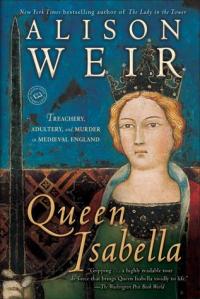
 Throughout medieval English history, there have been some famous queens who left their marks. Empress Matilda, Eleanor of Aquitaine, Eleanor of Castile, Philippa of Hainault, and Margaret of Anjou each left an impression on English history, either good or bad. However, there was one queen whose negative reputation came with the nickname “She-Wolf of France,” and her name was Queen Isabella of France. The wife of Edward II and mother of Edward III, she left her husband for Roger Mortimer and overthrew her husband in favor of her son. For centuries, she has been viewed as a horrible villainess, but is that a fair assessment of her life? Alison Weir dives into the archives to find the truth about Isabella of France, and she presents her findings in her biography, “Queen Isabella: Treachery, Adultery, and Murder in Medieval England.”
As a fan of Alison Weir, I am trying to read every book she has written so far, so when I saw this book in a used book store, I jumped at the chance to read it. I have read books that have featured Isabella of France, but I have never read a biography about her until now. I wanted to see if this book would change how I feel about her.
Isabella of France was the daughter of Philip IV, King of France, and Jeanne I, Queen of Navarre, born in 1295. As the only surviving daughter of Philip and Jeanne, she was expected to make a match that would create an alliance, which she did when she married Edward II of England. On paper, it should have been an ideal match, but Edward II had his favorites. The first was Piers Gaveston, whom Edward II knew before he married Isabella. Edward paid more attention to advancing Gaveston than governing, which led to the great men of England (known as the Ordainers) enacting the Ordinances of 1311 and Gaveston’s execution in 1312. Edward II swore revenge against those who killed Gaveston.
For a while, Edward and Isabella had a loving relationship. They had four surviving children: Edward III of England, John of Eltham, Earl of Cornwall, Eleanor Countess of Guelders, and Joan Queen of Scots. Unfortunately, Isabella’s happiness would not last long as Hugh Despenser the Younger would take the place as Edward’s new favorite. Things got so bad for Isabella that she decided to leave for France, stay there with her son Edward III, and start a relationship with Roger Mortimer. It would end with an invasion of England, the death of the Despensers, Edward II captured, and Edward III becoming King of England.
Isabella of France’s reputation may have been marred for centuries for her role in overthrowing her husband in favor of her son, and for what happened to Edward II afterward, but I think Weir does a decent job in rehabilitating her reputation. I don’t necessarily agree with her assessment of Edward II, but I felt like, when it came to Isabella herself, I appreciate her story and feel a bit sympathetic for what she had to deal with. If you want a biography about Isabella of France, I would recommend you read “Queen Isabella: Treachery, Adultery, and Murder in Medieval England” by Alison Weir.
 The year is 1599 in Rome, Italy. A young rich woman stands in front of an executioner’s block. She is a mother, a daughter, a sister, a lover, and a killer. Her victim was her father, a man who made her life and the lives of her family members a living hell. When she falls in love with one of her father’s spies, she believes that it is a way out. However, the path she chooses to embark on will bring deadly consequences. What is the truth surrounding this case, and is Beatrice Cenci a cold-blooded murderer or a victim looking for her freedom? Elizabeth Fremantle explores the life of Beatrice Cenci and the circumstances of this crime in her latest novel, “Sinners.”
 What’s better than snuggling up on a cold winter’s day and reading a murder mystery? How about an entire book about historical murders and the laws about murder and revenge? While we do have murder mysteries in every century and every walk of life, the farther back into the past we go, the more difficult it can be to discern fact from fiction. Take, for example, the stories of murder, betrayal, and revenge in Anglo-Saxon England. Annie Whitehead hopes to reveal a deeper understanding of this period through numerous murder cases in her latest book, “Murder in Anglo-Saxon England: Justice, Weregild, Revenge.”
 The year is 1523, and England is again preparing for war against its mortal enemy, France. Cardinal Wolsey is firmly in power as King Henry VIII’s right-hand man who is about to open Parliament, but Sir Thomas More’s star is slowly rising. London is busy, and at the center of it, all is Wolsey’s trumpeter and groom, Anthony Blanke. In this chaos of Wolsey’s household where murder and betrayal lie, and the enemies of the Cardinal begin to pile up. It is up to Anthony Blanke to clear his name and find the murderer before it is too late. Anthony’s latest thrilling adventure occurs in Steven Veerapen’s novel, “Of Judgement Fallen: An Anthony Blanke Tudor Mystery.”
 A 16-year-old duchess, who lived a sheltered life, died in a remote villa after only being married to her husband, Alfonso Duke of Ferrera, for a mere year. Many suspect that she died of a fever, but there are rumors that her husband had her poisoned. Not much is known about Lucrezia de Medici, Duchess of Ferrara, except her marriage portrait and a brief mention of her in Robert Browning’s poem, “My Last Duchess.” Did she die of a fever, or was there a more sinister plot behind her demise? The mystery around her life and unexpected death have not been discussed much until now in Maggie O’Farrell’s latest novel, “The Marriage Portrait.”
 The year is 1480. Intrigue and murder lurk everywhere at the Palace of Westminister, where no one is safe. A mysterious letter and the men who want the letter back lead to the murder of one of the clerks from the Office of the King’s Secretary. Under the orders of powerful men at court, including King Edward IV himself, Seb Foxley must join his wayward brother Jude as one of Secretary Oliver’s clerks to uncover the truth of the conspiracy against the crown. Can the brothers work together to decode the truth and save the life of the king’s beloved heir in time? Seb Foxley’s latest adventure is told in book ten of Toni Mount’s Sebastian Foxley Medieval Murder Mystery series, “The Colour of Rubies.”
 David Rizzio was one of Mary, Queen of Scots’ favorites at court and the private secretary to the queen. Being a royal favorite would not have been seen as a grave offense in any other country during this time, yet this is Scotland in the 16th century. Scotland was filled with deadly feuds between lords fighting for control of the crown, which would lead to numerous prominent men being murdered, including Rizzio. On March 9, 1566, David Rizzio was murdered in front of Mary, Queen of Scots, while she was several months pregnant. The tale of the grotesque crime and those who witnessed the events of that night are told in Denis Mina’s latest gripping novella, “Rizzio.”
 In 1483, King Edward IV’s family received a devastating announcement; the king in the prime of his life died, leaving the throne to his young son Edward V. However, neither Edward V nor his younger brother Richard of York would ever see the throne. Instead, they were taken to the Tower of London by their protector, Richard of Gloucester, for protection, never to be seen again. For over five hundred years, many theories have emerged about what happened to the princes in the tower and who might have possibly killed the boys. In MJ Trow’s latest book, “The Killer of the Princes in the Tower: A New Suspect Revealed”, he works hard to uncover the truth of what might have happened to the sons of King Edward IV.
 The year is 1399 in Paris and the royal family is concerned about the Priory in Poissy. Something has happened behind the cloistered walls and only one person who is extremely loyal to the king and queen can figure out what is amiss, Christine de Pizan the famous medieval writer. Christine goes to Poissy to act as a copyist for the prioress, but she soon finds herself in the middle of a sinister murder case. A nun has been found dead and it is up to Christine and her allies, plus one frenemy, to figure out who killed the nun while protecting the king’s youngest daughter who calls the priory home. Can Christine figure out who murdered the young nun and make it out of the priory alive? This is the premise of Tania Bayard’s latest installment of her Christine de Pizan murder mystery series, “Murder in the Cloister”.
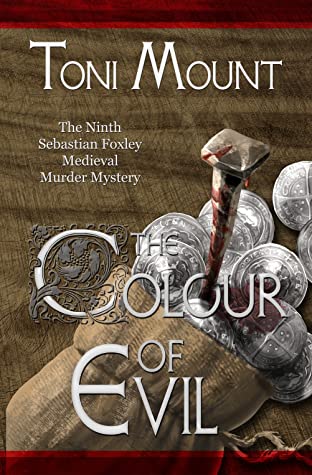 Money problems litter the streets of London like debris. Those who have money have power. Yet, there are those who try to beat the system by making their own counterfeit currency to beat the system. When this counterfeit currency leaves to murder, only Seb Foxley and his merry band of friends and family members can bring justice to those who were killed. When unexpected complications arise, like Seb’s wayward brother Jude coming home with an Italian child bride and a commission from King Edward IV himself, can Seb solve the case before anyone else becomes the next victim in this vicious cycle of greed and exploitation? Toni Mount takes her readers on another thrilling adventure in, “The Colour of Evil”, the ninth installment of the Sebastian Foxley Medieval Murder Mystery series.
 Adventures of a Tudor Nerd