
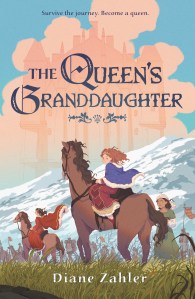
 When a medieval princess married, most of the time, she had to take an arduous journey to their new country. For many of these royal ladies, they had an idea that this would be their fate at a young age, but for others, it would come as a complete surprise. Take, for example, Blanca (Blanche) of Castile. She was the granddaughter of the indomitable Eleanor of Aquitaine. When it is time to create a marriage alliance between Castile and France, Blanca believes that her sister Urraca will be the one who will become Queen of France. However, Eleanor has other plans. How will the journey change Blanca and get her ready to rule a nation? Diane Zahler tells the tale of Blanca’s journey to the throne in her middle grade novel, “The Queen’s Granddaughter.”
I would like to thank Roaring Brook Press and Net Galley for sending me a copy of this novel. I tend to read books tailored towards young adults and adults, but I wanted to see how middle grade books handle historical figures. My love of history started with a middle grade book, so I wanted to see how middle grade books are for the next generation of history nerds.
We are introduced to Blanca of Castile when she was twelve years old. As the daughter of Alfonso VIII of Castile and Eleanor of England, Blanca realizes that she will have to marry one day, but she wants to stay with her family in Castile. With the arrival of her grandmother, Eleanor of Aquitaine, from England to discuss a match between Castile and the French dauphin Louis. Blanca believes that the intended bride will be her elder sister Urraca, but she doesn’t want her sister to leave. Grandmother Eleanor has a different plan and says that the bride to be is Blanca.
To say Blanca is shocked will be an understatement, but after spending time with her best friend Suna and her family, who are Almohads, Blanca decides that she will go to France. Suna, grandmother Eleanor, and Sir William Marshal join Blanca in her journey over the Pyrenees Mountains to France. The journey is arduous as they encounter a snow storm that lands the party in a cave while grandmother Eleanor recovers from an illness. They also face off against Hugh de Lusignan, a man who is seeking vengeance. Throughout the journey, Blanca learns that a queen must make difficult decisions and say the hardest goodbyes for the good of her new kingdom.
This was a great novel to get younger future history nerds interested in history. It was well researched and even gives Zahler’s readers mini biographies about the main characters so that they can begin their own journey into medieval European history. If you want a book for a young history lover in your life that focuses on medieval Castile and France, I recommend you check out “The Queen’s Granddaughter” by Diane Zahler.
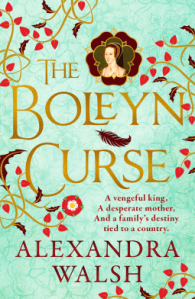 The court of Henry VIII was a treacherous place for anyone, but especially for the Boleyn family. We all know the stories of Anne, Mary, George, and Thomas, but one figure from this illustrious family does not get enough attention: Elizabeth Boleyn, the mother of Anne, Mary, and George. What was her relationship like with her family, her husband, and most importantly, King Henry VIII? And what does a Chaucer manuscript recently discovered at Cerensthorpe Abbey have to do with Elizabeth and the Boleyns? Alxandra Walsh explores the life of Elizabeth Boleyn and the mystery of the missing Chaucer in her latest dual-timeline novel, “The Boleyn Curse.”
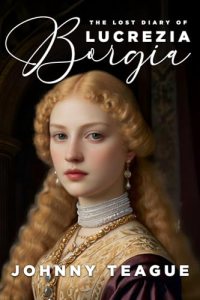 Have you ever wondered what it might be like to discover a long-lost diary of a historical figure by accident? Archaeologist Giuseppe Campise has already found a diary of Mary Magdalene. Now, the Vatican wants Giuseppe to uncover the tomb of Alexander the Great. However, while on the search for the tomb, Giuseppe finds something even more precious, the diary of Lucrezia Borgia. What secrets does the diary hold? Johnny Teague tells the tale of Lucrezia Borgia through her diary in his latest novel, “The Lost Diary of Lucrezia Borgia.”
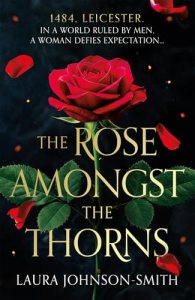 Lady Katherine Turner was never meant to be the Countess of Leicester, but when her brother William dies suddenly, she must take on the mantle of power. Unfortunately, with power comes responsibility, and in medieval England, women in power could not hold onto that power unless they married. That does not sit well with Katherine, who is a very independent woman. However, a choice must be made between two suitors, Lord Henry Tyrell, Earl of Dornton, and Lord James Stanford. Who will Lady Katherine Turner choose, and can she maintain her independent spirit while falling in love? Laura Johnson-Smith explores Lady Katherine’s love story in her debut novel, “The Rose Amongst the Thorns.”
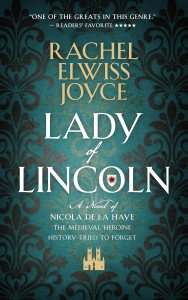 Medieval England, under the reign of Henry II and Eleanor of Aquitaine, was a turbulent time. The focus tends to be on the rebellion of Henry’s sons against their father and how Eleanor sided with her sons. This story has been told, but there is a story of another woman who was caught directly in the middle of the entire ordeal. Her story is most known for her role during the reign of King John and the Magna Carta, but that was when she was an older woman. The story of Nicola de la Haye and Lincoln Castle has been told in biographies and nonfiction books, but not really in historical fiction novels. Rachel Elwiss Joyce hopes to change that with her novel, “Lady of Lincoln.”
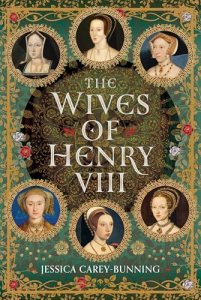 The wives of Henry VIII have been an area of fascination for history nerds and novices alike for centuries. We all know the stories of Catherine of Aragon, Anne Boleyn, Jane Seymour, Anna of Cleves, Katherine Howard, and Kateryn Parr. However, these stories only offer a glimpse at the lives of these women. They follow the more traditional studies of the Tudor queens, but what happens if we take a more revisionist approach to their lives? What can we learn about these women besides their crowns and who they all married? There is more to their stories, like the minute details that Jessica Carey-Bunning explores in her book, “The Wives of Henry VIII: Rethinking the Stories Behind the Symbols.”
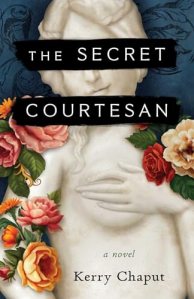 A statue several centuries old has been discovered in Italy. The leading male art expert believes that it was created by a sculptor named Lucca Armani. He has asked Dr. Mia Harding to support his research, but Dr. Mia feels that something is amiss. Sofia Rossi is a courtesan living in Renaissance Venice who aspires to a life devoted to creating art. Sofia and Mia may be separated by centuries, but their lives and reputations are tied to this mysterious statue. Can Dr. Mia figure out the truth of the statue before her time runs out? Kerry Chaput tells the tale of these two remarkable women in her novel, “The Secret Courtesan.”
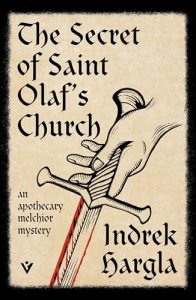 15th-century Estonia was at the edge of Christendom. It also just finished facing off against the notable Victual Brothers, a band of brigands and pirates who wreaked havoc across the land. In the town of Tallinn, St. Olaf’s Church is being constructed, but nefarious dealings are coming to the surface. A serial killer is turning this once peaceful town, which is finding its identity on its head. Now, an apothecary named Melchior Wakenstede must help the magistrate solve the case before anyone else is killed. This is the premise for the first Apothecary Melchior Mystery by Indrek Hargla, entitled “The Secret of Saint Olaf’s Church.”
 The year is 1540, and King Henry VIII is looking for a wife. He has been a widower for over three years, and his councilor Thomas Cromwell believes that a foreign alliance will be the best path forward for England, so he arranges a marriage between Henry and Anne of Cleves. In theory, it should be a good match, but it falls apart quickly. To top it all off, one of Anne of Cleves’ Maid of Honour brought her own drama to court that ended with a murder. Can Will Somers, the King’s Fool, navigate the drama at court while dealing with his own love life, or will the mystery of the missing body prove too much for him to handle? This is the premise of the next book in the King’s Fool Mysteries series called “Devil’s Gambit.”
 Adventures of a Tudor Nerd