
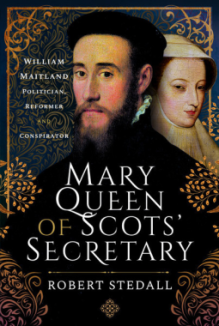
 One of the most dynamic queens in 16th century Europe who spent most of her youth in a country that was not her homeland, but was fighting for the right to rule England. Her name was Mary Queen of Scots, the cousin of Queen Elizabeth I. Many know of her tragic tale, but there was a man who was behind the scenes trying to guide Scotland to a brighter future. He was not married to Mary Queen of Scots, but he was influential in her life and choosing who she might marry and who she would end up divorcing. He was a politician and a religious reformer whose decisions would alter history dramatically. His name was William Maitland and he served as Mary’s secretary. He is always mentioned as a footnote in history, until now. Robert Stedall’s latest biography, “Mary Queen of Scots’ Secretary: William Maitland- Politician, Reformer, and Conspirator”, explores the life and legacy of this rather extraordinary secretary.
I would like to thank Pen and Sword Books and Net Galley for sending me a copy of this book. When I saw this book, I was intrigued since I had never heard of William Maitland, except in footnotes in books about Mary Queen of Scots that I have read in the past. I wanted to know more about the man who knew Mary so well and helped her with such significant decisions in her life.
After Mary Queen of Scots’ first husband, Francis II of France passed away at a young age, she made the journey back to the country of her birth, Scotland, where she was introduced to William Maitland. As a Protestant reformer, he believed that the best thing for the country and the Scottish Reformation would be to break the Auld Alliance with France and to gain closer ties with England. Mary’s second husband, Lord Darnley, is less than agreeable to Maitland, so he and others help plot his murder. This decision led to Mary’s imprisonment and the succession of her son James as king.
Stedall’s whole premise revolves around the idea that Maitland helped plan Darnley’s murder. I do have a few problems with this book. First, for a biography that should revolve around Maitland, it felt like Maitland was more of a background character to Mary’s story. Second, the case that he lays out for Maitland being involved in the murder revolves around the validity of the infamous Casket Letters, which many believe are forgeries and have disappeared. It is hard to prove a case when the evidence in question may have been forgeries and are lost to history. Finally, I felt like Stedall’s writing style was a bit dry for my personal taste. I know that this was supposed to be academic in nature, with the focus on the political and religious nature of Maitland’s life, but it just fell flat to me.
Overall, I felt like this book was okay. It may have shown how the political and religious divides influenced the decisions of Mary Queen of Scots’ reign, but it needed a stronger focus on William Maitland. I feel like Stedall has a passion for this period of Scottish history and he has done his research, but he needed to rein it in a bit more. I think if you enjoy reading about Mary Queen of Scots, “Mary Queen of Scots’ Secretary: William Maitland- Politician, Reformer and Conspirator” by Robert Stedall might be a book you should check out.
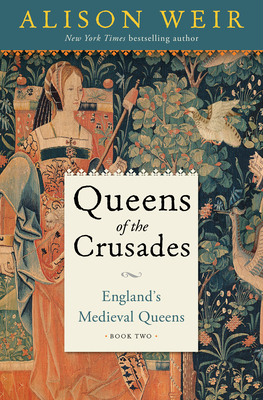 One of the most prominent royal families of English history was the Plantagenets, who reigned for over three hundred years. In the first one hundred years of this family’s infamous history, five kings ruled (the first two are considered kings of the Angevin dynasty): Henry II, Richard I, John, Henry III, and Edward I. These five kings saw England change drastically, but they also participated in the international political landscape of the day, which involved the series of wars that today we simply refer to as the Crusades. The early Plantagenet kings saw much bloodshed and war, but they were not alone in their struggle to keep the dynasty going. These men would not have gotten as far as they did without their wives who stood by their sides. In Alison Weir’s latest installment of England’s Medieval Queens series, “Queens of the Crusades”, she takes a deep dive into the lives of the first five Plantagenet queens to show how remarkable these women truly were to stand beside their husbands during the times of the Crusades in Europe.
 In the times of medieval kings, the power of the crown was dependent on the support that they maintained with noble families. One of the most notorious noble families in England was the baronial family known as the Despensers. Between the 13th and the 15th centuries, the Despensers were at the heart of royal politics and some of the biggest power plays during the reign of the Plantagenets. We know about the few members who truly made waves during this time, especially Hugh Despenser the Elder and Hugh Despenser the Younger, but this family’s story is much more than a few members. In Kathryn Warner’s latest book, “The Rise and Fall of a Medieval Family: The Despensers”, she takes on the challenge of explaining the entire family story of this infamous baron clan.
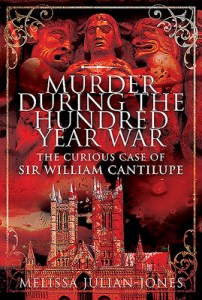 In 1375, the body of Sir William Cantilupe was found murdered in a field. He was stabbed multiple times, yet it looked like he was moved as his clothing had no marks on it. The initial investigation pointed to William Cantilupe’s immediate family and his household staff who appeared dissatisfied with how he ran his household. This particular case has been an area of fascination for medieval historians for centuries as it explores different aspects of life during the Hundred Years War. Some of these areas include domestic violence, social norms, law and order, and the punishment for crimes like murder. Melissa Julian-Jones explores every aspect of this case while combining contemporary sources to give readers a new approach to this murder in her book, “Murder During the Hundred Year War: The Curious Case of Sir William Cantilupe”.
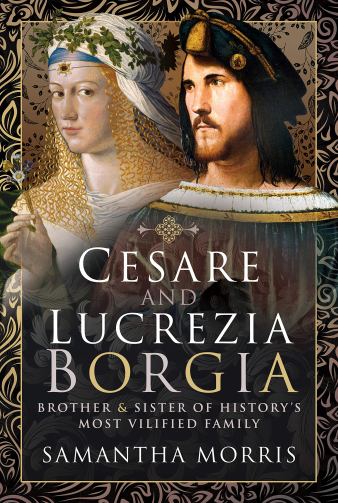 A family mired in myths and rumors of incest, murder, and intrigue for centuries. A brother and sister caught in the middle, attracting the attention of gossips and historians alike. No, I am not referring to a royal family in England. In fact, this story starts in Spain with Alonso de Borja, who moved to Italy and helped create the infamous Borgia family. Caught in the middle were the son and daughter of Rodrigo Borgia, Alonso’s nephew, and his mistress Vanozza Cattanei; Cesare and Lucrezia Borgia. How close were these famous siblings? What were their lives really like? In Samantha Morris’ latest biography, “Cesare and Lucrezia Borgia: Brother and Sister of History’s Vilified Family”, she dives deep into the archives to find out the truth about the legendary Borgia family.
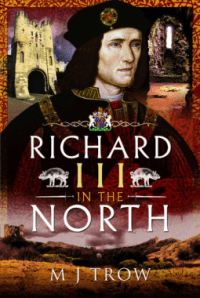 If you have studied the Wars of the Roses, you are obviously very familiar with the infamous last Plantagenet King of England, Richard III. He is known for many things, but the most notorious thing that he is associated with is the murder of the Princes in the Tower, his nephews. However, we cannot be certain that he committed this crime or if a crime was committed in the first place. These rumors swirled around London and Southern England where Richard III was not popular. It was a different story in Northern England, where he was much beloved. In M.J. Trow’s latest book, “Richard III in the North”, he tries to uncover the true story of Richard III by looking at his life while he was living in the North. Was he really the monster that literature has portrayed him as or do we have a case of misunderstanding a historical figure?
 One of the most popular Tudor historical fiction series in recent memory has revolved around the enigmatic Thomas Cromwell. Of course, I am talking about the famous
 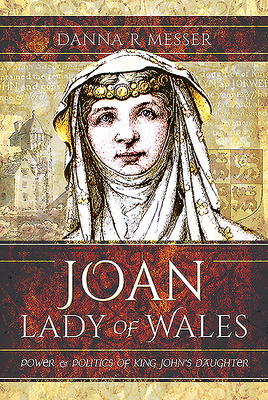 Medieval women held many different titles that defined their roles and their connections. Mothers, daughters, and wives tended to be the most popular and the most common. Titles such as queen, political diplomat, and peace weaver tend to be rare and given to women of power. Yet, these words accurately depict a unique woman who lived during the Angevin/ Plantagenet dynasty. She was the illegitimate daughter of the notorious King John and the wife of Llywelyn the Great, a Prince of Wales. She worked tirelessly to establish peace between England and Wales, yet she has not received much attention in the past. Her name was Joan, Lady of Wales, and her story is brought to life in Danna R. Messer’s book, “Joan, Lady of Wales: Power and Politics of King John’s Daughter”.
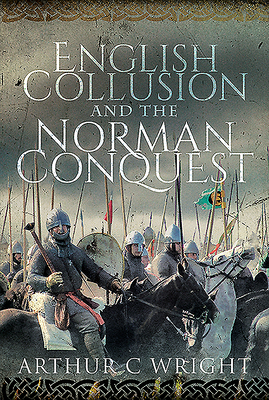 The Norman Conquest of 1066 was one of the most important dates in English and world history. It signaled the start of the Norman influence in England with Duke William, also known as William the Conqueror, becoming King of England. But does William I deserve the reputation that is attributed to him in history, or should we be careful with how we view him because his story is told by the avaricious Church? How much help did William and the Normans receive from their English counterparts? Can we call this event a “conquest”? Who was to blame for the “Harrowing of the North”? These questions and more are discussed in Arthur C. Wright’s latest book, “English Collusion and the Norman Conquest”.
 When one thinks about Medieval Europe and buildings, we tend to focus on the luxurious castles with their impenetrable walls. It is a rather glamorous image, but the problem is it is not accurate. Castles were used for defensive measures to protect the kingdom from attacks, either from outsiders or, in some cases, from within. Medieval warfare and castles go hand in hand, but one conflict where we tend to forget that castles play a significant role is in the civil war between the Yorks and the Lancasters, which we refer to today as The Wars of the Roses. Dr. Dan Spencer has scoured the resources that are available to find out the true role of these fortresses, both in England and in Wales, in this complex family drama that threw England into chaos. His research has been compiled in his latest book, “The Castle in the Wars of the Roses”.
 Adventures of a Tudor Nerd