
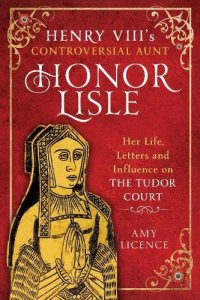
 Marrying into the royal family is not all sunshine and rainbows. Of course, we tend to think about those who marry the king, the queen, the prince, or the princess. But we also need to consider the aunts and the uncles of the royals as part of the family. Take, for example, Arthur Plantagenet, the illegitimate son of Edward IV and the uncle of Henry VIII. His second wife, Honor Lisle, would help him rule Calais; however, she is best known for her letters and her devout Catholic faith during the Reformation in England. So why is Honor Lisle considered a controversial figure, and what was the cause of the fall of Honor and Arthur from the royal good graces? Amy Licence explores the life of Henry VIII’s step-aunt in the first full biography dedicated to Honor Lisle, which is entitled “Henry VIII’s Controversial Aunt, Honor Lisle: Her Life, Letters, and Influence on the Tudor Court.”
I would like to thank Pen & Sword Books and NetGalley for providing me with a copy of this book. I have heard of Honor Lisle and her letters, but I did not know much about her life before this book. I did know that she was married to Arthur Plantagenet, but I had assumed that he was her first husband, so I didn’t know about her life before Arthur. When I saw that Amy Licence was writing a biography about Honor Lisle, I knew I wanted to read it.
Licence begins with the birth of Honor Grenville, Lady Basset, Lady Lisle Plantagenet. She was born in 1493 to Thomas and Isabel Grenville in the small town of Bideford, Devon. Her father served the first Tudor king, Henry VII, as Esquire of the Body, so Honor’s family did have some connection before Honor’s marriage to Arthur. Honor’s mother died a year after she was born, but her father did not die until 1513. In 1515, Honor would marry her first husband, Sir John Basset, and they would have between 7 and 8 children before his death in January 1528.
A year later was a monumental year for England as it was the start of the divorce between Henry VIII and Catherine of Aragon, which would be known as the Great Matter. It was also the year that Honor married Arthur Plantagenet. The couple would move to Calais, where Arthur would rule for his nephew. This is where we get to see the Lisle letters, Honor’s dictated correspondence to prominent figures in Tudor England. Honor and Arthur would go into debt, dealing with the constant threat of war, balance their faith and be loyal to the King, and handle a plot by Reginald Pole that would try to remove Henry VIII from the throne.
I found it so interesting to see Honor’s perspective on the big issues of the Tudor court while staying in France, as well as how life in Calais was different from it was in London during this time. Honor Lisle’s life and letters give us great insight into the reign of Henry VIII from the perspective of someone who was outside of England during the major events of his reign. Licence’s research, combined with an easy-to-follow writing style, makes this a very well-written biography. If you want a biography about a lesser-known Tudor woman and her famous letters, I highly recommend you read “Henry VIII’s Controversial Aunt, Honor Lisle: Her Life, Letters and Influence on the Tudor Court” by Amy Licence.
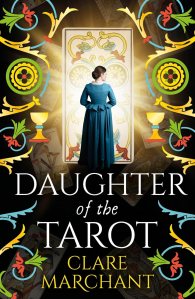 A single deck of cards changed the fate of generations of women. The tarot cards, created in 16th-century Italy, will connect two women separated by centuries. One was a woman in 17th-century London, originally from Milan, who used the cards to rescue women from abusive relationships. The other is a woman from modern-day London starting her life anew when she comes across an old tarot card deck with a missing card. What began as a hunt for a missing card will connect the two women and change lives forever. The cards hold secrets to the past, but will they bring hope or disaster? This is the premise for Clare Marchant’s latest dual-timeline novel, “Daughter of the Tarot.”
 One of the greatest threats to England during the reign of Elizabeth I was the Spanish Armada, under the orders of King Philip II of Spain. In the year 1587, the Spanish ships were spotted off the coast of Devon. Fear grips the country, but one woman is up to the task of keeping her beloved Dartington Hall and its inhabitants from harm. Roberda Chapernowne knows what it means to fight for those she loves and is willing to do it again while her husband, Gawen, is away in Ireland fighting for the Queen after he almost divorced Roberda. Roberda’s life turns upside down when Gawen returns home. Can they rekindle their relationship, or will they fall into despair and ruin? Rosemary Griggs concludes Roberda and Gawen Chapernowne’s stories in her latest novel, “Mistress of Dartington Hall.”
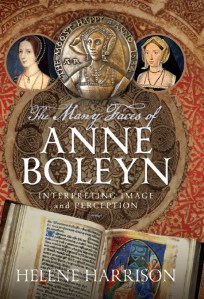 Anne Boleyn, a queen whose story has lived on for centuries. She was the woman who stood between Catherine of Aragon and King Henry VIII. Her daughter, Queen Elizabeth I, was her greatest legacy and her pride and joy. It was her untimely death due to charges that many believe were unfounded. We all have our image of the infamous queen, but how does that change when we switch the type of media we consume? Helen Harrison explores how our idea of Anne Boleyn changed over time in her latest book, “The Many Faces of Anne Boleyn: Interpreting Image and Perception.”
 We all know the story of Romeo and Juliet. Two crazy kids in love, whose families hated each other they decided to make the ultimate sacrifice and die for each other. One of the greatest tragic love stories of all time. But what if it didn’t end in tragedy? What if Romeo and Juliet had their happy ending and had a large family? In this version of Verona, Romeo and Juliet have a large family, and their eldest daughter Rosaline is the most beautiful, headstrong girl in all of Verona. Unfortunately, Rosaline (Rosie) has got herself in quite a mess with an unwanted prince fiancé, a ghost who only she can see, and a murder investigation. Can Rosie solve the case and figure out her love life before things go horribly wrong? This is the premise of the second book of the Daughter of Montague series by Christina Dodd called “Thus with a Kiss I Die.”
 The year is 1485, and the last Plantagenet king, Richard III, is dead. The young man whose army defeated the king is Henry Tudor, and he is about to start a dynasty that will reshape world history forever. Henry Tudor, now King Henry VII, married the daughter of King Edward IV and Elizabeth Woodville, Elizabeth of York. Their marriage and their children would lay the foundation for the Tudor dynasty, but what was life like for the children who were the first generation of this remarkable dynasty? Aimee Fleming explores the lives of these royal siblings in her latest book, “Tudor Princes and Princesses: The Early Lives of the Children of Henry VII and Elizabeth of York.”
 Throughout history, women have had one major job: giving birth and raising future generations. Each new generation had different ways of dealing with childbirth and raising children, and the Tudors were no exception. While the Tudors lived in the 16th century, the joys and fears of being a mother were similar to those of the modern age. However, the way women approached different stages of life in the 16th century is unique compared to the ways of modern women. So, how did Tudor women approach motherhood? Stephanie Kline hopes to answer this question in her latest book, “Raising the Tudors: Motherhood in Sixteenth-Century England.”
 Everyone knows the story of William Shakespeare—the famed poet, actor, and playwright who revolutionized English literature forever. There have been a series of debates about whether or not Shakespeare truly wrote the plays or someone else did. Well, what if a group of women employed William Shakespeare as a sort of spokesperson for their plays? Can this group of women survive to write another day? This is the premise of DJ Nix’s novel. “The Shakespeare Secret.”
 Miguel de Cervantes, the author of Don Quixote, lived quite an interesting life. He was a poet, soldier, war hero, prisoner, husband, brother, uncle, father, and author. His writing might portray a man of honor and dignity, but his home life was messy. You see, Miguel was married, but his daughter was not the daughter of his wife, Catalina de Salazar. His daughter, Isabel, was illegitimate, and when her mother died, Miguel decided the best possible solution was to invite Isabel to live with his sisters and his niece. What’s the worst that could happen? Martha Batiz explores the women’s lives connected to Miguel de Cervantes in her debut novel, “A Daughter’s Place.”
 Florence, Italy, in the 16th century, was a city of opportunity and full of art and architecture. It was also a city on the precipice of great change. The great banking family, the Medicis, holds the reins of government in Florence, and Lorenzo de’ Medici is the family’s current head. However, two bastards will radically change his life and the Medici family. One was a bastard son of a notary who became one of the most famous artists ever. The other was a bastard son who became a priest and the enemy of the Medici family. Their stories of power and ambition intersect in the city of Florence in Phil Melanson’s debut novel, “Florenzer”.
 Adventures of a Tudor Nerd