
 Illegitimate royal children have been known to make an impact on history. Take Henry Fitzroy, the illegitimate son of Henry VIII, and Bessie Blount, whom Henry VIII acknowledged as his son. There were discussions about Henry Fitzroy becoming the heir apparent if Henry VIII did not have a legitimate son. But what about the illegitimate children that a king did not acknowledge? What might their lives have been like? The story of Mary Boleyn and her affair with King Henry VIII has been told many times, but the story of her daughter born during that time is lesser known. In her first full-length nonfiction book, “Henry VIII’s True Daughter: Catherine Carey, A Tudor Life,” Wendy J Dunn has taken on the task of discovering the truth of Catherine Carey’s parentage and how it impacted her life.
I would like to thank Pen and Sword Books and Net Galley for sending me a copy of this book. I just finished reading Wendy J. Dunn’s novel, “The Light in the Labyrinth” about Catherine Carey, which is the book that inspired her to research and write this biography. I wanted to see if Dunn could write nonfiction as well as she writes historical fiction novels.
Dunn begins her biography by exploring what life was like in Tudor England before diving into the main point of her book, that Catherine Carey and her brother Henry Carey, were the illegitimate children of Mary Boleyn and Henry VIII. This was a point that she made in “The Light in the Labyrinth,” but it is in this biography that Dunn is able to expand on her theories even further, including the theory that Catherine was in the Tower and on the scaffold when her aunt, Anne Boleyn, was executed as a young woman. It is a sad theory, but it might explain why she was so close to her potential half-sister, Elizabeth Tudor.
Dunn shows how Catherine Carey grew up in the shadows of Henry VIII’s court. It is there where she met and fell in love with Francis Knollys, whom she married in April of 1540. As an audience, we get to see Catherine become a mother during the last years of the reign of Henry VIII and Edward VI’s tenure as king. It was during Mary I’s reign that life became dangerous for Catherine, Francis, and their family as they were Puritans, so they fled to Germany for three years. It was not until the reign of her potential half-sister Elizabeth that Catherine returned to court to serve her queen until Catherine died in 1569.
I think Dunn does a great job of combining her knowledge of Catherine Carey with her writing style as a historical fiction novelist. It creates a unique reading experience. I think for a first try at a full-length nonfiction book, it is pretty good. If you want a full-length biography of Catherine Carey that is informative with theories that will make you question what you think you know about the Tudors, I would suggest you read “Henry VIII’s True Daughter: Catherine Carey, A Tudor Life” by Wendy J Dunn.
 Time travel is a dream for history and science fiction nerds alike. To be able to go to a different period in history to witness major events sounds like it would be tons of fun, but it can also be treacherous if you do not know the era well. What should you wear? Where would you live? What would your occupation be and what should you eat? If you are invited to court, how do you navigate the crazy court intrigue and the ever-changing religious dilemma? Toni Mount has created the ideal book for those who wish to travel to the 16th century called, “How to Survive in Tudor England.”
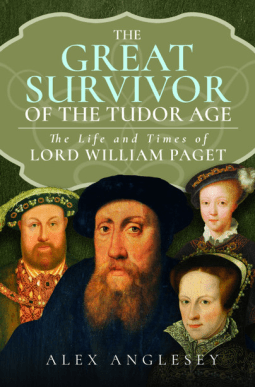 Rulers cannot govern alone. They require a team of men and women behind them to operate as a cohesive unit. The same can be said for rulers during the Tudor dynasty. We know the stories of men like Cardinal Wolsey and Thomas Cromwell, two men who rose through the ranks to prominent seats of power to ultimately have disastrous falls from grace. However, there was a third Tudor politician who should be in this discussion about rags-to-riches stories. He was the son of a common merchant who went to serve most of the Tudor monarchs as an advisor. Conspiracies and rebellions kept him on his toes, but he ultimately survived the Tudor dynasty, which was a difficult thing to achieve. His name was Lord William Paget and his story is told by his descendant Alex Anglesey in his debut book, “The Great Survivor of the Tudor Age: The Life and Times of Lord William Paget.”
 Have you ever watched a historical drama and wondered what it might have been like to wear the outfits for that period? You see so many reenactment groups online and you are envious of their talents for being able to bring clothing from the past, especially clothes from the 16th century, to life in the modern age. What might it have been like to dress like a lord or a lady? What about a commoner or a monk? How did fashion change throughout the Tudor dynasty? Judith Arnopp answers all of these questions and more in her latest book, “How to Dress Like a Tudor.”
 In any society throughout history, there are certain rules and regulations which citizens must follow to maintain order. When there is a transfer of power, those rules and their punishments shift a little bit to fit the vision of those who are in power. England was in a chaotic spiral as law and order were thrown asunder during the Wars of the Roses. The rise of the Tudors marked another shift to the justice system of England, with each monarch during this dynasty, the legal system changed yet again. In her book, “Crime and Punishment in Tudor England: From Alchemists to Zealots,” April Taylor examines the crimes of Tudor England and their respective punishments through case studies.
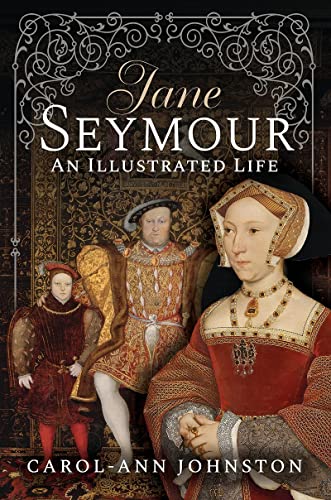 King Henry VIII’s six wives each have their unique story that transcends time. Katherine of Aragon was his first wife, the mother of Mary Tudor, and the one Henry left behind after 24 years to marry his mistress Anne Boleyn, the most famous of his wives and the mother of Elizabeth Tudor. Anna of Cleves had the shortest marriage to Henry VIII and ended up with an excellent annulment deal. Catherine Howard was young and a bit naive when it came to the ways of men, which led to her downfall while Catherine Parr survived until the end of Henry VIII’s reign. These five women are stories we know by heart, but the one whose story remains a mystery is Jane Seymour, Henry’s third wife, and the mother of the future King Edward VI. In her debut book, “Jane Seymour: An Illustrated Life” Carol-Ann Johnston tells the story of the wife who gave Henry his desired son.
 When we think about food during the Tudor dynasty, one of the first images that pop into our head is of Charles Laughton, who played King Henry VIII in “The Private Life of Henry VIII” from 1933. He is seen in a popular image online devouring a chicken at a Tudor feast. We assume that the Tudors were indulgent regarding their food, not caring about what they put in their bodies and their benefits. However, the recipes from this period, from the beginning of King Henry VII’s reign to the death of Queen Elizabeth I, tell a different story. In her debut nonfiction book, “Eating with the Tudors: Food and Recipes,” Brigitte Webster shows how the political and religious changes during the Tudor dynasty affected how those living in England ate every day.
 The tales of the Tudor kings are unique in how they became kings of England. We all know the story of how Prince Henry became King Henry VIII. His eldest brother, Prince Arthur, died shortly after he married the Spanish Princess Katherine of Aragon. Much has been discussed about Arthur’s wedding night and death, but not much has been written about his time as the Prince of Wales. In his debut book, “Arthur, Prince of Wales: Henry VIII’s Lost Brother” Gareth Streeter explores the life of the first Tudor prince.
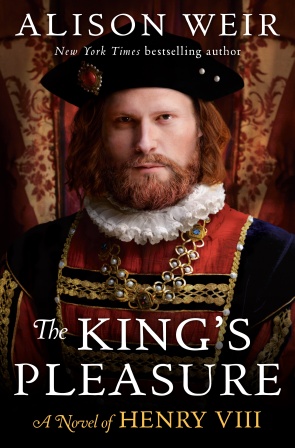 When we think about the Tudor dynasty, we often focus on the women in King Henry VIII’s life and his children, at least when it comes to novels. Writing about this larger-than-life figure, this notorious king and controversial figure in English history, are usually considered ambitious. Few have attempted to write a book about the king’s entire reign, but Alison Weir has embarked on this endeavor in her latest novel, “The King’s Pleasure: A Novel of Henry VIII.”
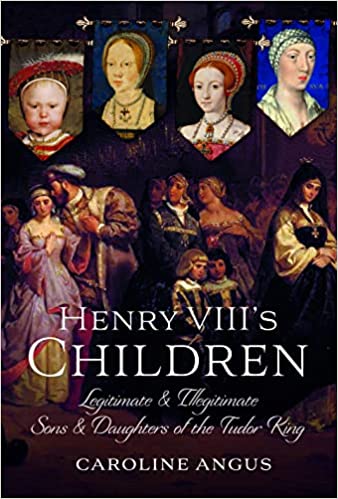 When we think about the title royal children, images of children who get whatever they want, being spoiled with gems and gowns, and ruling kingdoms, they are married to create alliances. In that sense, it would define a life of luxury. However, for the children of King Henry VIII, luxury was not always in their dictionary. What was life like for the legitimate and illegitimate children of Henry VIII? Caroline Angus explores this question in her latest book, “Henry VIII’s Children: Legitimate and Illegitimate Sons and Daughters of the Tudor King.”
 Adventures of a Tudor Nerd