
I am pleased to welcome Dirk Strasser to my blog to share a guest article about his latest novel, “Conquist”. I want to thank Dirk Strasser and The Coffee Pot Book Club for allowing me to participate in this blog tour.
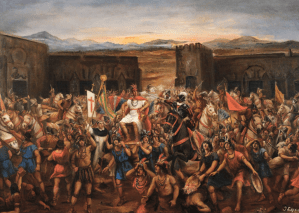
The capture of Atahualpa by Pizarro in Cajamarca (Juan Lepiani)
History isn’t as clear-cut as it’s often portrayed, particularly when it comes to conflict. There’s no doubt that victors usually get to write the narrative. Historians strive for an accurate reconstruction of our past by looking at sources from different sides of a conflict. But what happens when the sources from one side are few and far between because the losing culture has been comprehensively overwhelmed? Often myths abound about the innate superiority of the victors, and it takes a historian to pick them apart. As I was writing my historical fantasy novel Conquist, I did my best to ensure that I didn’t perpetuate these three myths about the Spanish conquest of the Incan Empire.
Myth 1: Fransisco Pizarro conquered an empire of several million with fewer than two hundred men.
The Incan Empire was the largest nation in the world when the conquistadors invaded. It was estimated to have a population of 10 million and an imperial army of 80,000 soldiers. Fransisco Pizarro had 168 men under his command: 106 on foot and 62 on horseback. These numbers are misleading.
Relatively recent archaeological examinations of human remains excavated from Incan cemeteries near conquistador Incan battlegrounds have shown a large percentage of injuries were from Indigenous weapons. Around 150,000 indigenous Andean peoples have been estimated to have fought on the side of the Spanish invaders. The conquistadors had the support of large numbers of Incan subjects like the Huancas and Chankas who seized the chance to escape Incan rule and rise against their oppressors. Also, just before the conquistadors invaded, the Incan Empire was undergoing a brutal civil war between two half-brothers Huáscar and Atahualpa, which Atahualpa won, so it was easy for the Spaniards to enlist Huáscar’s allies such as the Cañaris and Chachapoyas. A significant portion of the population of the Incan Empire would have sided with the conquistadors.
So, the combatant numbers were far more even than those usually quoted. In addition to the conquistadors’ indigenous allies, over 3000 Spanish reinforcements arrived at various stages of the invasion. Plus the Spanish encouraged support amongst the Incans by installing puppet emperors—the most notable being Manco Inca, who is central to the plot of Conquist during the period after he had escaped and was fighting against the Spaniards.
Myth 2: Guns gave the conquistadors a crucial advantage over the Incas in battle.
The type of gun used by the conquistadors, the harquebus, was a heavy and slow-to-reload low-velocity rifle. Harquebuses were unwieldy, unpredictable, and not terribly accurate. The Spanish used them as a support weapon rather than the mainstay of their army.
The conquistadors did have significant advantages over the Incas in battle, but it wasn’t their guns. Arguably the biggest of these advantages was their horses. Not only did horses provide fast transportation across different terrains, but they could also pull heavy cannons. The Inca had no equivalent riding animal and couldn’t match the speed and mobility of the Spanish cavalry, which could break up tight battle formations, quickly flank an enemy, or attack from the rear.
Conquistadors rode their horses in what’s known as the jimeta style, using bent knees to grip the sides of their mounts. This gave considerable maneuverability and control to the rider, and with only one hand on the reins, the other hand was free for the Spanish to use their swords to cut down the Inca soldiers from a height.
The Spanish perro de guerra or war dogs also gave the conquistadors a huge advantage over the Inca. They were huge breeds such as mastiffs and molossus dogs, many of them weighing over 100 kilograms and up to a meter tall. They often wore spiked armor and were specifically trained to chase, dismember, and kill people in battle.
Swords, crossbows, and steel armor were superior to the Incan slings, clubs, and cotton armor, but the conquistadors also had a tactical advantage. Incan warfare was inflexible and highly ritualized, tactics weren’t changed mid-battle, and Inca soldiers retreated if their leaders fell in battle. Most of all, ambush and deceit were not used in warfare, so the Inca were unprepared for the Spanish using these techniques. Crucially, the capture of the unsuspecting Incan emperor Atahualpa was achieved through subterfuge. In Conquist Cristóbal de Varga intentionally follows the battle plans and tactics of Pizarro, but it doesn’t work out quite the same way for him because the Inca have learned not to trust the Spanish.
Myth 3: All conquistadors were white.
There were a number of African conquistadors. They were an integral part of Spanish conquest campaigns in the Americas and fought alongside the Spanish against the Inca. The freed African slave in Conquist Lieutenant Héctor Valiente was inspired by the black conquistador Juan Valiente, who was born around 1505 in Northwest Africa where he was enslaved and transported to Mexico.
In 1533, Juan Valiente signed an agreement with his master Alonso Valiente, which allowed him to become a conquistador and return in four years with profits he could use to buy his freedom. He joined Pedro de Almagro’s expedition to Peru in 1534 as a soldier, where he was one of around 200 Africans. While most of the members of that expedition died in the Andes, Juan survived, and by 1540 he had been promoted to the rank of captain. Six years later he helped found the city of Santiago and as a reward he received an estate.
While he lived as a free and wealthy man in Chile, he was strictly speaking still a slave. Despite Juan’s attempts to pay his debt, Alonso Valiente claimed the payment hadn’t been received. Juan Valiente died fighting in the Andes at the Battle of Tucapel in 1553 and was never legally free, although his son did inherit his estate.
 Blurb:
Capitán Cristóbal de Varga’s drive for glory and gold in 1538 Peru led him and his army of conquistadors into a New World that refused to be conquered. He is a man torn by life-long obsessions and knows this is his last campaign.
What he doesn’t know is that his Incan allies led by princess Sarpay have their furtive plans to make sure he never finds the golden city of Vilcabamba. He also doesn’t know that Héctor Valiente, the freed African slave he appointed as his lieutenant, has found a portal that will lead them all into a world that will challenge his deepest beliefs. And what he can’t possibly know is that this world will trap him in a war between two eternal enemies, leading him to question everything he has devoted his life to – his command, his Incan princess, his honor, his God.
In the end, he faces the ultimate dilemma: how is it possible to battle your obsessions . . . to conquer yourself?
Buy Links:
Universal Amazon Buy Link: https://books2read.com/u/4AM52K
Publisher’s Conquist page: https://www.collectiveinkbooks.com/roundfire-books/our-books/conquist-novel
 Author Bio:
Dirk Strasser’s epic fantasy trilogy The Books of Ascension—Zenith, Equinox, and Eclipse—was published in German and English, and his short stories have been translated into several European languages. “The Doppelgänger Effect” appeared in the World Fantasy Award-winning anthology Dreaming Down Under. He is the co-editor of Australia’s premier science-fiction and fantasy magazine, Aurealis.
Dirk was born in Germany but has lived most of his life in Australia. He has written a series of best-selling school textbooks, trekked the Inca trail to Machu Picchu, and studied Renaissance history. “Conquist” was first published as a short story in the anthology Dreaming Again (HarperCollins). The serialized version of Conquist was a finalist in the Aurealis Awards Best Fantasy Novel category. Dirk’s screenplay version of Conquist won the Wildsound Fantasy/Sci-Fi Festival Best Scene Reading Award and was a featured finalist in the Cinequest Film & Creativity Festival and the Creative World Awards.
Author Links:
Website: https://www.dirkstrasser.com/
Twitter: https://twitter.com/DirkStrasser
Facebook: https://www.facebook.com/profile.php?id=100054955883297
LinkedIn: https://www.linkedin.com/in/dirk-strasser-1249a949/
Amazon Author Page: https://www.amazon.com.au/stores/author/B00CWMHGHO
Goodreads: https://www.goodreads.com/book/show/203225407-conquist
Dirk’s blog: https://www.dirkstrasser.com/dirks-blog

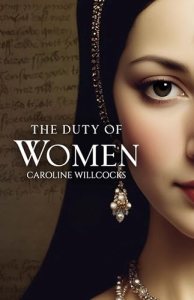 The Tudor court during the reign of King Henry VIII was a treacherous place to be, even for the humble female musician. It was full of men and women vying for a position of power, and they were ready to give anything and everything for that power. This is the world that Kat Cooke finds herself in. After faithfully serving Queen Katherine of Aragon for years, she must switch her loyalties to Anne Boleyn, but when things get dangerous, where will Kat’s loyalties lie? Can Kat survive such turbulent times or sacrifice everything she holds dear? Kat’s story is told in the second book of Caroline Willcocks’ Tudor Queens series, “The Duty of Women.”
 The medieval world could be a treacherous place to live in, especially when it comes to life in the medieval court. There was so much backstabbing and men reaching for titles and crowns that were not given to them. Take, for example, the House of York. Now, we will assume that their desire for the throne truly came to fruition during the period known as the Wars of the Roses in the 15th century. However, the sons and the daughter of Edmund of Langley and Isabella of Castile were fiercely loyal to those they served and were ruthless to those who they deemed as their enemies. This is the world that Constance of York, Lady Despenser, is raised in, but when her world is turned upside down, will she choose to stay on the sideline, or will she scheme with her family and fight for what they believe is right? Constance’s story is woven together in Anne O’Brien’s novel, “A Tapestry of Treason.”
 A love that can get through any obstacle even when the couple is married to other people is considered very rare. However, star-crossed lovers at court were practically unheard of, especially multiple couples from the same family. Anne Brandon knows how rare these matches are as her father Charles Brandon married the sister of King Henry VIII. Now she must figure out her feelings about romance while navigating court life. In the modern day, Caroline Harvey has relationship problems while she navigates the loss of her famous writer, grandfather Dexter Blake. How are these two women from different centuries connected and can they fight for who they love or are they destined to be alone? Alexandra Walsh tells both women’s stories in her novel, “The House of Echoes.”
 For centuries, the brave knights of Camelot and the Crusaders have searched for the Holy Grail. The cup that Jesus of Nazareth used during his Last Supper is rumored to be a vessel that can grant eternal life or miraculous healing powers. It can be a cup, plate, or stone, but in all stories, the Grail guardians and those searching for it are predominately male. But what if the guardians were male and female and the ones searching for it were predominately female? Alais from 11th-century France and Alice Tanner visiting France in 2007 share a connection that is centuries deep and it all started with a ring, a book, and an image of a labyrinth. How are these two connected to the labyrinth and the Grail and can they protect it from those who want to use it for their dark purposes? Kate Mosse weaves the tale of the Grail and the two women connected by fate in her novel, “Labyrinth.”
 Blurb:
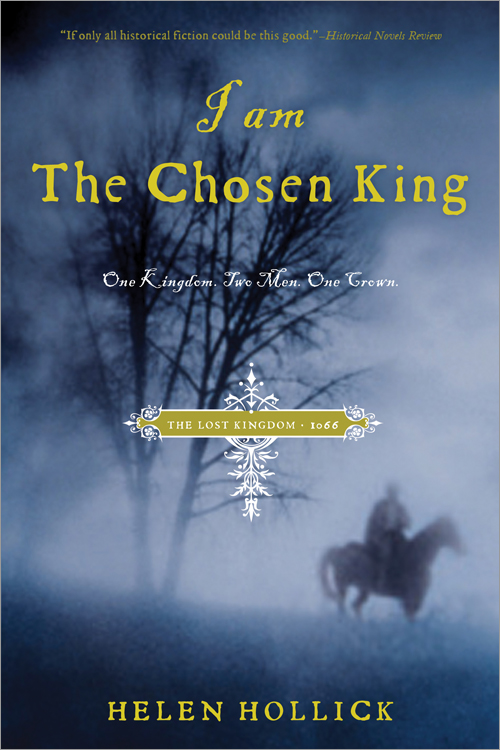 Praise for Helen Hollick:
 Author Bio:
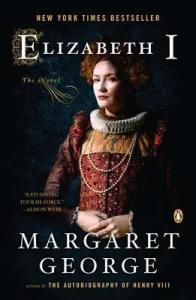 The stories of queens have been told in numerous ways for centuries, but one of the most famous queens in human history is the Virgin Queen, Elizabeth I. The daughter of Anne Boleyn and Henry VIII who famously decided not to marry any man and instead devout her entire life to serve England’s people. That does not mean she was subservient to others she demanded respect and adoration from her subjects. Most stories of Elizabeth I begin in her golden years, but what could a novel about the queen’s silver years tell us about her personality, her reign, and the people who choose to follow or rebel against the famous queen? Margaret George gives her readers an innovative look at the titular queen in her novel, “Elizabeth I.”
 When we think about the period known as the Renaissance, we often think about Italy and the artists like painters and sculptors. However, other craftsmen made Italy their home. Take, for example, tailors and seamstresses. These skilled craftsmen and women can create art you can walk in with their hands. However, there are gender barriers between tailors and seamstresses in that only men can be tailors and only women can be seamstresses. One orphan girl from Bologna not only challenges what it means to be a woman tailor but also challenges one of the wealthiest merchants in the entire city who has a dark connection to her past. This is the premise for Glennis Virgo’s debut novel, “City of Silk.”
 When we consider the issue of succession, we often imagine the crown being passed to the next legitimate heir, regardless of gender, but that was not always the case. We think about the struggles that women like Mary I and Elizabeth I endured to secure and stay on the throne, but one woman came before them so close to becoming England’s first ruling queen. She was the daughter of King Henry I and the next in line to the throne after her brother tragically died, but after her father passed away, it was her cousin Stephen who usurped the throne. The war for the crown which would last decades would be known as The Anarchy is the primary focus for Sharon Kay Penman’s novel, “When Christ and His Saints Slept.”
 Adventures of a Tudor Nerd