 The Crusades were conflicts predominantly focused on the stories of knights, kings, popes, Christians, and Muslims. We have some stories of women like Eleanor of Aquitaine who joined their husbands in battle. However, some women’s stories tend to get lost in the sands of the past. Take, for example, Eleanor of Aquitaine’s daughter-in-law, Berengaria of Navarre, the wife of Richard the Lionheart. Amid the Third Crusades, she must join Eleanor of Aquitaine on a treacherous journey to meet her husband while he battles for Jerusalem. Can Richard and Berengaria survive the journey to and from the Holy Land and produce the desired heir for the English throne before their enemies can claim victory? Carol McGrath has chosen to tell the tale of the forgotten queen Berengaria of Navarre in her latest novel, “The Lost Queen.”
I would like to thank Carol McGrath and Headline Books for sending me a copy of this novel. I am always looking for new heroes and heroines from the past to read about, whether it is historical fiction or nonfiction. I have heard the name Berengaria of Navarre mentioned in previous books about Plantagenet queens, but she is more of a footnote, so when I heard there was going to be a novel about her life, I knew I wanted to read it.
The year is 1191 and Berengaria of Navarre is meeting her future mother-in-law Eleanor of Aquitaine to embark on a journey to meet her future husband Richard the Lionheart in the Outremer. At the same time, Avelina FitzWilliam is planning her trip to the Outremer to find her husband William FitzWilliam who never returned from the Crusades. Avelina’s journey would not be as glamorous as Berengaria’s as she would go in disguise as a nun. Berengaria must also be wary of her surroundings as Philip of France is against the union altogether as Richard decided to pass on a union with Philip’s sister Alice of France to marry Berengaria.
Berengaria and Avelina were united by chance and became the closest of friends through numerous trials. Not only did they have to deal with the dangerous Alps crossing, but they also had to deal with pirates, Saladin’s army, Crusader factions loyal to Philip of France, Walter of Winchester and Prince John in England, and women like Princess Irene of Cyprus who only had eyes for King Richard. Through all the chaos around them, at the heart of this novel, are two love stories, Berengaria and Richard and Avelina and William.
As someone who knew very little about the life of Berengaria of Navarre, I found this novel positively enthralling. It was filled with twists, turns, high drama, and romance. I loved reading this novel and I was genuinely sad when it ended. McGrath was able to craft a luscious novel that was meticulously researched that any fan of medieval historical fiction novels will adore. If this sounds like you, I highly suggest you read, “The Lost Queen” by Carol McGrath.
The Lost Queen
1191 and the Third Crusade is underway . . .
It is 1191 and King Richard the Lionheart is on crusade to pitch battle against Saladin and liberate the city of Jerusalem and her lands. His mother, the formidable Eleanor of Aquitaine and his promised bride, Princess Berengaria of Navarre, make a perilous journey over the Alps in midwinter. They are to rendezvous with Richard in the Sicilian port of Messina.
There are hazards along the way – vicious assassins, marauding pirates, violent storms and a shipwreck. Berengaria is as feisty as her foes and, surviving it all, she and Richard marry in Cyprus. England needs an heir. But first, Richard and his Queen must return home . . .
The Lost Queen is a thrilling medieval story of high adventure, survival, friendship and the enduring love of a Queen for her King.
Acclaim for Carol McGrath’s ROSE trilogy:
‘Powerful, gripping, and beautifully told’ KATE FURNIVALL on The Silken Rose
‘A tour de force of gripping writing, rich historical detail and complex, fascinating characters’ NICOLA CORNICK on The Stone Rose
‘A beautifully narrated novel’ K J MAITLAND on The Damask Rose
Purchase Link – https://tinyurl.com/5n8ab2xv
 Author Bio – Following a first degree in English and History, Carol McGrath completed an MA in Creative Writing from The Seamus Heaney Centre, Queens University Belfast, followed by an MPhil in English from the University of London. The Handfasted Wife, first in a trilogy about the royal women of 1066 was shortlisted for the RoNAS in 2014. The Swan-Daughter and The Betrothed Sister complete this highly acclaimed trilogy. Mistress Cromwell, a best-selling historical novel about Elizabeth Cromwell, wife of Henry VIII’s statesman, Thomas Cromwell, was republished by Headline in 2020. The Silken Rose, the first in a medieval She-Wolf Queens Trilogy, featuring Ailenor of Provence, saw publication in April 2020. This was followed by The Damask Rose. The Stone Rose was published in April 2022. Carol is writing Historical non-fiction as well as fiction. Sex and Sexuality in Tudor England was published in February 2022. The Stolen Crown 2023 and The Lost Queen will be published on 18th July 2024. Carol lives in Oxfordshire, England, and in Greece.
Find Carol on her website:
http://www.carolcmcgrath.co.uk.
Follow her on Amazon @CarolMcGrath
https://scribbling-inthemargins.blogspot.com/
https://www.linkedin.com/in/carol-mcgrath-906723a/
https://www.facebook.com/CarolMcGrathAuthor1/

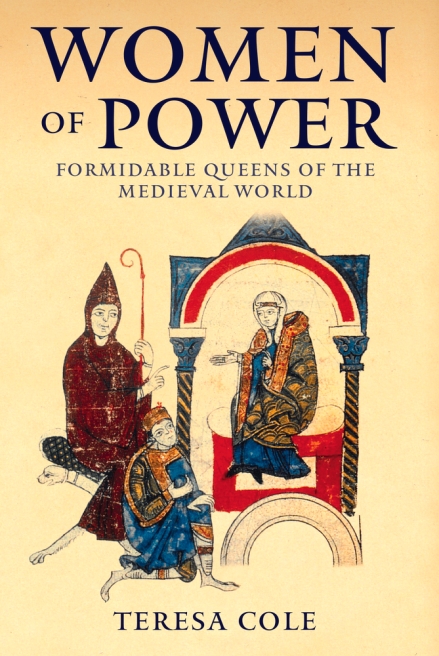 When we think about medieval women, we often think about very pious figures who relied on men, had numerous children, and would often fade into obscurity when they died. While this would be the ultimate fate for many women, it was not so for those close to thrones worldwide. In times of war and political upheaval, the daughters, the wives, and the queens picked up the pieces and patched their respective kingdoms back together. In her latest book, “Women of Power: Formidable Queens of the Medieval World,” Teresa Cole has chosen a select group of women to highlight her point about the strength of women who held power in the Middle Ages.
 Adventures of a Tudor Nerd