
Book Review: “Henry V: The Astonishing Triumph of England’s Greatest Warrior King” by Dan Jones

English history is filled with kings who had to fight for their crown, both at home and away in foreign lands. Men like William the Conqueror, Henry II, Henry IV, Edward IV, and Henry VII can be considered warrior kings, but one stands above them all. He only ruled for a little over nine years, but he proved his worth time and time again, especially against his French adversaries, and secured the crown of France for his young son. He was the son of Henry Bolingbroke, King Henry IV, and the grandson of John of Gaunt. He was Henry V and his story is one of the most remarkable tales in English medieval history, told masterfully in Dan Jones’ latest book, “Henry V: The Astonishing Triumph of England’s Greatest Warrior King.”

I have been a fan of Dan Jones and his books for a few years now and always jump at the chance to read his latest book. When I heard that he was writing a biography about Henry V, it was an instant pre-order for me because it is Dan Jones’ first biography and I did not know much about Henry V minus the main points about his life and reign.

It was a miracle that Henry V became King of England. Henry was the son of Henry Bolingbroke and Mary de Bohun, the grandson of John of Gaunt, and cousin to King Richard II. He was the son of an Appellant lord who was banished from England for opposing Richard II, so the likelihood that he would even be the next Duke of Lancaster was significantly small. Jones shows his audience what Henry’s childhood was like before his father was banished and after he returned and took the throne from Richard II. It was a dramatic change for the young man as it meant that he had to adapt to life as the Prince of Wales, which meant that he had to fight for English control of Wales and against those who also claimed his title, primarily Owain Glyndwr and the Percy family (including Henry Hotspur Percy). The fight for Wales culminated in the Battle of Shrewsbury where Henry Percy died and the army of Henry IV was victorious. Henry V was shot in the face with an arrow and almost died, but Doctor John Bradmore saved his life.

After the arrow incident, we see a different side of the young Prince as he is more mindful of religious matters. When his father Henry IV falls ill, we also see Prince Henry take more of a leading role in politics as part of a council meant to help the king rule England. When Henry IV died on March 20, 1413, the young King Henry V was ready to rule. He believes that to be a strong ruler, he must show it by facing the English’s mortal enemies, primarily France, in battle. He led England to great victories against the French, including the Battle of Agincourt, which was marked as one of the greatest victories for the English during the Wars of the Roses. Henry V was a competent ruler who made England a powerhouse in European history. He was able to secure the French throne for his young son Henry VI, the only child of Henry V and his wife Catherine of Valois before the great warrior king died on August 30, 1422.

I was thoroughly impressed with this biography and I am surprised that it took Dan Jones this long to write a biography. You can tell his passion for the life of Henry V through every page. I hope Jones will write another biography soon. If you are a Dan Jones fan, a medievalist, or just a fan of fantastic biographies, I highly suggest you read, “Henry V: The Astonishing Triumph of England’s Greatest Warrior King” by Dan Jones.

Book Review: “The House of Grey: Friends and Foes of Kings” by Melita Thomas

51fOOu0p2GL._SX332_BO1,204,203,200_There are many noble or royal families that truly were the backbone of the English society and that could help or hinder the monarchy. One such family was the Greys, who started as a baronial family and rose through the ranks by good marriages and staying loyal to those who were in power. Of course, when one rises high, there is also the risk of falling low spectacularly, which happens when Lady Jane Grey becomes Queen of England for a mere 9 days. The story of the house of Grey is complex, yet it has never been told in its entirety, until now. This extraordinary family saga is told in Melita Thomas’s latest book, “The House of Grey: Friends and Foes of Kings”. 
I would like to thank Amberley Publishing for sending me a copy of this book. Melita Thomas is the co-founder and editor of Tudor Times and this is her second book.  This particular book caught my eye as I did not know much about the Grey family, besides the story of Lady Jane Grey and her sisters. 

The story of the House of Grey begins with a rivalry between Owain Glyndwr and Lord Grey of Ruthyn over throwing off English dominance in Wales. Not a great start for a family who would become loyal to the crown of England. It was during the Wars of the Roses and the Battle of Northampton when Edmund Grey switched from supporting the Lancasters to supporting the Yorks, splitting the Grey family apart for a time. It was when Sir John Grey died at the Second Battle of St. Albans that the Greys truly supported the Yorkist crown since his widow, Lady Elizabeth Woodville, married King Edward IV. It is here that Thomas tracks the road to the crown through Elizabeth Woodville’s two Grey sons, Thomas and Richard.

Melita Thomas shows how the Grey boys made names for themselves; Richard Grey being executed while Richard of Gloucester was Lord Protector and Thomas Grey turning rebel and joining the Tudor cause to put Henry Tudor on the throne. Thomas Grey married Cecily Bonville and it was through their line that the Greys inherited the title of Marquis of Dorset. The title would pass onto each son until it reached Henry Grey, who’s ambitions for his daughter would prove fatal.

Thomas navigates the tumultuous times of the Greys to show how truly colorful the family was, from tiffs with fellow landowners to grand fallouts with kings and queens. The Grey family was able to restore themselves time after time to the monarchy’s good favor, no matter how low they fell. The Greys and their influence did not just reach England, but other corners of Europe as well, which is rather remarkable to read all about. Thomas gives the reader an opportunity to understand the roller coaster dynamics of the Grey family and the political atmosphere of the royal courts of different monarchs. The times that the Grey family lived in was one of great change and they were all along for the ride.

I found this book rather engaging and utterly fascinating. It is meticulously researched and you can tell that Melita Thomas had a passion for the subject she was writing about. Many people only know the story of Lady Jane Grey and her immediate family, but I think that this book paints a vivid picture of a complex family who survived the reigns of medieval and Tudor kings and queens. If you want to a delightful in-depth dive into the lives of the Greys, I highly recommend you read, “The House of Grey: Friends and Foes of Kings” by Melita Thomas.


“The House of Grey: Friends and Foes of Kings” by Melita Thomas will be available in the United States on January 1, 2020. If you would like to pre-order this awesome book, you can follow this link: https://www.amazon.com/House-Grey-Friends-Foes-Kings/dp/1445684977/


Biography: Owen Tudor

Full name: Owen ap Maredudd ap Tudur. (Born around 1400- Died February 2, 1461) Son of Maredudd ap Tudur and Margaret ferch Dafydd. Husband of Catherine of Valois.  Father of 4-6 children, including Edmund and Jasper Tudor.

Owen Tudor was the son of Maredudd ap Tudur and Margaret ferch Dafydd. We do not know much about his early life. Owen’s father and his uncles were involved in the rebellion of Owain Glyn Dwr, the last Welsh Prince of Wales, against the English. This rebellion was suppressed and Welshmen moved into England to find work. In 1421, he found work with Sir Walter Hungerford, the steward of King Henry V. In 1422, King Henry V would die from dysentery, leaving behind his 21 year old wife Catherine of Valois and their baby son, who was now King Henry VI. It was during this time that  it is said that Owen came to work in Catherine’s household.

Parliament passed a bill that stated that the dowager queen could not marry again unless she had the king’s permission. If she did marry without permission, her husband would lose everything, but their children would remain legitimate. It is said that the couple was married between 1428 and 1429. In May 1432, Owen Tudor was given the same rights as an English gentleman. The couple had at least 4 children; Edmund born in 1430, Jasper born in 1431, a son who is rumored to have become a monk, and a daughter who either died young or became a nun.

Catherine would enter Bermondsey Abbey to receive medical attention, where she died on January 3, 1437. Edmund and Jasper were sent to the Abbess of Barking to receive  their education while Owen dealt with the king’s Regency council. Owen was nervous about the council and so he sought sanctuary at Westminster Abbey; when he did arrive at the council, he was cleared of all charges and was allowed to return to Wales. However, he was captured by Lord Beaumont and sent to Newgate Prison.

In 1438, he managed to escape with the help of a priest and a servant; he was recaptured and held at Windsor Castle under the guardianship of Edmund Beaufort. In 1439, King Henry VI pardoned Owen Tudor, restored all of his lands, provided him a position at court, and made the Keeper of the King’s Parks in Denbigh. In 1442, Henry VI welcomed his half- brothers Edmund and Jasper to court with open arms. In November 1452, Edmund became the earl of Richmond and Jasper became the earl of Pembroke. On November 3, 1456, Edmund Tudor died from the plague, leaving his young son and wife in the capable hands of his brother Jasper Tudor.  Owen and Jasper would serve Henry VI by capturing Yorkist supporters for the king and in return gaining their estates, including John, Lord Clinton in 1459; that same year, Owen had a son with an unknown mistress named Sir David Owen, born at Pembroke Castle.

Owen joined his son Jasper’s army to raise an army in Wales in January 1461. On February 2, 1461, their army faced off against the Yorkist army at the battle of Mortimer’s Cross. It was a devastating loss for the Lancasterian cause. Jasper Tudor escaped, but Owen was captured and beheaded under the orders of Edward Earl of March, later Edward IV, at Hereford.

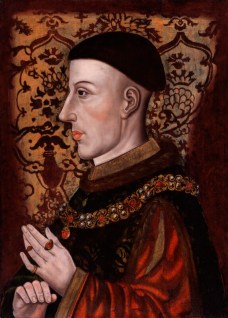
Biography: King Henry V

mw03074(Born September 16, 1387- Died August 31, 1422). Son of Henry IV and Mary de Bohun. Married to Katherine of Valois. He only had one son Henry VI.

Henry V was a soldier from birth. He did so much for his country, yet he died too soon, leaving his kingdom in the incapable hands of his baby son Henry VI.

At the age of fifteen, Henry V fought alongside his father against the Welsh rebels under Owain Glyn Dwr and the English rebels under Edmund Mortimer and Henry “Hotspur” Percy. Henry’s relationship with his father in the later years of Henry IV’s life was not great. The two argued about many issues, but it was mostly about the English involvement in France. Henry IV wanted to press his claim to the French throne while France was in the midst of a civil war between the Burgundians and the Armagnacs; Henry IV supported the Armagnacs while Henry V supported the Burgundians. This issue would never be resolved between them as Henry IV would die in 1413 and Henry V became king.

As king, Henry V desired to regain the lands in France that he believed was rightfully his, but unlike his father, he was able to get the full support of Parliament to do so. Henry V tried to negotiate with the French to regain all of the old Angevin Empire,  but when that failed, he invaded on August 11, 1415. On October 25, 1415, the Battle of Agincourt took place. Even though the French had the English outnumbered, the English had longbowmen. The French lost some 6,000 men whereas the English only lost 400 men.

Agincourt was a tremendous victory for the English, but the French refused to fall. Henry V gained support from Sigismund, the Holy Roman Emperor and John, duke of Burgundy and started a new campaign in August 1417. In the spring of 1419, Normandy fell to Henry V. In May 1420, Henry V signed the Treaty of Troyes with the Burgundians which recognized him and his heirs  as heir to the French throne. In order to cement this new alliance, he married the daughter of the French King Katherine of Valois.

Everything seemed right in Henry’s kingdom, but he still wanted to gain more French land. In 1421, he went back to France and was able to gain control of the Dauphin’s stronghold of Meaux in May 1422. Unfortunately, in the winter of 142, Henry V fell ill from dysentery and died on August 31, 1422. He left his kingdom in the hands of his infant son Henry VI. Even though Henry V’s reign was one of the shortest of any English king since the Norman Conquest, it was one of the most successful. England was in a position of power on the world stage thanks to the actions of Henry V.

Biography: King Henry IV (aka Henry Bolingbroke)

(Born April 3, 1367- Died March 20, 1413). Son of John of Gaunt and Blanche of mw03072Lancaster. Married to Mary de Bohun and Joan of Navarre. He had 7 children with Mary, including the future Henry V. He was the 1st king from the house of Lancaster.

Henry was the son of John of Gaunt and Blanche of Lancaster and was born at Bolingbroke Castle on April 3, 1367. Early in his life, he became one of the Lords Appellant who were opposed to the rule of Richard II. He stepped down from this role in 1389 and in 1390, went on his first adventure, journeying with the Teutonic Knights to Lithuania. Two years later, he went on a pilgrimage to Jerusalem. During this time, he visited numerous courts in Europe and was held in high regards. He was a handsome young man, but it was early in life where Henry’s ill health that plagued him during his reign started to appear.

Henry was a good person to help the king, however the only one who failed to realize this was Richard II. He banished Henry in 1398 for ten years, but when John of Gaunt died the following year and Henry became the next Duke of Lancaster, Richard II took all of his lands and banished him forever. This was the last straw for Henry. While Richard was occupied with unrest in Ireland, Henry took his chance and invaded England, forcing Richard to abdicate. The next one in line to the throne was Edmund Mortimer, earl of March, but he was only eight years old, so Parliament agreed that Henry would be a better choice to be king. His reign as Henry IV began on September 30, 1399.

However, not everyone was happy with Henry as king. Henry IV’s first rebellion that he had to deal with was by the earls of Kent, Salisbury and Huntingdon, just a month after he became king. Henry took care of this rebellion quickly and violently. It is also believed that this was around the same time that Henry ordered the death of Richard II. A few months after the first rebellion, Henry IV had to deal with a second rebellion in Wales, where Owain Glyn Dwr was declared Prince of Wales in September 1400. This revolt was quickly put down, but Owain evaded capture for several years, leading to guerrilla style warfare.

Owain’s supporters grew not only amongst Welsh barons, but English ones as well, including the Mortimers who were upset that Henry was king and not Edmund, who was Owain’s son in law after he married Owain’s daughter. Another supporter was Henry “Hotspur” Percy, the son of the earl of Northumberland who believed that he did not get the recognition that he deserved after he fought against the Scots. These forces came together and fought against Henry at the battle of Shrewsbury on July 21, 1403, where Henry defeated Hotspur easily and killed him. Henry was not going to let the rebel army get away and by 1408, they were all but eliminated.

Two years before this, in 1406, Henry IV took James I of Scotland hostage and his young heir was sent to France. James was in the English court for 17 years as a hostage and for that time, the relationships between England, Scotland and France were good. Things were looking up for Henry IV, except for his health. Starting in 1406, his health was in decline and there was a serious concern for his life. He tried to govern, but he became more reliant on his Parliament. In 1409, Henry’s son Prince Henry was made chancellor over Thomas Arundel, archbishop of Canterbury. Arundel returned in 1411 when Henry and his council were debating if he should step down in favor of Prince Henry, which Henry refused to do. Henry died in 1413 from some sort of wasting disease at the age of 45. His son Prince Henry would succeed him as Henry V.