
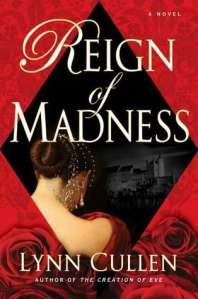
 The daughters of Isabel of Castile and Ferdinand of Aragon lived very interesting lives. Of course, we know what happened to Katherine of Aragon, but her elder sister, Juana, has her own tragic tale. She was known as Juana the Mad because the rumors were that when her husband, Philip the Handsome, died, she carried her coffin around for months and would not let him be buried. Was Juana truly mad, or was it all a ruse by powerful men to steal her lands and titles? Lynn Cullen explores Juana of Castile’s life in her novel, “Reign of Madness.”
This was a book that I found when I was in a used book shop. I saw that it was about Juana of Castile, and I’ll be honest, I have never read a novel that is solely about her life. I know the basic information about her life and reign, but I was hoping that a novel would help me connect to Juana a bit more.
Juana of Castile was the daughter of Isabel of Castile and Ferdinand of Aragon. Since she was the second daughter, she was third in line for the throne of Castile, behind her brother, Juan, and eldest sister, Isabel. She was not destined to become queen, so her parents married her off to Philippe the Handsome, Duke of Burgundy. While it was a marriage for an alliance, love did bloom between Juana and Philippe, even though she did not always get along with Dowager Duchess Margaret of York. Eventually, the honeymoon stage ended, and it was replaced with paranoia and fears of infidelity. At the same time, fortune’s wheel turned in such a way that Juana became her mother’s heir to Castile. Juana doesn’t want power for herself, but Philippe desires power. Juana just wants to take care of her family, which includes her son, the future Charles V. Eventually, the desire for power would become so great that the idea of Juana as mad would overtake her entire life and her legacy.
I had some issues with this book, and there were times when I wanted to throw the book across the room. Some of the biggest ugh moments for me were when she said that bathing was something that only the Spanish were familiar with, and when Philippe kept breaking into Juana’s confinement chamber. These elements, along with a few others, showed me that Cullen didn’t fully grasp the 16th-century European world and its nuances. I also did not like how Juana was portrayed as a mousey character, and her father, Ferdinand, came across as almost a trophy husband.
This novel had the potential to do something groundbreaking when it comes to writing a novel about Juana of Castile by showing that she was sane, but it fell a bit flat. I think if you are someone who is not particular about historical nuances being accurate in a historical novel, and you want something about Juana of Castile, you might enjoy “Reign of Madness” by Lynn Cullen.
 The 16th century was dominated by powerful women who left their indelible mark on European history. Take, for example, the aunt of Charles V, the Holy Roman Emperor. No, not Catherine of Aragon, the first wife of Henry VIII. I am talking about a woman who was the daughter of Emperor Maximilian I, was married three times, had no children, and helped raise her nephew Charles V, was an essential part of the Ladies’ Peace, taught Anne Boleyn how to live at court, and was a patroness of the arts and literature. Of course, I am talking about Margaret of Austria, the Governor of the Netherlands. A formidable woman who saw much change and chose to be part of politics, even though she was a woman. Her remarkable story is told in Rozsa Gaston’s novel, “Margaret of Austria: Governor of the Netherlands and Early 16th-Century Europe’s Greatest Diplomat.”
 In an age when most women of power did not have much power outside their own countries, one stood higher than most. She was not even supposed to become queen, but fate had a bigger mission for the young woman: rescue Christianity from dying out. As a ruler, this seems like a monumental task to complete especially when their enemies were the Ottoman Empire and the Turks at the height of the power. There was one woman who was up to the challenge while fighting to reclaim Spain for the Christians, exploring the new world, and dealing with her family drama. Isabella of Castile is either viewed as a saintly queen or a horrible woman ruler, but what do the archives tell us about her reign? Kirstin Downey tells the story of this revolutionary queen in her biography, “Isabella: The Warrior Queen.”
 Adventures of a Tudor Nerd