
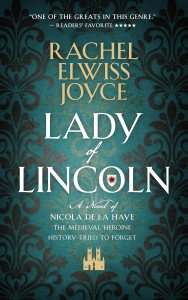
 Medieval England, under the reign of Henry II and Eleanor of Aquitaine, was a turbulent time. The focus tends to be on the rebellion of Henry’s sons against their father and how Eleanor sided with her sons. This story has been told, but there is a story of another woman who was caught directly in the middle of the entire ordeal. Her story is most known for her role during the reign of King John and the Magna Carta, but that was when she was an older woman. The story of Nicola de la Haye and Lincoln Castle has been told in biographies and nonfiction books, but not really in historical fiction novels. Rachel Elwiss Joyce hopes to change that with her novel, “Lady of Lincoln.”
I would like to thank Books Go Social, Hedgehog Books, and Net Galley for sending me a copy of this novel. I first became aware of Nicola de la Haye from Sharon Bennett Connolly’s book on the women of the Magna Carta, followed up by her fantastic biography about Nicholaa de la Haye. I am familiar with her story, but I was curious to see how her life would translate to a novel. When I saw the description of this novel, it definitely caught my attention.
We are introduced to Nicola de la Haye as a young woman who is helping a young soldier, Suardinc, train, when her mother goes into labor and loses her son. That means that Nicola and her sisters are the heiresses of the de la Haye estates. Their father gives her sister, Julia Normandy, and Nicola receives Lincolnshire and Lincoln Castle. Nicola loves Lincoln Castle and the people who inhabit Lincolnshire, including the Jews that the constable of the castle must protect. Nicola wants to be a constable, but her father reminds her that she must marry and her husband will become the constable of Lincoln Castle. Three men want to marry Nicola: Gerard de Camville, the man whom Nicola’s father wants her to marry; Sir Alured of Pointon, the outside schemer who wants Nicola’s lands; and Sir William FitzErneis, the man Nicola falls hard for.
We get to see Nicola fall in love with her first husband, Sir William FitzErneis, even if they face extreme monetary hardships. FitzErneis decides to side with the Young King Henry when he rebelled against his father, King Henry II. This placed Nicola, her family, and the castle in a precarious situation as Alured became the sheriff and tried every which way to make Nicola his, even when she was married. Luckily, Gerard de Camville keeps a close eye on Nicola, even though he himself has fallen for Nicola.
We get to see Nicola transform from a naive young woman to a fiercely determined mother and wife who would do anything to protect her family, her friends, and her family home. I enjoyed that we not only got to see Nicola interacting with the typical nobility, but also the common people, including the Jewish population of Lincolnshire. If you want a well-written novel about one of the most important women in 12th century England, I recommend you read “Lady of Lincoln” by Rachel Elwiss Joyce.
 When we think about significant law documents from medieval England, we think about the Doomsday Book, the Assize of Clarendon, and the Statutes of Westminster. These documents would remain significant to England, but there is only one that would transcend its original purpose: the Magna Carta. To many nations, it is the foundation of liberty and justice for all. But, if we take away all the sparkling praise of the present day for the document, what can we discover about the Magna Carta? What was the Magna Carta truly at its heart, and why was it written? Dan Jones examines this document and the circumstances behind its creation in his book, “Magna Carta: The Birth of Liberty.”
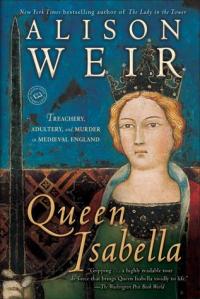 Throughout medieval English history, there have been some famous queens who left their marks. Empress Matilda, Eleanor of Aquitaine, Eleanor of Castile, Philippa of Hainault, and Margaret of Anjou each left an impression on English history, either good or bad. However, there was one queen whose negative reputation came with the nickname “She-Wolf of France,” and her name was Queen Isabella of France. The wife of Edward II and mother of Edward III, she left her husband for Roger Mortimer and overthrew her husband in favor of her son. For centuries, she has been viewed as a horrible villainess, but is that a fair assessment of her life? Alison Weir dives into the archives to find the truth about Isabella of France, and she presents her findings in her biography, “Queen Isabella: Treachery, Adultery, and Murder in Medieval England.”
 Medieval Europe was a time of conflicts and change. While smaller disputes between countries or civil wars would define borders, the most prominent conflict during this period was the Hundred Years’ War. A conflict that has been traditionally taught to have lasted 116 years between England and France. It is often told from the English perspective, with battles such as Agincourt, Crecy, and Poitiers celebrated. But what if we look at the bigger picture and expand our lens to the whole of Europe while keeping a neutral approach to the France vs England conflict? What if the conflict did not last a mere hundred years, but in fact two hundred years? What type of story would this kind of approach tell when it comes to medieval European history? Michael Livingston takes on the mammoth challenge of telling the tale of how this war changed European history forever in his latest book, “Bloody Crowns: A New History of the Hundred Years War.”
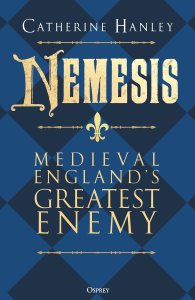 The Plantagenets, one of England’s most dynamic dynasties, were always in the middle of some sort of conflict. Whether they were fighting foreign adversaries, their own people, or their own family, it felt like the Plantagenets were always getting into some sort of trouble. And there was one king who knew how to use the weaknesses of the kings of England to his advantage. He was King Philip II of France, also known as Philip Augustus. He had to deal with four different Plantagenet kings and had a strategy for each one of them. Just what were Philip II’s strategies, and how did his reign affect English/French relationships as a whole? These questions are answered in Catherine Hanley’s book, “Nemesis: Medieval England’s Greatest Enemy.”
 The Plantagenets, a dynasty that ruled England for over three hundred years. At least that is if you include the Lancastrian and Yorkist kings. Otherwise, the reign of the Plantagenets ended with Richard II being overthrown. So, how did the Plantagenets fall? How did wars, favoritism, and the plague factor into the fall? Helen Carr examines these questions and the rule of three kings over the fourteenth century in her latest book, “Sceptred Isle: A New History of the Fourteenth Century.”
 The medieval world could be a treacherous place to live in, especially when it comes to life in the medieval court. There was so much backstabbing and men reaching for titles and crowns that were not given to them. Take, for example, the House of York. Now, we will assume that their desire for the throne truly came to fruition during the period known as the Wars of the Roses in the 15th century. However, the sons and the daughter of Edmund of Langley and Isabella of Castile were fiercely loyal to those they served and were ruthless to those who they deemed as their enemies. This is the world that Constance of York, Lady Despenser, is raised in, but when her world is turned upside down, will she choose to stay on the sideline, or will she scheme with her family and fight for what they believe is right? Constance’s story is woven together in Anne O’Brien’s novel, “A Tapestry of Treason.”
 Adventures of a Tudor Nerd