
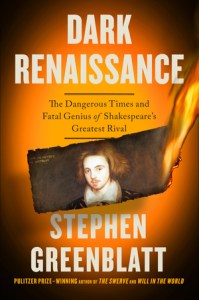
Book Review: “Dark Renaissance: The Dangerous Times and Fatal Genius of Shakespeare’s Greatest Rival” by Stephen Greenblatt

Sixteenth-century England was a time of great change. There were religious changes as the crown passed from one member of the Tudor family to another. Wars and illnesses like the plague and the sweating sickness were rampant. However, this was also a time of an explosion of the arts, particularly of the theatre. We see men like William Shakespeare and Ben Jonson rise from obscurity to write plays that would propel them to become phenomena. There was a third playwright who should be included in this list. He was the son of a cobbler who was educated at Cambridge University. A brilliant man who wrote groundbreaking plays while he was a spy for her majesty Queen Elizabeth I, his cause of death when he was only in his twenties would remain a mystery for centuries. Christopher (Kit) Marlowe’s story is told in Stephen Greenblatt’s latest book, “Dark Renaissance: The Dangerous Times and Fatal Genius of Shakespeare’s Greatest Rival.”

I would like to thank W. W. Norton & Company and Net Galley for sending me a copy of this book. I will be honest. Although I do spend a lot of time studying the 16th century, I don’t read a lot of plays by Shakespeare or Marlowe. So, when I saw this book and its premise, it piqued my curiosity. I knew that Marlowe was a famous playwright, he was a spy, and that he died young, but that’s all I knew before reading this book. I wanted to know more about Kit Marlowe and his world.

Christopher Kit Marlowe was the son of John Marlowe, an immigrant shoemaker, and his wife, Katherine Arthur. As their only son, it was believed that Kit would become a cobbler, but he had different skills that were more academically inclined. The cobbler’s son would study the classical writers of Ancient Greece and Rome, while learning Latin and debating theology. Kit would find himself at Cambridge University, and he paid for his education on a scholarship. While the main focus of these chapters is Marlowe, Greenblatt does show the lives of the scholars and fellow students who would shape Marlowe’s writings and his path in life.

Just as Marlowe was about to complete his Master of the Arts degree, his attendance dropped, and he was seen in Rheims in France. He was beginning to establish connections to the Elizabethan spy network with William Cecil, Lord Burghley, and Sir Francis Walsingham. This is the stage of life where we not only see Marlowe get in trouble with the law, but we also get to see Marlowe become a playwright who would rival Shakespeare himself. Greenblatt takes his time to analyze Marlowe’s works, including Tamburlaine the Great, Edward II, The Jew of Malta, and Doctor Faustus. Finally, Greenblatt examines Marlowe’s death on May 30, 1593, and who might have been responsible for his murder.

I found this book extremely informative, not only when it comes to the life of Christopher Kit Marlowe, but also the worlds of Elizabethan higher education, the theatrical community, the divides on religious beliefs, and the spy world. Marlowe is one of those figures who challenged what it meant to be a playwright through his rather controversial works, which inspired others like William Shakespeare. If you want a book about a playwright with a tragic end who doesn’t get a lot of attention, I highly recommend you read “Dark Renaissance: The Dangerous Times and Fatal Genius of Shakespeare’s Greatest Rival” by Stephen Greenblatt.

Biography: William Shakespeare

800px-Shakespeare(Baptized April 26, 1564- Died April 23, 1616)
Son of John Shakespeare and Mary Arden.
Married to Anne Hathaway.
Father of Susanna Hall, Hamnet Shakespeare, and Judith Quiney.
William Shakespeare was a poet and playwright. He is regarded as one of the greatest writers of all of English History and one of the greatest dramatists of all time.

William Shakespeare was born to John Shakespeare and his wife Mary Arden in Stratford-upon-Avon. We do not know his exact birth date, but many believe that he was born on St. George’s day, which is April 23rd because he was baptized on April 26, 1564. His father John Shakespeare was an alderman and a successful glover while his mother, Mary Arden, was the daughter of a successful landowning farmer. We believe that William Shakespeare went to King’s New School, which was a free chartered grammar school that was located in Stratford. It is here where Shakespeare learned Latin and his passion for the theatre. Since he was a commoner, there is no record of him ever going to university, which was a luxury that was reserved for upper-class families.

At the age of 18, William Shakespeare married Anne Hathaway, who at the time was 26 years old. The marriage licence was issued on November 27, 1582. At the time of their marriage, Anne was already pregnant with their first child, Susanna, who was baptized on May 26, 1583. Two years later, William and Anne welcomed twins Hamnet (son) and Judith (daughter), in 1585. They were baptized on February 2, 1585. Unfortunately, Hamnet would tragically die at the age of 11 from an unknown cause and he was buried on August 11, 1596.

After the birth of his twins in 1585, there are not many historical records about Shakespeare’s life until 1592. These years are known as “Shakespeare’s Lost Years” and many stories have emerged about what he supposedly had done during this time. One of the stories states that Shakespeare was in Stratford to avoid persecution for deer poaching. Another claims that he was a schoolmaster for some time. The problem with these stories is that there is no evidence to support them. We do not know what Shakespeare was doing during these years.

Shakespeare’s plays started to appear in London theaters in 1592, but we do not know when his writing career actually began. He was well known just enough for him to be attacked in newspapers. After 1594, Shakespeare’s plays were performed only by the Lord Chamberlain’s Men, a company owned by a group of players, including Shakespeare, that soon became the leading playing company in London. After the death of Queen Elizabeth in 1603, the company was awarded a royal patent by the new King James I, and changed its name to the King’s Men.

In 1599, Shakespeare and others purchased some land near the river Thames and created the Globe Theatre and in 1608, the group was able to take over the Blackfriars indoor theatre. Shakespeare was able to become a very wealthy man and was able to own property in both London and Stratford, but he preferred to live in London. In 1594, the first known quartos of Shakespeare’s plays were published, solidifying his reputation and by 1598, his name became the selling point in new productions. He gained a reputation of not only being a talented actor but a playwright as well.

In 1609, London suffered from the bubonic plague and in 1610, Shakespeare decided to retire from public life, which was extremely unusual. This, however, did not mean that he was not busy. Shakespeare is known to have collaborated with other playwrights like John Fletcher. William Shakespeare died on April 23, 1616 and was buried at the Holy Trinity Church in Stratford.

In total, Shakespeare is known to have written at least 38 plays and over 150 poems, both long and short. If you would like to read more about his works, The Folger Shakespeare Library is a fantastic place to start: https://www.folger.edu/shakespeares-works

Sources:
https://www.shakespeare.org.uk/explore-shakespeare/shakespedia/?gclid=CjwKCAjwxILdBRBqEiwAHL2R84IxV7c3RHGPLkDwe8371g3ZF-p8i_7t0Xp314sNrSi3lF04CxIfShoCeuMQAvD_BwE
https://en.wikipedia.org/wiki/William_Shakespeare
https://www.williamshakespeare.net/
https://www.folger.edu/shakespeares-works

Biography: Christopher Marlowe

Christopher_Marlowe(Born around February 26, 1564( the date he was baptized)- Died May 30, 1593)
Son of John Marlowe and his wife Catherine.
Marlowe never married and did not have any children.
Christopher Marlowe was an Elizabethan poet, playwright and translator. His work influenced William Shakespeare, who was born in the same year, and others. Marlowe’s works are known for their blank verse and their overreaching protagonists. He would tragically be stabbed to death at the young age of 29.

Christopher Marlowe was born in Canterbury to a shoemaker named John Marlowe and his wife Catherine. We do not know the exact date of his birth, but we do know that he was baptized on February 26, 1564, so it is safe to assume that he was born a few days before. When he was old enough, he attended The King’s School in Canterbury and then received a Matthew Parker scholarship, which allowed him to study at Corpus Christi College, Cambridge. He received his Bachelor of Arts degree in 1584. In 1587, he received his Master of Arts degree on time after the school was hesitant to award him his degree since there was a rumor that he intended to go to the English college at Rheims, presumably to prepare for ordination as a Roman Catholic priest.

After Marlowe graduated, it is believed that Marlowe may have been a spy for Sir Francis Walsingham. Marlowe was known to have spend a lot of money on food and drink while he was in college, more than what his scholarship would have allowed, which has led many to question where he was getting the extra money for his expensive eating habit. There is no concrete evidence that he was in fact a spy, but there was a letter from the Privy Council that stated that Marlowe did serve the government in some way.

Christopher Marlowe is known for his literary career, which lasted from 1587 until his death in 1593. Some of his works include: Dido, Queen of Carthage, Tamburlaine the Great, The Jew of Malta, Edward the Second, The Massacre at Paris, Doctor Faustus, Hero and Leander, and The Passionate Shepherd to His Love.

Marlowe had a reputation for “atheism,” but this could, in Elizabeth I’s time, indicate merely unorthodox religious opinions. There is further evidence of his unorthodoxy, notably in the denunciation of him written by the spy Richard Baines and in the letter of Thomas Kyd to the lord keeper in 1593 after Marlowe’s death. Both Baines and Kyd suggested on Marlowe’s part atheism in the stricter sense and a persistent delight in blasphemy. On May 18, 1593, the Privy Council issued an order for Marlowe’s arrest. On May 30, however, Marlowe was stabbed to death by Ingram Frizer, at a lodging house in Deptford, where they had spent most of the day and where, it was alleged, a fight broke out between them over the bill. We do not know what was the cause of the fight. Marlowe was only 29 years old when he died.

Sources:
https://en.wikipedia.org/wiki/Christopher_Marlowe
https://www.britannica.com/biography/Christopher-Marlowe

Marlowe’s Life


https://www.biography.com/people/christopher-marlowe-9399572
https://www.poetryfoundation.org/poets/christopher-marlowe