
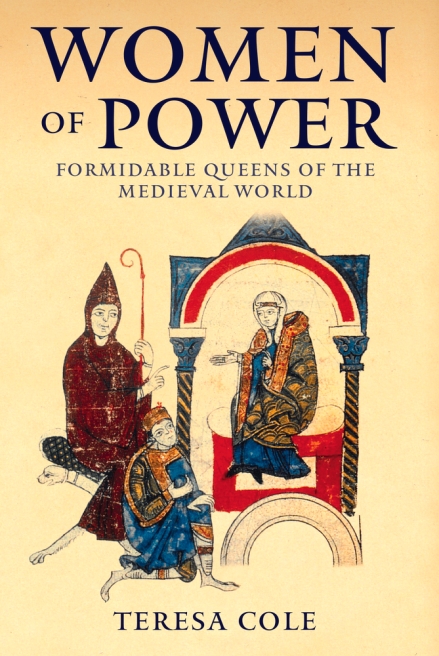
 When we think about medieval women, we often think about very pious figures who relied on men, had numerous children, and would often fade into obscurity when they died. While this would be the ultimate fate for many women, it was not so for those close to thrones worldwide. In times of war and political upheaval, the daughters, the wives, and the queens picked up the pieces and patched their respective kingdoms back together. In her latest book, “Women of Power: Formidable Queens of the Medieval World,” Teresa Cole has chosen a select group of women to highlight her point about the strength of women who held power in the Middle Ages.
I would like to thank Amberley Publishing for sending me a copy of this book. When I heard about this book, I had an inkling about which women would be included in this conversation, but I wanted to see who else Cole included in her book and if she decided to stay in England or venture off to other countries.
The group of powerful women that Cole has chosen to highlight in this book are Emma of Normandy, Matilda of Tuscany, Empress of Matilda, Matilda of Boulogne, Melisende of Jerusalem and her sisters of the Outremer, and Eleanor of Aquitaine. In terms of history, it is a span of close to three hundred years, covering everything from the Viking invasions of England, the Anarchy, the Holy Roman Empire vs the Papacy, the Crusades, and the reign of Henry II. It is a lot to cover in one book, but what Cole does well is that she has chosen women whose stories are interconnected to create a glimpse of the political environment in Europe and the Middle East during this time.
Before reading this book, I knew quite a bit about Emma of Normandy, Empress Matilda, Matilda of Boulogne, and Eleanor of Aquitaine, so those sections felt like a review for me. The stories of Matilda of Tuscany and Melisende of Jerusalem with her sisters of the Outremer were filled with new information for me and while I thoroughly enjoyed learning about Melisende of Jerusalem and the Outremer, I had such a struggle reading about Matilda of Tuscany.
There were so many popes, anti-popes, and Holy Roman Emperors during that period in which Matilda ruled Tuscany, I wish Cole had included some sort of chart to make it easier to follow. I also wish that Cole spent a little bit more time focusing on the women instead of their male counterparts in the chapters to truly highlight their strengths because there were points where I felt like the women were being lost in their chapters.
Overall, I think Cole does a decent job highlighting the women and the periods in this book. It does show a glimpse into the hardships women had to endure to hold onto power in the medieval world. If you want to explore the Middle Ages with some new historical figures who left their marks on the past, I recommend you read, “Women of Power: Formidable Queens of the Medieval World” by Teresa Cole.
 When we think of the German Duchy of Cleves, our first thoughts tend to go to Anna of Cleves, King Henry VIII’s fourth wife, whom he immediately divorced due to not being attracted to her looks, at least according to English tales. We tend to leave Anna’s German life to the side and forget about her family’s story when we study the ever-changing 16th and 17th centuries, even though Germany was dealing with the Reformation. We have an inkling about how life might have been like for Anna of Cleves in England with the fabulous book, “Anna, Duchess of Cleves: The King’s Beloved Sister,” but what about Anna’s siblings, Sybylla, Wilhelm, and Amalia? Heather Darsie has decided to take up the challenge of telling the story of Anna of Cleves’ family from the German perspective in her latest book, “Children of the House of Cleves: Anna and Her Siblings.”
 Adventures of a Tudor Nerd