
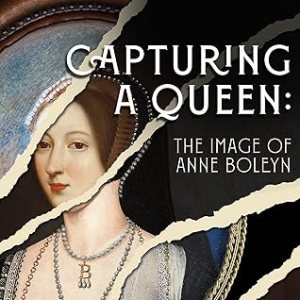
 Have you ever stared at a portrait of a historical figure and wondered if that’s what they really looked like? Anne Boleyn is one of the most famous queens in all of English history. Her image of a woman with dark hair, wearing a dark gown with a French hood, and a B initial necklace. For many people, this is what Anne Boleyn looked like, but is that accurate? What did Anne Boleyn look like, and why does it matter? The most recent exhibit at Hever Castle explores these questions, and the book that accompanies this exhibit goes deeper into the research behind this exhibit. The book shares the same name as the exhibit, “Capturing a Queen: The Image of Anne Boleyn” by Owen Emmerson and Kate McCaffrey.
I would like to thank Owen Emmerson for sending me a copy of this book. I have been interested in this exhibit ever since it was announced that Dr. Owen Emmerson and Kate McCaffrey were researching portraits of Anne Boleyn. Since I could not visit the exhibit in person, I really wanted a copy of this companion book as a way to support the research that is ongoing at Hever Castle.
So how can we possibly understand what a woman who lived over 500 years ago looked like? Well, to begin with, we need to examine how her daughter, Queen Elizabeth I, brought her mother’s name and figure out of obscurity to solidify her own legitimacy as Queen of England. We get an exploration of corridor portraits and the famous Chequers Ring to show how the Elizabethans remembered Anne Boleyn. The book then moves to the term damnatio memoriae, which was a Roman practice to eliminate someone’s name and images from history. In the case of Anne Boleyn, her image and name were not eliminated, and in fact, we do have a few artifacts that survived to the modern day, including some that were recently discovered, and her personal books.
Now, we come to the main topic of the exhibition, what Anne Boleyn looked like. We get to examine physical descriptions of Anne, including her hair color, which might surprise people. We also get a glimpse of how Anne’s European education shaped her time as queen consort. Finally, Emmerson and McCaffrey give their readers a deep dive into contemporary portraits of Anne, what messages the portraits tell, and how the image of Anne transformed over the centuries through different media. This includes an in-depth analysis of the Hever Rose portrait, which is one of the most famous portraits of Anne Boleyn, that recently underwent more scientific research.
I loved this book so much. I learned a great deal from this book, and I am sure the exhibit is fabulous in person. The amount of research that went into this exhibit and this book was extraordinary, and I applaud the respect that they gave to those historians who came before in this field of research. If you are a Tudor nerd or an Anne Boleyn fan, the new exhibit at Hever Castle is a must-see exhibit, and “Capturing a Queen: The Image of Anne Boleyn” by Owen Emmerson and Kate McCaffrey is a book you must read.
 When we think of famous artists in the 15th and 16th centuries, we focus on the great European masters. Michelangelo, Leonardo da Vinci, and Albrecht Durer tend to come immediately to mind. However, one man from Augsburg, Germany, revolutionized how we viewed the Tudor dynasty through portraiture: Hans Holbein the Younger. Many are familiar with his famous works of art and how they influenced how the Tudors have been perceived for centuries, but the man behind the masterpieces has been overlooked. His story and how art was understood in the 16th century is told in Franny Moyle’s latest biography, “The King’s Painter: The Life of Hans Holbein.”
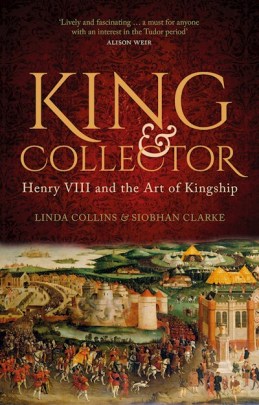 When we think of the legacy of King Henry VIII, a few descriptions come to mind—married six times, father of three children who would be the king and queens of England one day. We often see him as a man conflicted with religious changes and someone who could be tyrannical when dispatching his enemies and those closest to him. We don’t usually associate Henry VIII with a collector and patron of fine art, but his collection would help bring the Royal Collection to life. The artwork that Henry VIII commissioned and collected tells how he wanted to be viewed by the world. In “King and Collector: Henry VIII and the Art of Kingship,” Linda Collins and Siobhan Clarke peel back the layers of Tudor propaganda to show the truth about King Henry VIII and the artists who made his ideal image.
 Adventures of a Tudor Nerd