
 Today, I am pleased to welcome Catherine Mathis to my blog to discuss Ines de Castro, the main protagonist of her novel, “Ines,” the first book in her Queens of Portugal trilogy. I would like to thank The Coffee Pot Book Club and Catherine Mathis for allowing me to participate in this blog tour.
Inês resides more in our imaginations than in fact. She lived, had children, and died.
Her family came from Galicia, in the northwest of Spain, where the famous city of Santiago de Compostela is located. Her father was a powerful noble, Pedro Fernãndez de Castro. Her mother, a noblewoman of Portuguese antecedents, was the mistress of her father. Her birth was illegitimate, which narrowed many of the choices available in her social class. She had kings in her lineage. Her parents also had a son, Alvaro. It is recorded that Alvaro became a good friend of the Pedro in this tale.
Some accounts say she was raised in Portugal, and others in Castile. Inés could have been a young woman serving in the court of Portugal. But the legend says she came from Castile with Constanza, who married Portugal’s Infante Pedro. Coming with Constanza feels more probable because they were cousins and knew each other. If the legend is true that she and Pedro fell in love quickly, then the odds fall on the side to say their first knowledge of each other was a sudden arrival at court, not her growing up there.
What comes down in the legend is her blonde hair and long neck, neither particular markers of great beauty in medieval Portugal. Yet, she is held out as a beauty. In those days, a high forehead was greatly prized, so women plucked their hair to make their foreheads taller. Did Inês? Probably – what young woman does not follow current fashion?
There are no paintings or drawings for most people at this time. Pedro did leave us with an incredible gift, their sarcophagi. He was instrumental in their design. This is how Pedro remembers Inês.
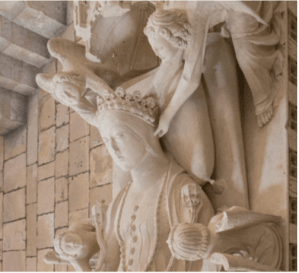
(Effigy of Inês. © Alcobaça Abbey, Portugal.)
My underlying belief for Inês is that her beauty stems partly from appearance and partly from personality. I see her as easy to talk with, an attentive listener, and someone who gives you her full attention. She is loyal. She is determined.
Most of all, Inês is true to herself. She is likely just 14- or 15-years old when she arrives on the scene. We know nothing of her years beforehand. I expect she could read and write as well as stitch and hunt, all skills of a medieval noblewoman. I believe that having suffered the shame of her birth, she desired the life of a legitimately married woman. She would eschew being mistress of any man, even the heir to the throne. Combine her marriage goal with her loyalty to her cousin Constanza, Pedro’s wife, and just sleeping with Pedro was out of the question. When you are marked young with an unfortunate circumstance, the power of motivation to alter the course of your life is strong. She will suffer for her choices, losing the trust of the king and being exiled. Repeatedly, the crown of Portugal throws obstacles in her way, and she perseveres.
Then comes the day when Pedro plays his part. A widower, he holds out the promise of marriage. No one sees her as fit to be a queen. Of course, there is political intrigue involving her brothers. Life is never simple when you are in the orbit of the royal family. She loves children. She cares for her cousin’s children and her own with recorded affection.
She is the glue of the story. In the novel, she is caught between two men, one whom she is unworthy to wed and one who repels her. When she rejects the king’s trusted adviser, Gonçalves, his hurt turns to jealous anger. “If I cannot have her, then no man can.” Who will the king trust, his son or his adviser? The choices she makes have dire consequences for our protagonist and antagonist.
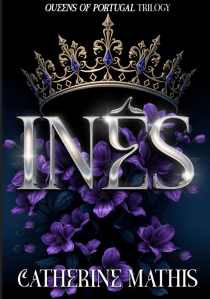 Blurb:
An heir to the throne, a gorgeous blonde lady-in-waiting, the king’s trusted advisor. When a father and son don’t understand each other, the son pays an outrageous price.
Love, jealousy, loyalty, and revenge roil the court of 14th-century Portugal.
In this engrossing launch to the Queens of Portugal trilogy, Catherine Mathis gives a fresh take on the tale of Pedro and Inês, Portugal’s real-life Romeo and Juliet. Pedro’s father would not have been king if not for his trusted advisor, Gonçalves. Once king, he wants no part in neighboring Castile’s royal convulsions, though his son, Pedro, befriends powerful Castilians.
The all-consuming drive of the king is to ensure his line rules Portugal for centuries to come. He needs legitimate, strong heirs. The Infante Pedro loves a woman not deemed worthy to wear the crown as queen. Between father and son is Gonçalves, the king’s powerful, unquestioned counselor, who is a mentor to the son. Both Gonçalves and Pedro seek the attention of Inês.
There is a horrific cost to winning the love of Inês. She will not release her grip on Pedro until he keeps the two sworn oaths he made to her. Can Pedro do the impossible to satisfy Inês?
Inês is based on real people and events, exploring a cultural touchstone of Portuguese history.
Praise for Inês:
“Mathis masterfully weaves emotional depth into the narrative, creating a deeply engaging experience that leaves a lasting impression and invites readers on an unforgettable journey through the grandeur and intrigue of Portugal’s past.”
~ Mary Anne Yarde, The Coffee Pot Book Club 5* Review
“This exciting start to the Queens of Portugal trilogy describes the legendary love story of Pedro and Inês, and I was amazed at the excellent storytelling and how the author brings the courts to life. There is a lot of drama and intrigue, and the characters’ emotions are beautifully captured in this engrossing tale.”
~ Readers’ Favorite 5* Review
Buy Link:
Universal Buy Link: https://books2read.com/u/br8OBY
 Author Bio:
Catherine Mathis was born in Berlin, the daughter of an American spy. As she grew up in Washington, D.C., her spy father turned into a drug enforcement agent. His career change wrecked any chance at high school popularity. She graduated from Sewanee | The University of the South with a degree in history focused on the medieval period. After a career in finance, she returned to her first love of medieval history to ‘Share Iberian Tales.’ Outside of writing, spare time joys are family, friends, reading, collecting folk/outsider art, and travel.
Author Links:
Website: www.catherinemathis.com
Facebook: https://www.facebook.com/profile.php?id=100007239702480
Instagram: https://www.instagram.com/cmathisauthor/
Amazon Author Page: https://www.amazon.com/stores/Catherine-Mathis/author/B0F7FZHJ9T
Goodreads: https://www.goodreads.com/author/show/6987876.Catherine_Mathis
 Throughout English history, a colorful cast of queens has left their marks in their distinct ways. While the Plantagenet and Tudor queens are more well-known, the Stuart queens and the mistresses of the Stuart kings were dynamic in their unique ways. One of the lesser-known queens was the wife of King Charles II. Though Charles II is known for his numerous mistresses, his wife Catherine of Braganza is not discussed much in England, but in her native Portugal, she is famous. So who was Catherine of Braganza, and what is her legacy in England and Portugal? Susan Abernethy tells the story of this almost forgotten queen in her book, “Charles II’s Portuguese Queen: The Legacy of Catherine of Braganza.”
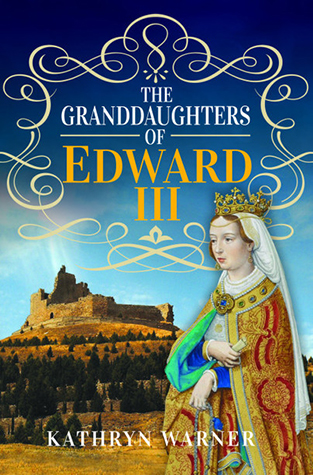 When we think about the legacy of Edward III, we often think about a warrior king who became king after his father, Edward II’s disastrous fall from grace. We know about his sons that he had with his beloved wife, Philippa of Hainault: Edward the Black Prince, Lionel of Antwerp, Duke of Clarence, John of Gaunt 1st Duke of Lancaster, Edmund of Langley, 1st Duke of York, and Thomas of Woodstock, Duke of Gloucester. Famously, we get the 15th-century conflict known as the Wars of the Roses through the descendants of Edward III. However, the male descendants only tell half the story of Edward III and Philippa of Hainault’s legacy in England and throughout Europe. In her latest book, “The Granddaughters of Edward III,” Kathryn Warner examines the lives of Edward III’s female descendants to better appreciate the strength of this group of branches of the Plantagenet family tree.
 Adventures of a Tudor Nerd