
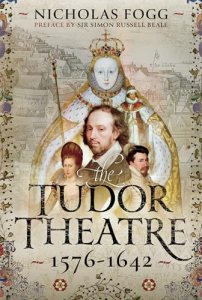
When we think about the world of the Tudor theatre, we often think about the greatest playwrights of the age. Kit Marlowe, Ben Jonson, Thomas Kyd, and of course, William Shakespeare. We think of the Globe Theatre and the grand plays and masques that were performed for the rich and the poor alike. But this is only a small glimpse into the world of the Tudor theatre scene. Nicholas Fogg explores the beginnings and the end of this period in theatrical history in his book, “The Tudor Theatre: 1576-1642.”
I would like to thank Pen & Sword Books and NetGalley for providing me with a copy of this book. I am not very well-versed in theatre history, so I was hoping for something that would be easy for me to follow along, yet also very informative.
Fogg begins in the year 1576 with the opening of The Theatre, which was a passion project of James Burbage. It was the first location dedicated solely to plays and acting, but it will not be the last. Over sixty years, we see the explosion of the theatrical arts from the great playwrights to lesser-known figures. Fogg takes the time to analyze the popular plays and those that don’t get enough attention. We also get to see how politics, the Puritans, and the plague affected the theatre scene. We witness the rise and fall of actors, playwrights, and theatres until the Puritans finally decided to close theatres for good in 1642, once the Stuarts fell for a time.
Fogg is an expert in this field of study, and he shows it on each page, but sometimes, as a novice, I felt a bit lost. The amount of information in this book was a bit overwhelming for someone like me, who is not too familiar with the theatre world. However, if you are someone who loves the Tudor theatre and wants an in-depth look at this period of theatrical history, you might enjoy “The Tudor Theatre: 1576-1642” by Nicholas Fogg.
 Christmas is seen today as a time of gift giving, twinkling lights and joy. We often celebrate it only one day a year, on December 25th, and then we celebrate a few days later the New Year from December 31st to January 1st. However, in the past, Christmas and New Years were a part of 12 days of celebrations. We often think that our traditions for Christmas date from the time of the Victorians, but that may not be the case. In fact, some of our more time-honored traditions for the holidays may in fact date from the Tudors and further back in history. So what are these traditions and how was Christmas celebrated in the time of the Tudors? That is the topic that Alison Weir and Siobhan Clarke wanted to explore in their book, “A Tudor Christmas”.
  Adventures of a Tudor Nerd