
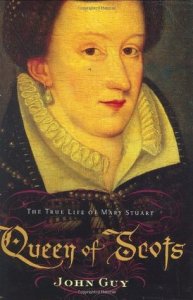
 Women rulers in the past have either been praised or pushed down. They are either seen as ideal women or power-hungry villains. One such figure who suffered the worst from having her image raked through the mud for centuries was Mary Stuart, known throughout history as Mary, Queen of Scots. The Queen of Scotland who was married three times, was once the Queen of France, the mother of the future King of both England and Scotland, accused of having a hand in her second husband’s murder, plotted to overthrow Elizabeth I, and was executed for treason. Her story is well known, but what does the archival information tell us about Mary Stuart? John Guy scoured the archives to find the truth about this queen and presented his research in his biography, “Queen of Scots: The True Life of Mary Stuart.”
I have heard about this particular title for a few years, as it inspired the Mary Queen of Scots movie. I have read similar books about Mary Queen of Scots, but this biography is so revered that I wanted to give it a shot.
Guy begins at the end of Mary’s life, with the day of her execution and the details that made her death legendary. Mary Stuart was the daughter of King James V and Mary of Guise of France. Five days after she was born, her father James V died after the battle of Solway Moss, and the young girl was proclaimed Queen of Scotland; it was solidified nine months later at her coronation. She didn’t have much time to enjoy her youth as she had to deal with the Rough Wooing from England, which was Henry VIII’s attempt to have Mary marry his son Edward VI, which did not end well. Guy shows how Mary’s education began in Scotland before she moved to France, where she would continue to learn how to become a queen before she married Francis II. While in France, Mary started to fight for her claim to the English throne as her father James V was the son of Margaret Tudor. Francis II and Mary would become King and Queen of France for a short time as Francis would tragically die from an ear infection, which meant that Mary had to go back to her native Scotland.
It is in Scotland where we get to see Guy’s research truly shine as he shows how Mary had to navigate her tumultuous court. Mary had to navigate being a queen while searching for her next husband, who ended up being Henry Stuart Lord Darnley. To say their relationship was rocky would be an understatement. Even though Henry was the father of the future James VI/I, he was not the most liked person in court and it ended up costing him his life. Shortly after the death of Darnley, Mary married for a third and final time, to James Hepburn Earl of Bothwell, who was one of the men who allegedly was behind Darnley’s murder. It is the last portion of this book where Guy focuses on the trial, the Casket Letters, and the schemes that led to Mary’s imprisonment and ultimate execution.
I found this a very rich and well-researched biography. I found myself taking my time reading this book as I wanted to fully understand the points Guy was making about Mary and her reign. If you want an excellent biography about a queen whose reputation has been tarnished for centuries, I highly recommend you read, “Queen of Scots: The True Life of Mary Stuart” by John Guy.
 When one thinks about Queens of Scotland during the time of the Tudors, many automatically think of Mary Queen of Scots and her tragic life. However, there was another queen who had a deep connection to the Tudors and was also a queen of Scotland. She tends to be pushed aside in favor of her more famous siblings; Arthur Tudor, Henry VIII, and Mary Tudor. Her story is full of turmoil and triumphs. Her only desire was to unite England and Scotland peacefully, but the choices that she made in her lifetime would prove foolish, leading to more troubles between the two nations. This is the story of Henry VIII’s oldest sister Margaret, which is brought to life in Sarah-Beth Watkins’ book, “Margaret Tudor Queen of Scots: The Life of King Henry VIII’s Sister”.
  Adventures of a Tudor Nerd