
 Two women destined to be rivals for one man’s affection. One is the daughter of royalty, destined to become Queen of England since she was a baby. Her first husband died suddenly, and she married her brother-in-law, the young King Henry VIII. The other woman is the daughter of a family on the rise at court. She has been educated in courts abroad but has returned to her native England to serve the Queen of England, but King Henry VIII falls in love with this young woman. Catherine of Aragon and Anne Boleyn; are two women destined to be rivals, but a new museum exhibit uncovers these women’s similarities. In this corresponding book, “Catherine and Anne: Queens, Rivals, Mothers,” Owen Emmerson, Kate McCaffrey, and Alison Palmer share the latest academic research to understand better these two queens who dominated the 16th century.
This is not the first book I have read that corresponds with a new exhibit at Hever Castle. Last year, I read the book connected with the “Becoming Anne: Connections, Culture, Court” exhibit. Since I cannot visit Hever Castle in time to see this new exhibit, I wanted to read this book to support Hever Castle and the ongoing research to breathe new life into the times of the Tudors.
“Catherine and Anne: Queens, Rivals, Mothers” is a brand-new exhibit exploring the connection between Catherine of Aragon and Anne Boleyn, which is ongoing until November 10, 2023 (although the Book of Hours belonging to Catherine of Aragon will be available to view up until June 4, 2023). Emmerson, McCaffrey, and Palmer give their readers a quick overview of the lives of Catherine of Aragon and Anne Boleyn, including their education, their relationships with Henry VIII, and their daughters, before diving into the piece de resistance of the entire exhibit, the two Books of Hours belonging to the two queens respectively.
Hever Castle’s Assistant Curator, Dr. Kate McCaffrey, has uncovered the remarkable similarities between the Book of Hours owned by Catherine of Aragon (owned by the Morgan Library) and the Book of Hours once owned by Anne Boleyn, which is now located at Hever Castle. Not only were they created by the workshop of Hardouyn. They may have been made in the same workshop, but the differences in the decoration style and how they were used as worship tools show how unique the two queens were.
Although I can’t visit this exhibit, the illustrations and the new research provided an unexpected window into the past. I hope Kate McCaffrey will one day write a book exploring more of her research, as I would most definitely be interested in learning more about it. An informative and delightful little book, “Catherine and Anne: Queens, Rival, Mothers” by Owen Emmerson, Kate McCaffrey, and Alison Palmer, is a book for any Tudor fan.
 Medieval Europe was inundated with strong rulers and dominant figures who made a difference in how the policies of certain countries were formed. We tend to focus on the male figures, from kings to lords and rebels, when we study medieval European history. Still, the women in their lives significantly influenced how their countries were governed. Although many women stood by the side of their husbands and didn’t make much of an impact on European history, some women chose to stand out from the crowd and make a name for themselves. Rebecca Holdorph has chosen to highlight a handful of these dynamic women throughout medieval Europe in her book, “Women in the Medieval Court: Consorts and Concubines.”
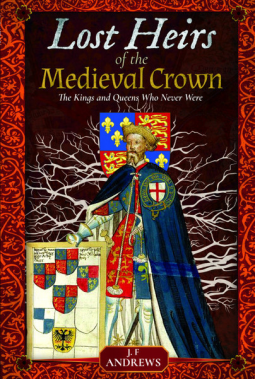 In history, we tend to focus on those who were crowned kings and queens of different nations. Their strengths and their weaknesses. Their accessions and the legacies that they left behind. With every story of someone who triumphed in gaining the throne, there are tales of those who were close to the throne but were never able to achieve the ultimate goal of ruling a nation. These “lost heirs” fall into two categories; either their names live on in infamy or they are thrown into the dust of the past. Who were these men and women and why did they lose their chances to sit on the throne? These questions are explored in J.F. Andrews’ book, “Lost Heirs of the Medieval Crown: The Kings and Queens Who Never Were”.
 In English history, the story of the royal families tends to capture the imagination of those who study it. Full of dynamic tales of kings and queens, and numerous nobles, these are tales that make it into history books and history classes. We tend to focus on the same kings and queens, who have become the popular royals. But what about those who are left in the dust of those popular royals? Who were the royal women who lived in the shadow of the throne that time has forgotten? What were the lives of these women like? It is these women who are the focus of Erin Lawless’s latest book, “Forgotten Royal Women: The King and I”.
 attention towards women like Elizabeth I, Isabella of Castile, Katherine of Aragon, Mary I and Catherine de Medici. These seemed like extraordinary examples of power that stretched the boundaries on what was right and acceptable for women of the time. That, however, couldn’t be further from the truth. In fact, the sixteenth century in Europe was filled with powerful women who do not get the attention that they deserve. In Sarah Gristwood’s book “Game of Queens: The Women who made Sixteenth- Century Europe”, we are shown that it really wasn’t the men who had control, but their wives and daughters.
 Adventures of a Tudor Nerd