
Book Review: “Elizabeth of York and the Birth of the Tudor Dynasty: Uniting the Roses” by Beverley Adams

Throughout English history, some of the most famous queens have been associated with the Tudor dynasty. We have the six wives of Henry VIII (Catherine of Aragon, Anne Boleyn, Jane Seymour, Anna of Cleves, Catherine Howard, and Catherine Parr), Queen Mary I, and Queen Elizabeth I. However, one Tudor queen is often overlooked for her daughters-in-law and granddaughters, the first Tudor queen, Elizabeth of York. So who was Elizabeth of York and what role did she play in the transition between the Plantagenet dynasty and the Tudor dynasty? Beverley Adams hopes to enlighten readers about this remarkable queen in her latest book, “Elizabeth of York and the Birth of the Tudor Dynasty: Uniting the Roses.”

I want to thank Pen and Sword Books and Net Galley for sending me a copy of this book. While I know quite a bit about Elizabeth of York, the Wars of the Roses, and the origins of the Tudor dynasty, I wanted to see how Adams would portray these topics for beginners. 

To begin with, Adams lays out the origins of the conflict that we know today as the Wars of the Roses with Edward III and his sons, John of Gaunt 1st Duke of Lancaster, and Edmund of Langley, 1st Duke of York. This led to a clash between King Henry VI and Richard Duke of York. Elizabeth of York’s father, the future King Edward IV, was the son of Richard Duke of York and he had to fight for his throne. Adams explores Elizabeth’s childhood as the eldest child of Edward IV and his wife Elizabeth Woodville during this tumultuous period of English history, which would form the foundation of what kind of queen she would be in the future.

Everything changed when Edward IV died suddenly, which meant that Elizabeth’s younger brother became Edward V and left Richard Duke of Gloucester as Lord Protector. For some reason, Richard Duke of Gloucester decided to take matters into his own hands, took control of the country, declared the children of Edward IV and Elizabeth Woodville illegitimate (including Elizabeth of York), and was crowned King Richard III in a matter of months. Some resisted the new king including the son of Margaret Beaufort and Edmund Tudor, Henry Tudor. Margaret Beaufort and Elizabeth Woodville arranged a marriage between Henry and Elizabeth that would occur if Henry was able to defeat Richard III and become King of England, which he did at the Battle of Bosworth Field. The rest of this book is dedicated to showing how Elizabeth of York was as a wife, queen, and mother as she dealt with death, treachery from Lambert Simnel and Perkin Warbeck, and triumphs as she was able to see the start of the Tudor dynasty.

I think Adams does a decent job with a book that is an introduction to Elizabeth of York, the Wars of the Roses, and the beginning of the Tudor dynasty. There are some myths that she repeats to debunk, but I feel like, in some places, Elizabeth of York was not the main focus, which was a bit disappointing. Overall, if you want a solid introductory book to the life and times of the first Tudor queen, I would recommend you read, “Elizabeth of York and the Birth of the Tudor Dynasty: Uniting the Roses” by Beverley Adams.

Book Review: “Anthony Woodville: Sophisticate or Schemer?” by Danielle Burton

Anthony WoodvilleThe Woodvilles were a family synonymous with the Wars of the Roses and the rise of King Edward IV. Some of the more notable names from this family include Jacquetta Woodville, the family’s matriarch, and Elizabeth Woodville, the controversial choice for King Edward IV’s wife. However, it was not just the women of the Woodville family who made a name for themselves. Anthony Woodville, the son of Jacquetta and brother of Elizabeth Woodville, would become famous for his unexpected execution at Pontefract Castle. Still, there was so much more to his story than his death. Who was Anthony Woodville and what is his legacy? Danielle Burton hopes to answer these questions and more in her debut biography, “Anthony Woodville: Sophisticate or Schemer?”

I would like to thank Amberley Publishing for sending me a copy of this book. I have had an eye for new takes on the Wars of the Roses and so when I heard about a biography about Anthony Woodville, I jumped at the chance to read it as I knew very little about the man and I wanted to know more.

Burton begins by exploring how Anthony Woodville’s legacy has been overshadowed by other figures in the fifteenth century, like Richard III and Anthony’s sister Elizabeth Woodville. Anthony’s connections with William Caxton, who helped bring the printing press to England, and the education of Edward Prince of Wales, made Anthony a formidable figure all on his own. In fact, unlike the common misconception about the Woodville family, Anthony earned every title on his merits alone. He was not only a scholar and a bibliophile, but also a warrior who fought alongside his brother-in-law King Edward IV.

Anthony Woodville would marry twice in his short life. His first wife was Elizabeth Scales, the daughter and heiress of Thomas Lord Scales and his second bride was Mary FitzLewis. Unfortunately, Anthony had no legitimate children, but he did have an illegitimate daughter named Margaret who would marry Robert Poyntz. It was his connection to the young Prince of Wales that led to his ultimate downfall and rather unjust execution after the meeting with Richard Duke of Gloucester at Stony Stratford.

Burton does have a passion for sharing Anthony Woodville’s story and clearing the air about his legacy. It is a very well-researched biography and Burton does show potential, but there were points where it felt a bit muddled for me. I am interested in seeing who she will write about next. If you want a solid biography about the brother of Elizabeth Woodville and how he impacted the 15th century, I would suggest you read, “Anthony Woodville: Sophisticate or Schemer?” by Danielle Burton.

Book Review: “On This Day in the Wars of the Roses” by Dan Moorhouse

On this day in the Wars of the RosesThe Wars of the Roses, a conflict that engulfed English politics for over 30 years and heralded a new dynasty, the Tudors. While there were battles and political intrigue galore during this period of unrest, there were also births, marriages, and deaths of powerful figures. Each day during the Wars of the Roses holds significance to nobles and commoners alike. Dan Moorhouse has compiled his years of research into this conflict into his book, “On This Day in the Wars of the Roses.”

I would like to thank Dan Moorhouse for sending me a copy of this book. I have been studying the Wars of the Roses for a few years now and so when I hear about books on the subject, I jump at the chance to read them to see if they bring any new revelations to the period.

Like many other books that focus on historical events of the past, Moorhouse highlights each date, starting from January and ending in December. However, unlike other books, the dates do not go in chronological order by year the entries jump from decade to decade, telling a more comprehensive story of the conflict.

Throughout this book, Moorhouse explores major battles, the disappearances of the Princes in the Tower, the madness of King Henry VI, and plots and executions of nobles and commoners alike. We also get to see how commoners got along during these tumultuous times through advancements in trade, alchemy, military tactics, and marriages. By focusing on the stories of those who were not nobility, Moorhouse is showing that even though this was a conflict for the crown, normal life moved on, as it always does.

Moorhouse is very knowledgeable about the period and can share all that he knows succinctly. He is also able to keep a neutral tone, neither siding with the Lancastrians nor the Yorkists, for the historical facts to speak for themselves. I found myself enjoying this book and the new stories from this conflict that I never knew. If you want a different approach to the Wars of the Roses, I recommend you read, “On This Day in The Wars of the Roses” by Dan Moorhouse.

Book Review: “Cecily” by Annie Garthwaite

55818511._SY475_The Wars of the Roses was a time filled with dynamic figures who fought for the right to restore order to England. We often think about the strong warrior men who marched into battle, facing their inevitable doom just for the chance to wear the crown and rule the land. The women who stood by their husbands’ and sons’ sides were just as strong as their male counterparts, even if they did not wear armor. They were on the sidelines, ensuring that they could create alliances that would prove helpful in future conflicts. The most famous examples of strong women during the Wars of the Roses are Margaret of Anjou, Margaret Beaufort, and Elizabeth Woodville. Yet, there was another woman who stood firmly on the side of the Yorkist cause. She was known as the Rose of Raby and the wife of Richard, Duke of York. Her name was Cecily Neville, and she is the protagonist of Annie Garthwaite’s brilliant debut novel, “Cecily.”

I have been a fan of Wars of the Roses historical fiction for a while now, and so when I heard about this novel, I knew I wanted to read it. I usually don’t comment about the covers of books, but this particular cover was simply gorgeous, which added to my desire to read it. Cecily Neville is one of those characters that is rarely given a chance to shine, so this book was a treat to see how Garthwaite would portray her.

Garthwaite’s novel begins with the execution of Joan of Arc, which was an event that Cecily Neville witnessed with her husband Richard Duke of York. It marked a turning point for the English campaign in France as the young King Henry VI was crowned King of France. Richard Duke of York is a cousin of the young king and is considered next in line to the throne until Henry VI has a son. Richard is given command of the French campaign, with his beloved wife by his side. Cecily and Richard have known the sorrow of losing children, but eventually, their family begins to grow with the birth of their eldest son Edward. More children will follow, including Edmund, George, and little Richard often referred to as Dickon.

The campaign in France does not end well, so Cecily, Richard, and their growing family go back to England. Along the way, Henry VI decides to take Marguerite of Anjou as his bride; Marguerite and Cecily start as friends and allies, but their relationship will eventually sour and turn into rivals. Richard and Cecily will travel to Ireland to help their king to show their loyalty. Still, when Henry VI falls ill, Richard believes that he must protect his king and country from men like Henry Beaufort, Duke of Somerset, who is a favorite of Queen Marguerite.

It was during this conflict that Cecily’s true strength shines through. She not only has to be a mother to her growing family, but she has to act as a political advisor and confidant to her husband while staying loyal to her king and undermining the queen’s authority. It was not a rebellion that Richard and Cecily wanted, but they felt that it was a necessary evil to protect their family and their kingdom. To see Cecily protecting her young children from the Lancastrian as her husband and oldest sons flee to fight another day. When Richard and their son Edmund tragically died at the battle of Wakefield, to see Cecily go through her grief while fighting to give Edward a chance to defend her family’s honor was inspiring.

This novel was a delightful read. Garthwaite portrayed Cecily as a strong, independent wife and mother who would stop at nothing to protect her dear ones. For a debut novel, this is a smash hit. It is unique and tells an engaging story that every fan of the Wars of the Roses will love. I cannot wait for Garthwaite’s next novel. If you want a new book with a heroine that you will adore, check out “Cecily” by Annie Garthwaite.

Book Review: “The Colour of Shadows” by Toni Mount

cover_proof crop2The year is 1479, and Richard III is still the Duke of Gloucester. Peace reigns throughout England as Edward IV continues his second reign as king, and for Sebastian Foxley and his household, life is hectic yet thrilling with new projects for his workshop and his family growing. But life has a way of changing rather quickly. When a young boy is found dead in Sebastian’s studio, and another goes missing, the investigation into both cases takes Foxley and those close to him into the nefarious underworld of Bankside and the mysterious The Mermaid Tavern. Can they shed some light into this dark world of shadows to uncover the truth in time to save a life? This is the premise of the latest Seb Foxley mystery by Toni Mount, “The Colour of Shadows.”

I would like to thank Toni Mount for sending a copy of this novel. I will be honest. This is my first Seb Foxley mystery ( I know, I am late to the party since this is the eighth book in the series), but after reading this book, I want to go back and read the series from the beginning.

Since this is my first Seb Foxley novel, I did struggle a bit, in the beginning, to figure out the relationships between these colorful characters. Mount does include elements of previous stories in the dialogue between certain characters that intrigued me. Once I did figure out who these characters were, I feel in love with each and every one of them.

The thing about the Seb Foxley mystery series is that the main characters are average English citizens in the 15th century, focusing heavily on the Wars of the Roses period. This is somewhat unusual since many novels about 15th century England tend to focus on the royal families of York, Lancaster, and Tudor. What Mount has does is simply remarkable by creating such complex and lovable characters. Seb and his wife Emily bickering back and forth in a loving matter while their young family continues to grow. Adam, Seb’s cousin and closest friend who is always there to lend a helping hand. The kind and hardworking Rose who works hard to maintain order in the Foxley household. Tom, the rebellious scamp who believes that everything in life should be given to him on a silver platter. Kate and Jack, the naive youngsters who want to grow up quickly. And of course, the lovable four-legged friend, Gawain, the dog, who is always ready for treats and adventures.

Mount’s world building is, in a word, stunning. The only person I could compare it to is C.J. Sansom and his Shardlake series. I was left mesmerized by how Mount brought her knowledge of the medieval world into this novel to create a believable story. From the typical family life of the Foxley family to the education system, and of course, the seedy and shady underworld of Bankside and The Mermaid Tavern, Mount made medieval London feel so real. The details are impeccably written that I forgot that I was reading a novel.

I did not want this novel to end. Since this was my first Seb Foxley book, I did not know what to expect, but I fell in love with this series and these characters. Mount is a master at making characters feel like real people. I honestly cannot wait to start reading this series from the very beginning to explore Seb Foxley’s world even further. If you want a sublime book to escape into the medieval world or if you are a fan of the Seb Foxley series, I highly recommend you read, “The Colour of Shadows” by Toni Mount. A truly imaginative work of art that you will not want to leave.

Book Review: “Wars of the Roses: Ravenspur- Rise of the Tudors” by Conn Iggulden

41+RQteGLUL._SX324_BO1,204,203,200_By the year 1470, England had been embroiled in a civil war between the houses of York and Lancaster for nearly 20 years. Edward IV was king until he was driven out of the country by his former best friend Warwick and Edward’s own brother, George Duke of Clarence. The House of Lancaster is back in charge with Henry VI, but Edward IV and his other brother Richard Duke of Gloucester are not giving up without a fight. However, there is another family who wants to fight for the throne, the Tudors. How will it come to an end? Who will become King of England when all the major battles come to an end? These questions are answered in Conn Iggulden’s thrilling conclusion to his Wars of the Roses series, “Ravenspur- Rise of the Tudors.”
We are thrown back into the story with Edward forced to leave England and his wife and children forced to go into sanctuary while the Lancasters, with Warwick and George Duke of Clarence taking over military control. We are also introduced to new characters. Jasper Tudor, his nephew Henry Tudor, and Edward’s other brother Richard Duke of Gloucester, who would one day become King Richard III. In his historical note, Conn Iggulden explains Richard, his twisted spine and the struggle he might have had on the battlefield:

For all those who have imbibed a romantic view of King Richard III, I think they have cause to be grateful to Shakespeare, for all the bard’s delight in making him a hunchbacked villain. Without Shakespeare, Richard Plantagenet was only king for two years and would have been just a minor footnote to his brother’s reign. There is not one contemporary mention of physical deformity, though we know now that his spine was twisted. He would have lived in constant pain, but then so did many active fighting men. There is certainly no record of Richard ever needing a special set of armour for a raised shoulder. Medieval swordsmen, like Roman soldiers before them, would have been noticeably larger on their right sides. A school friend of mine turned down a career as a professional fencer because of the way his right shoulder was developing into a hump from constant swordplay- and that was with a light, fencing blade. Compare his experience to that of a medieval swordsman using a broader blade, three feet long or even longer, where strength and stamina meant the difference between victory and a humiliating death. (Iggulden, 456-457).

Iggulden explores the relationship between the main characters; Edward IV, Warwick, Jasper Tudor, Richard III, George Duke of Clarence, and Henry Tudor, and how the events between 1470 and 1485 radically changed their lives forever. The betrayal of Warwick and George and how that affected Edward and Richard. How Edward and Richard leaving England for a time affected Elizabeth Woodville and her children. When Edward and Richard landed in Ravenspur and marched against Warwick and George at the Battle of Barnet. The final defeat of the Lancasterian cause at the Battle of Tewkesbury and what followed after the death of Edward IV in 1483. And of course, the Battle of Bosworth where Henry Tudor wins the crown and begins the Tudor dynasty.

“Ravenspur” is a well-written and thrilling conclusion to Iggulden’s “Wars of the Roses” series. He was able to combine exciting battle scenes with family drama, internal dialogue, and political intrigue to create a masterpiece of a series. The only problem I had with the book was that I did want more dialogue from Elizabeth Woodville, Elizabeth of York and Margaret Beaufort. They seemed to have been sprinkled in when it was convenient. Overall, I found “Ravenspur” engaging and enjoyable. If you have read the three previous books in Conn Iggulden’s series, I highly encourage you to read “Ravenspur- Rise of the Tudors” as it brings the Wars of the Roses to a dramatic end.

Biography: The Princes in the Tower (Edward V and Richard Duke of York)

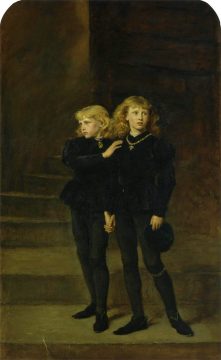
PrincesEdward V (Born November 2, 1470- Date of Death Unknown). Richard Duke of York (Born August 17, 1473- Date of Death Unknown). Sons of King Edward IV and Elizabeth Woodville. Richard was married to Anne Mowbray. Edward V and Richard Duke of York are known as “The Princes in the Tower”. They were placed in the Tower of London after their father’s death and were never seen again. Their disappearances and whether or not they were murdered has become one of the greatest mysteries in history.

Edward and Richard were both the sons of Edward IV and Elizabeth Woodville. Edward IV had married Elizabeth Woodville in secret, causing distrust between Edward and his biggest ally Richard Neville Earl of Warwick. With the rise of the Woodvilles, Warwick feared that they would overthrow his title of the second most powerful man in England.

Warwick decided to side with Edward’s power hungry younger brother George Duke of Clarence, and Louis XI of France, who promised Warwick land in France if he overthrew Edward. Warwick’s plan was to depose Edward and place George on the throne. Warwick had Edward imprisoned in the Tower, but when his reputation began to suffer, he released Edward in October 1469. Warwick and George both decided to reconciled with Edward but Edward never truly trusted either of them ever again.

Warwick knew that if he was going to restore his power, he had to discuss matters with Louis XI and Margaret of Anjou, which meant that he had to defect to the Lancastrian cause, which he did. In September 1470, Warwick and his rebellion made its way to England; Edward was unprepared and was forced to leave England on October 2 and seek aid from his brother in law the duke of Burgundy. His wife Elizabeth Woodville and their children were forced to seek sanctuary at Westminster Abbey. It was there on November 2, 1470 that the future Edward V was born.

Edward returned to England on March 11, 1471. His army defeated Warwick’s army at the Battle of Barnet, where Warwick and John Neville were killed. On May 4, 1471, Edward faced off against the Lancastrian army at the Battle of Tewkesbury, where the Lancastrians were finally defeated and Edward of Westminster was killed. Edward V was created Prince of Wales in June 1471. In 1473, Edward V was moved to Ludlow Castle and was created president of the Council of Wales and the Marches. Edward was in the care of the queen’s brother Anthony, Earl of Rivers, who was a renowned scholar.

Edward’s brother Richard was born on August 17, 1473. In May 1474, he was made Duke of York and the following year, Richard was made a Knight of the Garter. From this point on, the second son of the king was created Duke of York. On June 12, 1476, Richard was created Earl of Nottingham. It was on January 15, 1478 that Richard was married to Anne Mowbray, 8th Countess of Norfolk. The groom was around 4 years old and the bride was 5 years old. On February 7, 1477, Richard was created Duke of Norfolk and Earl Warenne. Richard’s brother Edward was arranged to be married to Anne of Brittany in 1480 to conclude an alliance between England and Brittany, but the marriage never happened. In November 1471, Anne Mowbray died and instead of her Mowbray estates passing onto the next heirs, William, Viscount Berkeley and to John, Lord Howard, Parliament ruled in January 1483 that the estates would pass onto Richard Duke of York.

On April 9, 1483, Edward IV died, leaving his eldest son Edward V to be king at the age of 12. Edward did not hear about his father’s death until April 14, 1483 since he was at Ludlow Castle at the time. Edward IV’s brother Richard Duke of Gloucester was named Lord Protector. On April 29, as previously agreed, Richard and his cousin, the Duke of Buckingham, met Queen Elizabeth’s brother, Anthony Woodville, 2nd Earl Rivers, at Northampton. At the queen’s request, Earl Rivers was escorting the young king to London with an armed escort of 2000 men, while Richard and Buckingham’s joint escort was 600 men. The young king himself had been sent to Stony Stratford. Richard had Earl Rivers, his nephew Richard Grey and his associate, Thomas Vaughan, arrested. They were taken to Pontefract Castle, where they were executed on June 25 on the charge of treason against the Lord Protector after appearing before a tribunal led by Henry Percy, 4th Earl of Northumberland. Richard took the young king under his protection, escorted him to London, and placed him in the Tower for his protection. Elizabeth Woodville took her daughters and Richard Duke of York and fled to sanctuary at Westminster Abbey yet again.

The coronation for Edward V was scheduled for June 1483, but it was postponed. On June 16, it is said that Richard Duke of York joined his brother in the Tower. It was around this time that Richard Duke of Gloucester announced that he believed that Edward IV’s marriage to Elizabeth Woodville had been illegal since Edward IV had a pre-contract marriage arrangement with Lady Eleanor Butler. This meant that his children with Elizabeth Woodville were considered illegitimate, including the young king Edward V and his brother Richard. This meant that the next in line to the throne, Richard Duke of Gloucester, was the rightful king. On June 25, 1483, King Edward V was deposed and Richard Duke of Gloucester became Richard III. We do not know if it is true if Edward IV did indeed enter into a pre-contract marriage with Lady Eleanor Butler.

Edward V and Richard Duke of York were last seen in the Tower in the summer of 1483. We do not know what happened to them. There are theories that they were murdered, which includes a list of suspects including their uncle Richard III as the main suspect. There are also theories that the boys somehow managed to escape the Tower and came back as pretenders like Lambert Simnel or Perkin Warbeck. The simple fact is right now, we do not know what happened to Edward V and Richard Duke of York, “the Princes in the Tower”.