
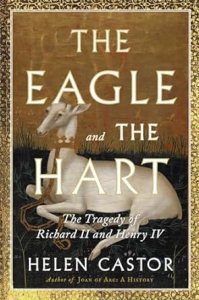
 The story of the Plantagenets is filled with high triumphs and devastating tragedies. It is a story of families torn apart for a crown and the desire to either rule with an iron fist for the glory of England or live a life of luxury at the expense of their citizens. The story explored in this particular book is the tale of two cousins born months apart, Richard of Bordeaux and Henry Bolingbroke. Richard and Henry were not born to become King of England, but Fortune’s Wheel had a different plan for the cousins. So how did these cousins become kings and how did their tale turn to tragedy not only for their relationship but for all of England? Helen Castor tells the tale of these two Plantagenet kings in her latest book, “The Eagle and the Hart: The Tragedy of Richard II and Henry IV.”
I want to thank Avid Reader Press and Net Galley for sending me a copy of this book. I have seen this book on social media and ever since it was announced, I knew I wanted to read it. I have enjoyed Castor’s posts online as well as her documentary on the She-Wolves, based on her book of the same name, so when I heard about this one, it was an intriguing premise and so I jumped at the chance to read it.
The fact that Richard of Bordeaux and Henry Bolingbroke became King Richard II and King Henry IV respectively is quite the story. Richard was the son of Edward The Black Prince and Henry was the son of John of Gaunt; both of their fathers were sons of Edward III and so the idea was that one of his sons would inherit the throne. However, Edward III had different plans after the death of Edward The Black Prince. It was announced that the young Richard of Bordeaux would be crowned King of England. This should have been the first red flag for England because it means that a Regency council must be formed. There are fights for power and fights over finances that culminate in the Peasants’ Revolt. Richard II doesn’t have much desire to fight for his country on the battlefield against the French or the Scottish, but he does care about favoring his favorites, even if it means turning the government against him. One such group, the Appellant Lords, will prove an extremely dangerous challenge for Richard II, and it will include his cousin Henry Bolingbroke. While many of the Appellant Lords will end up dead, Henry Bolingbroke is merely exiled, which in the long run, was not the best decision for Richard II.
In 1400, John of Gaunt died and the title as well as the lands of the Duke of Lancaster were turned over to Richard II while Henry Bolingbroke was in exile in France. This marks the turning point for Henry as he decides to invade England while Richard is away dealing with problems in Ireland. It will end with Richard’s abdication and the coronation of Henry Bolingbroke as King Henry IV. However, things are not all sunshine and rainbows for Henry IV, the 1st Lancastrian King of England, as he finds out that it is not easy being a king.
I must applaud Castor for writing a dual biography that is both balanced and utterly brilliant. It did take me a while to read this book because I was taking so many notes while I was reading and it gave me a better understanding of this tumultuous time. I would suggest that if you do read this book, take your time so that you can understand the complex nature of the conflict between these two cousins. If you are a fan of the Plantagenet dynasty, I highly recommend you read, “The Eagle and the Hart: The Tragedy of Richard II and Henry IV” by Helen Castor.
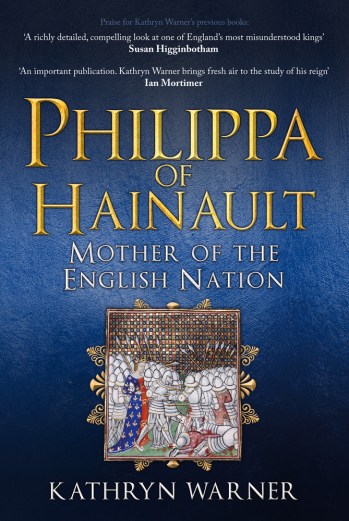 In medieval England, the queens were almost as famous, or infamous, as their husbands. In most cases, they came from royal backgrounds and their sons would become kings. That, however, was the case for Philippa of Hainault, the wife of King Edward III. She tends to be forgotten when it comes to discussing her famous husband, her infamous mother-in-law Isabella of France, and her sons whose children would go on to shape English history forever. That is until now. Kathryn Warner has decided to discover the truth about this rather remarkable woman in her latest biography, “Philippa of Hainault: Mother of the English Nation”.
 Adventures of a Tudor Nerd