
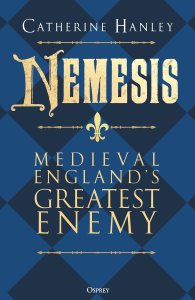
 The Plantagenets, one of England’s most dynamic dynasties, were always in the middle of some sort of conflict. Whether they were fighting foreign adversaries, their own people, or their own family, it felt like the Plantagenets were always getting into some sort of trouble. And there was one king who knew how to use the weaknesses of the kings of England to his advantage. He was King Philip II of France, also known as Philip Augustus. He had to deal with four different Plantagenet kings and had a strategy for each one of them. Just what were Philip II’s strategies, and how did his reign affect English/French relationships as a whole? These questions are answered in Catherine Hanley’s book, “Nemesis: Medieval England’s Greatest Enemy.”
I would like to thank Osprey Publishing and Net Galley for sending me a copy of this book. I enjoy reading about the Plantagenets and their impact on England and Europe as a whole. When I saw that this book took a French approach to the Plantagenets and focused on Philip Augustus, it was an intriguing premise to me.
As Hanley states in the introduction, this book is not your typical biography, as she focuses on the relationship between Philip Augustus and his Plantagenet opponents. That does not mean that we do not get biographical information for Philip, who was the son of Louis VII and Adela of Blois. Per tradition, as the heir to the French throne, Philip was crowned as Junior King of France on November 1, 1179, which meant that his father was still alive when he was crowned, and he trained to become the proper King of France.
While Philip knew that he had factions to deal with inside of France, his main concerns were overseas with the Plantagenets, primarily King Henry II and his sons. Over the course of his forty-year reign, Philip dealt with Henry II, Richard I the Lionheart, John, and Henry III. Each English king presented his own challenges for Philip, but Philip took them in stride and worked hard to make France stronger. At the same time, Philip had to deal with his own family dramas. He was married three times to Isabelle of Hainault, Ingeborg of Denmark, and Agnes of Merania. It was his marriage to Agnes of Merania that gave Philip his heir, the warrior King Louis VIII of France. However, it was Ingeborg of Denmark who gave Philip the biggest headache as she never gave up fighting for her marriage.
From military to political strategies, Hanley shows how Philip maneuvered against the English, and yet she shows that he was not a perfect person or a king. Philip was a flawed human who had to deal with the cards he was dealt like anyone else. Hanley presents a comprehensive book that explores the complex nature of medieval politics and how one man battled against an entire dynasty during his reign. If you are someone who wants to explore the early Plantagenets from the eyes of their enemy, King Philip II of France, I recommend you read “Nemesis: Medieval England’s Greatest Enemy” by Catherine Hanley.
 The Crusades were conflicts predominantly focused on the stories of knights, kings, popes, Christians, and Muslims. We have some stories of women like Eleanor of Aquitaine who joined their husbands in battle. However, some women’s stories tend to get lost in the sands of the past. Take, for example, Eleanor of Aquitaine’s daughter-in-law, Berengaria of Navarre, the wife of Richard the Lionheart. Amid the Third Crusades, she must join Eleanor of Aquitaine on a treacherous journey to meet her husband while he battles for Jerusalem. Can Richard and Berengaria survive the journey to and from the Holy Land and produce the desired heir for the English throne before their enemies can claim victory? Carol McGrath has chosen to tell the tale of the forgotten queen Berengaria of Navarre in her latest novel, “The Lost Queen.”
 Author Bio – Following a first degree in English and History, Carol McGrath completed an MA in Creative Writing from The Seamus Heaney Centre, Queens University Belfast, followed by an MPhil in English from the University of London. The Handfasted Wife, first in a trilogy about the royal women of 1066 was shortlisted for the RoNAS in 2014. The Swan-Daughter and The Betrothed Sister complete this highly acclaimed trilogy. Mistress Cromwell, a best-selling historical novel about Elizabeth Cromwell, wife of Henry VIII’s statesman, Thomas Cromwell, was republished by Headline in 2020. The Silken Rose, the first in a medieval She-Wolf Queens Trilogy, featuring Ailenor of Provence, saw publication in April 2020. This was followed by The Damask Rose. The Stone Rose was published in April 2022. Carol is writing Historical non-fiction as well as fiction. Sex and Sexuality in Tudor England was published in February 2022. The Stolen Crown 2023 and The Lost Queen will be published on 18th July 2024. Carol lives in Oxfordshire, England, and in Greece.
 Blurb
Blurb Author Bio:
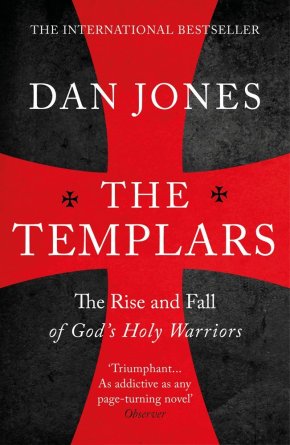 The Crusades were a series of wars between Christian and Muslim warriors for the right to control the Holy Lands of the Middle East. Many men on both sides earned legacies that would surpass their earthly bodies during bloody battles. It created many bands of knights that would last for generations, such as the Hospitallers and the Teutonic Knights. The Templars were the most famous of these knight groups, who may have lasted only for less than two hundred years, but whose legacy would turn into myth. Dan Jones has taken on the arduous task of discerning fact from fiction about the Templars in his book, “The Templars: The Rise and Fall of God’s Holy Warriors.”
 The story of the Crusades has been told in many different ways from numerous directions. The epic conflict between Christianity and Islam for the Holy Lands that went on for centuries that has lived in infamy. Many questions have arisen as historians try to separate facts from the myths surrounding this topic. How and why did it start? Why did it continue to go on for so long? Was there really a winner in this conflict? Who were the people who defined this conflict? Dan Jones has taken on the challenge of writing a comprehensive history of this conflict and the people who fought during this time in his latest book, “Crusaders: The Epic History of the Wars for the Holy Lands”.
 Adventures of a Tudor Nerd