
 I am pleased to welcome Deborah Swift back to my blog today to share information about the real-life locations for her latest novel, “The Cameo Keeper.” I would like to thank Deborah Swift and The Coffee Pot Book Club for allowing me to participate in this blog tour.
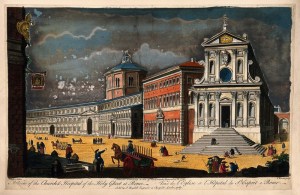
Santo Spirito Hospital
One of my characters, Jacopo Vanelli, is a surgeon, so he spends his time at the Santo Spirito Hospital in Rome. The ‘Holy Spirit’ hospital was founded in the Middle Ages and was recognised as one of Europe’s oldest and most advanced hospitals. Its remit included not only tending to the sick and the poor, but also taking in unwanted babies, abandoned children, and travellers who fell ill within the bustling heart of Rome.
Within its grand Renaissance walls, was a museum, an apothecary shop, a public operating theatre and an orphanage run by nuns. The operating theatre became an influential centre for medical education — hosting lectures, dissections, and practical training sessions that drew aspiring doctors from across Italy and Europe.
Here is the octagonal tower of the main building, below.

The architecture of the hospital was striking, with vast wards, airy cloisters, and a famous spiral staircase designed to allow for the swift transfer of patients. Ornate chapels and frescoes adorned the interior, along with stained glass windows. It was seen as an extension of the Church, in what was considered the holiest city in the Western world.
The Ruined Roman Baths

By the 17th century, the once-magnificent Roman baths of the city stood as haunting reminders of Rome’s imperial past. Structures such as the Baths of Caracalla and the Baths of Diocletian, though partially collapsed and overgrown, continued to inspire awe with their towering arches and crumbling mosaics. Locals and visitors alike wandered amidst these grand ruins, imagining the bustling social life and sophisticated engineering that had filled these halls centuries before.
This was an ideal place for lovers to meet, and two of my characters meet at the Baths of Caracalla. Mostly in decay, the stone was pillaged to build new buildings, but there was also a market in trinkets and souvenirs that went on there amongst the ruins. Artists and antiquarians flocked to the baths, sketching their weathered columns and broken statues, and imagining the naked bathers of centuries before.
The Vatican Apartments

One of my characters is the Pope’s sister-in-law, Donna Olimpia Maidalchini, a powerful and wealthy woman who dominated Roman life. Many of my scenes take place in the Vatican Apartments, which represent the heart of papal authority and splendour. These lavish chambers were home to the Pope and his closest advisors, serving as both living quarters but also the centre of Rome’s governance. The apartments showcased the best artistry of Renaissance and Baroque craftsmen. Daily life within the Vatican Apartments was a blend of solemn ritual and political intrigue, with cardinals, diplomats, and foreign dignitaries as regular visitors.
The most celebrated rooms, such as the Raphael Rooms and the Sistine Chapel—already famed for Michelangelo’s ceiling—were objects of wonder and inspiration for all who visited. The Vatican Apartments thus stood not only as the spiritual and administrative core of the Catholic world, but also as a testament to Rome’s enduring patronage of the arts and its pivotal role in shaping the cultural legacy of the 17th century.
Rome is a fabulous place to set a novel with many beautiful and atmospheric locations, and I hope I’ve used them all to advantage in The Cameo Keeper.
 Blurb:
Rome 1644: A Novel of Love, Power, and Poison
Remember tonight… for it is the beginning of always ― Dante Alighieri
In the heart of Rome, the conclave is choosing a new Pope, and whoever wins will determine the fate of the Eternal City.
Astrologer Mia and her fiancé Jacopo, a physician at the Santo Spirito Hospital, plan to marry, but the election result is a shock and changes everything.
As Pope Innocent X takes the throne, he brings along his sister-in-law, the formidable Donna Olimpia Maidalchini, known as La Papessa – the female Pope. When Mia is offered a position as her personal astrologer, she and Jacopo find themselves on opposite sides of the most powerful family in Rome.
Mia is determined to protect her mother, Giulia Tofana, a renowned poisoner. But with La Papessa obsessed with bringing Giulia to justice, Mia and Jacopo’s love is put to the ultimate test.
As the new dawn of Renaissance medicine emerges, Mia must navigate the dangerous political landscape of Rome while trying to protect her family and her heart. Will she be able to save her mother, or will she lose everything she holds dear?
For fans of “The Borgias” and “The Crown,” this gripping tale of love, power, and poison will keep you on the edge of your seat until the very end.
Praise:
‘historical fiction that is brisk, fresh and bristling with intrigue’
~ Bookmarked Reviews ★★★★★
Buy Link:
Universal Buy Link: https://mybook.to/CameoKeeper
 Author Bio:
Deborah Swift is the author of twenty novels of historical fiction.
Her Renaissance novel in this series, The Poison Keeper, was recently voted Best Book of the Decade by the Wishing Shelf Readers Award. Her WW2 novel Past Encounters was the winner of the BookViral Millennium Award, and is one of seven books set in the WW2 era.
Deborah lives in the North of England close to the mountains and the sea.
Author Links:
Website: www.deborahswift.com
Instagram: https://www.instagram.com/deborahswiftauthor/
Twitter / X: https://twitter.com/swiftstory
Facebook: https://www.facebook.com/authordeborahswift/
Pinterest: https://www.pinterest.co.uk/deborahswift1/
 The year is 1599 in Rome, Italy. A young rich woman stands in front of an executioner’s block. She is a mother, a daughter, a sister, a lover, and a killer. Her victim was her father, a man who made her life and the lives of her family members a living hell. When she falls in love with one of her father’s spies, she believes that it is a way out. However, the path she chooses to embark on will bring deadly consequences. What is the truth surrounding this case, and is Beatrice Cenci a cold-blooded murderer or a victim looking for her freedom? Elizabeth Fremantle explores the life of Beatrice Cenci and the circumstances of this crime in her latest novel, “Sinners.”
 When we think about travel in the Middle Ages, we often think of wealthy nobles or those who went to war fighting in foreign lands. However, that is merely a misconception. Travel was open to everyone, from the wealthy, the poor, the pious pilgrims, and the merchants. Each group had their reasons for traveling to different countries. Still, they all wrote down their experiences to tell future generations about their encounters and encourage others to explore the world, both the known and unknown parts. Anthony Bale has compiled many of these accounts into one comprehensive book called, “A Travel Guide to the Middle Ages: The World Through Medieval Eyes.”
 Adventures of a Tudor Nerd