
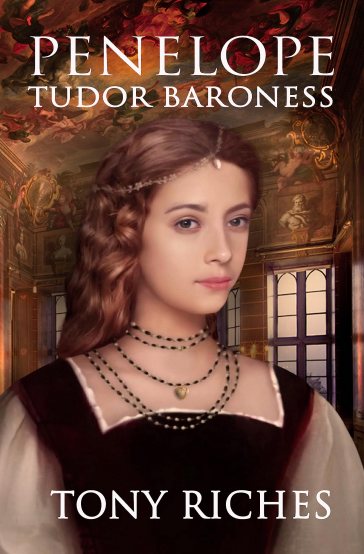
 In a time when marrying for love was taboo, one woman took a stand to follow her heart no matter the consequences. Lady Penelope Devereux, the daughter of Lady Lettice Knollys and the step-daughter of Sir Robert Dudley understands how dangerous it is to defy the wishes of Queen Elizabeth I. Her mother and stepfather were banished from court for choosing to marry secretly, but this did not deter Penelope from pursuing love. A story spanning decades, full of love, intrigue, and plots galore, “Penelope- Tudor Baroness” by Tony Riches tells the tale of this remarkable woman and her family.
I would like to thank Tony Riches for sending me a copy of his latest novel. I have been a fan of Riches’ previous novels, which were written about male protagonists, so when I heard that he was writing a book about a Tudor woman, I was curious. I did not know much about Penelope’s life before this novel and I wanted to learn about her life.
Riches begins his novel with Penelope as a young woman going to work at court as a maid of honor for Queen Elizabeth I. It is a great honor as her parents were Lord Walter and Lady Lettice Devereux. To learn what it meant to be a maid of honor, she and her siblings went to the house of Catherine Hastings, Countess of Huntingdon. It seemed as if Penelope was destined for greatness, but it all came crashing down when her mother Lettice married the queen’s favorite, Sir Robert Dudley. A devastating blow for a young woman who wanted a role in the glittering Tudor court, but it did not deter her for long.
Penelope was a woman known for her beauty as she caught the attention of men like Anthony Bagot before she ever set foot in Elizabeth’s court. Her looks captured the attention of Sir Philip Sidney, who wrote the sonnet Astrophel and Stella in her honor. Sidney had her heart, but she would marry a man she did not love, Lord Rich. She is willing to risk everything for love, including her standing at court and the family she has with Lord Rich, but the man she risked it all for is not Sir Philip Sidney. The man who had Penelope’s heart for over 20 years was Charles Blount.
Penelope saw great change during her lifetime. She saw Elizabeth courting the Duke of Anjou and the attack of the Spanish Armada. She was in the middle of her brother’s failed rebellion against Queen Elizabeth, which was known as the Essex Rebellion. Penelope swore loyalty to King James I as Queen Elizabeth was approaching the end of her life and she was there as a lady of the bedchamber for Queen Anne of Denmark. Towards the end of her life, Lady Penelope Rich saw the impact of the Gunpowder Plot against King James I, her divorce from Lord Rich, and fighting for the rights of her children with Charles Blount.
Riches weaves a delightful tale of love, and loyalty to one’s family even amongst plots for power. Penelope was a strongly independent woman who fought for love and her family, even if that meant becoming enemies with the most powerful people in England. A remarkable woman who left her mark on both the Tudor and Stuart dynasties, Lady Penelope Rich took her life and legacy into her own hands. “Penelope- Tudor Baroness” by Tony Riches is a gorgeous novel that fans of Tudor and Stuart history will adore.
 learning and discoveries. While that is true, like any age, there were good elements and bad elements. We tend to overlook the bad elements with Elizabeth’s “Golden Age” and move on to the good elements. However, we cannot get a full image of the age if we only look at the good elements. That is why A.N. Wilson wrote the book “The Elizabethans”:
 Adventures of a Tudor Nerd