Guest Post: “Gilded Power – The Jewelry Legacy of the Tudors” by Sam Mee

I am pleased to welcome Sam Mee, founder of the Antique Ring Boutique, to my blog today to share an article about Tudor jewelry.

Jewelry was predominantly religious in the austere Middle Ages, focusing on relics, devotional rings, and crosses. But the Tudor rulers developed it as a way to project their own royal power and authority. Clothing fashions of the time emphasized structure, and monarchs like Henry VIII and Elizabeth I integrated jewelry to proclaim their status and divine favor. 

This was the age of portraiture, when the elite commissioned likenesses as propaganda. Hans Holbein the Younger depicted Henry VIII in a way that showed off his jewels and chains of office as much as his formidable bulk (and codpiece). Holbein’s most famous image of Henry is a 1537 mural that, while destroyed by fire in 1698, is still known through copies. It shows the King with a powerful stance and wearing multiple chains and rings to further emphasized his authority and wealth.

Holbein portrait, public domain image: https://upload.wikimedia.org/wikipedia/commons/thumb/f/f9/After_Hans_Holbein_the_Younger_-_Portrait_of_Henry_VIII_-_Google_Art_Project.jpg/1024px-After_Hans_Holbein_the_Younger_-_Portrait_of_Henry_VIII_-_Google_Art_Project.jpg

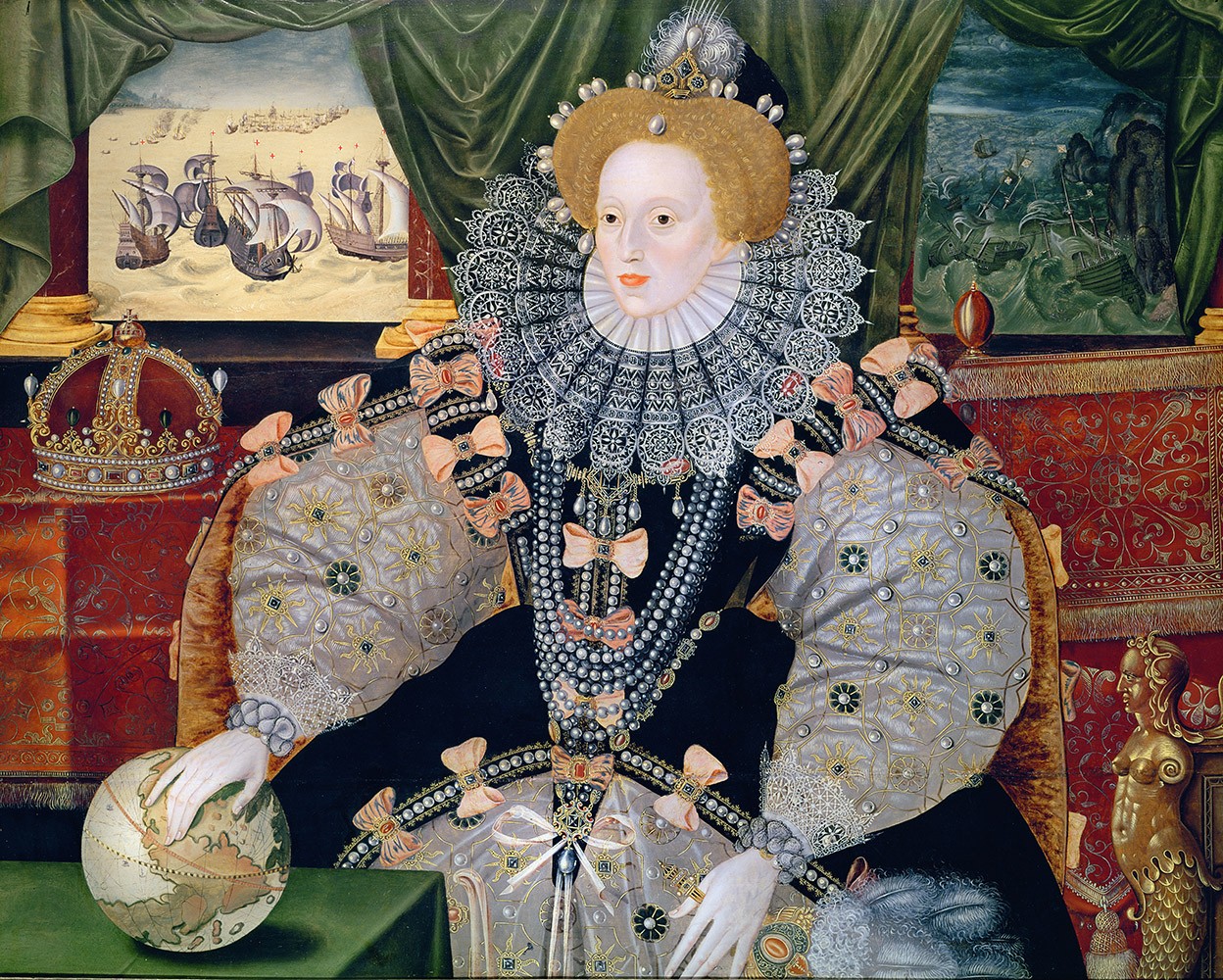
Three similar Armada portraits of Elizabeth I were painted after England defeated the Spanish Armada. They take allegory even further. The Queen is almost encased in pearls. Her gown is embroidered with them, they sit on her hair, and pearl ropes hang from her neck, all to symbolize chastity and divine protection. More explicitly, her hand rests on the globe as a symbol of empire. Her powerful warships are visible in the background behind her gem-encrusted crown, signifying divine authority. 
Armada portrait, public domain image: https://upload.wikimedia.org/wikipedia/commons/7/7b/Elizabeth_I_%28Armada_Portrait%29.jpg

In fact, Elizabeth I was rarely painted without pearls – other examples include the Darnley Portrait (c1575) and Rainbow Portrait (c1600). The pearls repeatedly symbolized the Virgin Queen’s chastity and wealth in bodily form.

The sumptuary laws

If gems and clothing signified power, then rulers needed to control who wore what. Medieval 15th-century sumptuary laws started to codify this across Europe. A 1463 English statute restricted who could wear “royal purple”, while a 1483 act restricted velvet to knights and lords and satin for gentry with a yearly income of £40.

Tudor England was an intensely hierarchical society, and so the laws were tightened further. Elizabeth’s 1574 Act of Apparel spelled out in detail who could wear what – her rules set which fabrics hats could be made of and dictated the length of swords, depending on the wearer’s standing. Check out the list here: https://midtudormanor.wordpress.com/sumptuary-laws/

Jewelry was also regulated with gold chains, heavy pearls, and precious stones reserved exclusively for the nobility. 

Enforcement was patchy but real, with surviving court records showing individuals tried for breaches and fined. These laws were somewhat symbolic, though. They were a way to make hierarchy visible rather than consistently enforced. Ambitious merchants and courtiers often flaunted jewels beyond their rank, with monarchs turning a blind eye.

Fashion at court

Jewelry was inseparable from clothing at court. Goldsmiths worked hand in hand with tailors, and jewels were sewn directly into doublets and headdresses.

We know Henry VIII wore vast gold chains and pendants and even occasionally jeweled codpieces. Courtiers followed suit with jeweled hat badges, enameled rings, and ornate girdle books (these were tiny, jeweled prayer books that hung from belts). They also wore gold pearl earrings. Women sported pearls, rubies, and diamonds on top of layered dresses made from richly embroidered fabrics. 

Anne Boleyn’s necklace – a large gold “B” with three drop-pearls dangling from it – is one of the period’s most famous jewels. It’s a very personal bit of jewelry that symbolized her individuality and status. (It survives only in portraits – its whereabouts after her 1536 beheading is not known).

Anne Boleyn’s B necklace, public domain image: https://upload.wikimedia.org/wikipedia/commons/f/f2/Anne_boleyn.jpg

Global trends and treasures

The rise in the prominence of jewelry was part of a wider trend of expanding horizons – culturally, societally, geographically, and economically. Spain’s influx of New World gold and silver boosted Europe’s wealth, with England claiming its own share through figures like Sir Walter Raleigh and Sir Francis Drake.

There’s extraordinary archaeological evidence of this, not just from the images of the time but from the Cheapside Hoard, discovered in 1912 beneath a London cellar. It’s a collection of more than 400 pieces. There are emerald rings, diamond pendants, and enameled chains with gems sourced from Colombia, India, Burma, and Brazil. The treasure shows that London goldsmiths had access to a global supply of jewels long before the height of the empire. 

Together with portraits, the Hoard is the richest record we have of Tudor jewelry, showing how jewels were actually made. You can read more about it here: https://www.londonmuseum.org.uk/collections/london-stories/jewels-cheapside-hoard/

Evolution of Tudor Jewelry

New fashions, new materials, and new freedoms (for some). Tudor jewelers developed new techniques to match these wider changes in society, combining medieval traditions with Renaissance artistry. Enameling reached new heights, and these techniques were carried forward into Georgian mourning jewelry and even into Victorian revival pieces.

Foil-backing was widely used in Tudor times to enhance jewels. Thin sheets of colored foil were placed behind gems like diamonds, rubies, or rock crystal to enhance their brilliance. This technique remained common until the 18th century, when more advanced diamond cutting began to produce inherent sparkle.

Gem cutting itself advanced in the Tudor period. Gemstones are rarely cut in bespoke shapes but tend to use standardized cuts designed to maximize brilliance or colour. This has been true since the Renaissance. Earlier medieval gems were typically worn as cabochons (smooth, polished domes), which enhanced colour but not brilliance. Then, from the late 15th century, jewelry began to experiment with faceting, where flat surfaces were cut at angles to reflect light, and Tudor lapidary work played a key role in the development and take-up of new techniques:

  • Cabochon: The oldest approach. A smooth, rounded dome without facets. Used in the medieval period for sapphires, garnets, and emeralds.
  • Point cut: This simple cut shaped a diamond into a pyramid with four sides. Mostly common in the 15th century.
  • Table cut: Developed in the late 15th century, this removed the top of the pyramid to create a flat “table” facet. It meant increased brilliance and became standard in Tudor jewelry.
  • Rose cut: Emerged in the 16th century as diamond saws and polishing technology improved. This had a flat base and a domed top covered in triangular facets to resemble a rosebud. The rose cut was popular until the 19th century.
  • Old mine cut: An 18th-century development. It’s a squarish cut combined with a high crown, deep pavilion, and large culet. It was the forerunner of the modern brilliant cut.

You can read more about the evolution from medieval jewelry techniques here. (https://historicalbritainblog.com/the-debt-antique-jewellery-owes-to-the-middle-ages-guest-post-by-samuel-mee/)

Settings in Tudor times typically enclosed the stone with gold, but Tudor jewelers began experimenting with more open settings to admit light. It was the Stuart era that really saw the development of the claw setting for diamonds, where the gem was held with tiny metal arms to allow much more light to pass through, dramatically increasing sparkle.

Tudor trends can be seen in subsequent centuries: 

  • Georgian jewelers turned enamel and foil into sentimental jewelry such as portrait miniatures (also common in Tudor times) and mourning rings.
  • Victorian designers enjoyed historical revival, and they often deliberately echoed Tudor styles, such as heavy Holbein-like gold chains and memento mori skulls.
  • Edwardian jewelers drove a revival of Elizabethan-style pears and combined them with lace-like platinum settings.
  • Art Deco designs were modernist in geometry but had a strong revivalist theme from Egyptian motifs to statement designs that matched 16th-century theatricality.

Surviving themes

Tudor jeweler was many things: regulated, global, technical, and symbolic. It was constrained by law, used as propaganda, and yet pushed at boundaries. It was part of the evolution of techniques and materials that developed over several hundred years as jeweler changed to become ever more personal. And even specific gem traditions persisted. The Tudor love of pearls was echoed in the Edwardian era. Tudor foiling foreshadowed Georgian brilliance. Tudor enameling was revived multiple times in the centuries that followed. Let’s just hope the codpiece doesn’t return. 

About the Author

Sam Mee is the founder of the Antique Ring Boutique (https://www.antiqueringboutique.com/), which sells rings from the Georgian, Victorian, Edwardian, and Art Deco eras. He has several guides on his website for buying rings from different historical periods. EG, you can learn more about ring cuts and foiling in the guide to Georgian rings: https://www.antiqueringboutique.com/en-us/pages/georgian. He is a member of both Lapada (https://lapada.org/dealers/antique-ring-boutique/) and BADA (https://www.bada.org/dealer/antique-ring-boutique). 

Guest Post: “Spotlight for ‘Bess-Tudor Gentlewoman’ by Tony Riches

I am pleased to welcome Tony Riches to my blog to share a blurb for his latest novel, “Bess-Tudor Gentlewoman.” I would like to thank Tony Riches and The Coffee Pot Book Club for allowing me to participate in this blog tour. 
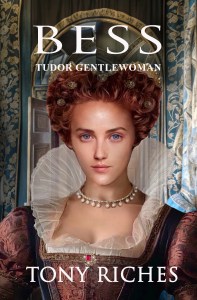
Blurb: 

Bess Throckmorton defies her notorious background and lack of education to become Queen Elizabeth’s Gentlewoman and trusted confidante. 

Forced to choose between loyalty and love, duty and desire, will she risk her queen’s anger by marrying adventurer Sir Walter Raleigh without permission? 

Entangled in a web of intrigue, from the glittering Palace of Whitehall to the cells of the Tower of London, Bess endures tragedy and injustice, becoming a resilient, determined woman who takes nothing for granted. 

Can she outwit her enemies, protect her family, and claim her destiny in a world where women are pawns and survival is a game of deadly consequences? 

This is the true story of the last of the Elizabethans, which ends the story of the Tudor dynasty – and introduces their successors, the Stuarts. 

Buy Link: 

Universal Buy Link: https://mybook.to/BESS  

This title is available to read on #KindleUnlimited. 

Author Bio: 

Tony Riches is a full-time UK author of Tudor historical fiction. He lives with his wife in Pembrokeshire, West Wales, and is a specialist in the lives of the early Tudors. 

As well as his Elizabethan series, Tony’s historical fiction novels include the best-selling Tudor trilogy and his Brandon trilogy (about Charles Brandon and his wives). 

For more information about Tony’s books, please visit his website, and his blog, The Writing Desk, and find him on social media. 

Author Links

Website: https://www.tonyriches.com/  

Blog: http://tonyriches.blogspot.co.uk/  

Twitter / X: https://twitter.com/tonyriches  

Facebook: https://www.facebook.com/tonyriches.author/  

Instagram: https://www.instagram.com/tonyriches.author/  

Bluesky: https://bsky.app/profile/tonyriches.bsky.social  

Amazon Author Page: https://www.amazon.co.uk/stores/Tony-Riches/author/B006UZWOXA  

Goodreads: https://www.goodreads.com/author/show/5604088.Tony_Riches  


Guest Post: “The Dos and Don’ts of Tudor Men’s Dress – What to Wear in Sixteenth-Century England” by Toni Mount

I am pleased to welcome Toni Mount to share her advice about Tudor men’s fashion to promote her latest book, How to Survive in Tudor England. I would like to thank Toni Mount and Pen and Sword Books for allowing me to be part of this blog tour. 

In writing my new book How to Survive in Tudor England I realised how tricky it was to be fashionable during the sixteenth century: hard work and expensive for men and women. So here’s a taster of what was required for a man to get noticed at court.

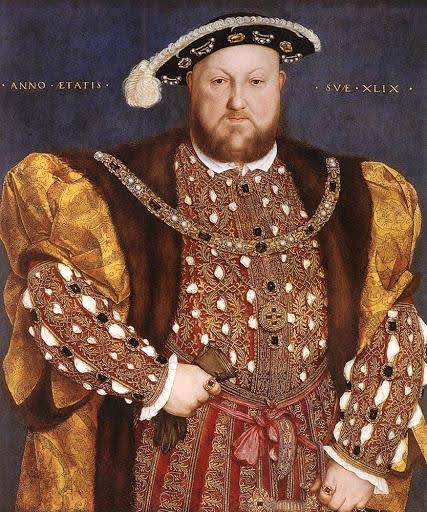
Henry VII favors long robes of fine cloth to show his wealth but his son, young Henry VIII, famed for his athletic, shapely legs, wears fitted hose and short robes so he can show off his best features. Now that the robe is so short, the flap that covers the join between the two separate legs of the hose [stockings] for modesty’s sake is now visible and Henry turns this into an asset by attaching a great codpiece to show off his virility. Since the courtiers take their fashion cues from the king, codpieces become a vital accessory. Henry is a well-muscled sporty young man but even so, his natural physique is accentuated by padding the shoulders of his doublet to extreme proportions. 

Henry VIIIHenry VIII wearing a padded doublet 

In this image, you can see the slashes in the sleeves of his doublet so that little puffs of his fine shirt can be pulled through. The doublet has a skirt or peplum, of varying length according to fashion, underneath which are hidden ties (‘points’) or hooks, to attach the breeches. 

The basics of men’s clothing is wearing layers. Next to your skin, you have a white linen shirt. This may be embroidered around the collar band. Katherine of Aragon introducebris ‘black-work’ embroidery from Spain and this becomes very fashionable, looking good on white linen. Later, the collar band is simply what your ruff is pinned onto, unless it has become a separate item by the time of your visit.

Breeches and hose come in a bewildering variety, going in and out of fashion almost weekly – another reason why a courtier’s wardrobe can empty his purse in no time, just trying to keep up. Here is a selection: round or French hose are short, full breeches ending anywhere between the upper thigh to just above the knee and excessively padded at the hips to accentuate your buttocks. These can make dancing or even walking elegantly quite difficult. Canions are tight-fitting tubes attached to the short version of the round hose to extend them to the knee. Below the knee, you wear stockings or ‘netherstocks’ held up with garters.

Whatever the style, the hose must be ‘paned’ – that is cut into narrow panels, joined at the waist and hem, with a colored lining showing between the panes. With so much padding and paning, you can understand why the codpiece is in decline, giving way to a modest buttoned or lace-up opening that doesn’t spoil the symmetry of your panes. Both your doublet and hose may also be decorated by ‘pinking’: slits cut in the fabric, in a pattern, with the coloured lining pulled through, as in Henry VIII’s time. One contemporary commentator of Elizabethan men’s fashion thought things had become quite ridiculous:  ‘Except it were a dog in a doublet you shall not see any so disguised as are my countrymen of England’, he wrote and Elizabethan clothes indeed disguise the wearer’s true physique more than the fashions of any other period. 

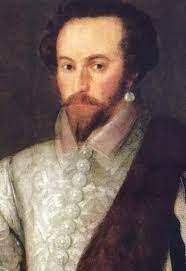
Sir Walter RaleighThe fashionable Sir Walter Raleigh

As you’ll see in the portrait of Sir Walter Raleigh [above], men also need to wear a bit of bling. Sir Walter has a single pearl earring, the sign of a truly fashionable man-about-town. Finger rings are a must.

Facial hair is also in vogue ever since Henry VIII grew a beard but at the Elizabethan court, the natural look isn’t enough. Once again, Sir Walter is a fine example to copy with his beard neatly trimmed to a point and his moustache curled. Set your ensemble with a short cape, fur-lined, and edged with a braid. This isn’t a practical cloak to keep you warm and dry but rather an accessory to be draped nonchalantly over one shoulder for that devil-may-care look that’s the height of fashion.

Footwear

No one of any significance goes without shoes. The pointy-toed, medieval styles go out of fashion almost as the first Tudor king sits on the throne. Rounded toes are the thing. But Henry VIII, maybe because he has broad feet, went further, creating a fashion for square toes. With more leather used to make the uppers, it’s also possible to have slashes to show off a contrasting inner lining, as with sleeves. However, these early Tudor styles are thin-soled and flat like their medieval predecessors but around 1500, somebody invents the ‘welt’ – a narrow strip of leather that goes around the shoe, in between the upper and the sole, making the shoe far more sturdy and able to withstand fancier shaping and decoration. 

King Henry is tall and impressive anyway but others who want to emulate him could do with a few extra inches in height and by the time of Elizabeth heeled shoes have been invented. At first, the heel is just a wedge of cork or wood fixed between the leather sole and the upper but soon these become proper heels and part of the sole. With so much innovation in the world of shoemaking, in 1579 the queen grants their coat-of-arms to the Guild of Cordwainers in London.

Women’s dainty dress shoes, called ‘pinsons’, now with heels and a more dainty tapered toe, can be of silk, velvet, or brocade often with bejeweled rosettes. Mid-century, most are slip-ons but lacing and buckles become increasingly fashionable. A pair of Tudor or Elizabethan shoes are made the same for both feet so there is no correct right or left shoe so they can be swapped over for more even wear. 

For outdoor wear, you can either put overshoes on to protect your indoor footwear, or you can have leather boots for walking and riding. Loose or tight-fitting, ‘gamaches’ are thigh-length high boots, and ‘buskins’ come to the calf.  

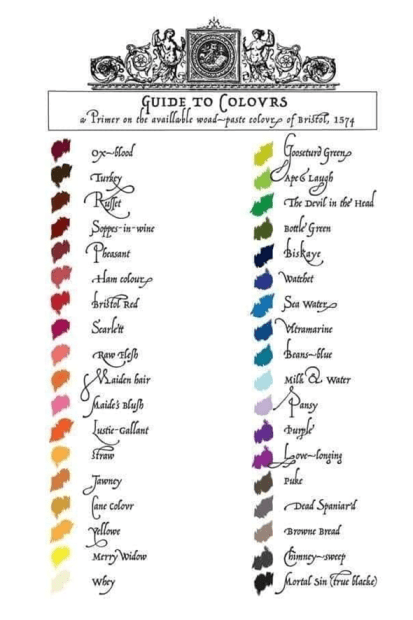
colour chartActs of Apparel 

In Henry VIII’s reign, realizing some of the up-and-coming wealthier gentry and merchants were wearing more sumptuous clothes than noblemen and courtiers, new laws are passed, termed Acts of Apparel, in 1509-10, 1514, 1515, and 1533. Europe has similar ideas but whereas their regulations tend to be drawn up by and apply only to individual towns, England’s laws come from Parliament and apply throughout the country, in theory, anyway.  

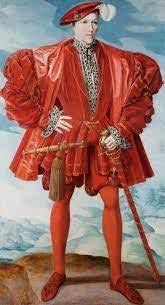
According to the 1509-10 Act against Wearing of Costly Apparel, only the king, the queen, the king’s mother (the act must have been first drawn up before Margaret Beaufort died in June 1509), along with the king’s brothers and sisters can wear cloth of purple silk or gold, while dukes and marquises can only use cloth of gold as linings of their coats and doublets. An earl and those of higher rank may wear sable fur, but those below may not. Certain imported furs can be worn by royal grooms and pages, university graduates, yeomen, and landowners whose estates bring in an income of at least £11 per annum. Barons and knights of the Order of the Garter (the highest-ranking knights) are permitted to wear woolen textiles manufactured abroad but, for those of lesser status, it’s a crime to wear imported cloth. The same applies to wearing clothes dyed with the most expensive crimson and blue dyes. 

CrimsonToo much crimson dye?

Anyone who isn’t a lord’s son, a government servant, or a gentleman with an income from the land of at least £100 per annum is forbidden to wear velvet, satin, or damask, although, if their land is worth £20 or more, satin, damask or camlet may be used to line or trim their clothing but not for the main, visible body of the garment. 

The problem is, as it has been for centuries, more and more successful merchants are becoming richer than the aristocracy. Intermarriage makes matters even more complex. The nobility want to share in mercantile wealth and merchants yearn for titles and high status. The solution is for a lord’s penniless second and untitled son to wed the daughter of a rich merchant but where do their offspring stand on the social ladder? The children aren’t the sons and daughters of a lord and yet they can now afford to live in greater opulence than their paternal relatives who still have titles. No wonder the laws are flouted. 

An additional oddity concerns the way wealth is judged. Annual income from land is always regarded as having greater status than the same monetary income gained from trade. The sumptuary laws passed in the reign of King Edward III, in 1363, equated a landowner worth £200 a year to a merchant worth £1,000. These relative values are still maintained throughout the Tudor period. And there is another problem that becomes more acute in Henry VIII’s reign: that of people – and courtiers were some of the worst offenders – vying with their peers to be the most fashionable and expensively dressed and running up huge debts in the process. This situation leads to An Acte for Reformacyon of Excesse in Apparayle being passed in 1533:

…for the necessaire repressing avoiding and expelling of the inordinate excesse dailye more and more used in the sumptuous and costly araye and apparel accustomablye worne in this Realme, whereof hath ensued and dailie do chaunce suche sundrie high and notable inconveniences as to be the greate manifest an notorious detriment of the common Weale, the subvercion of good and politike order in knowledge and distinction of people according to their estates p[re]emyences dignities and degrees, and to the utter impoverysshement and undoyng of many inexpert and light persones inclined to pride moder of all vices…

Despite the declaration that these laws are intended to avoid the ‘notorious detriment of the common weal’, i.e. everyone, the legislation is aimed, as usual, at morally ‘light persons inclined to pride (mother of all vices)’. The laws also reiterate earlier attempts to mark out prostitutes from respectable women but in 1533 the earlier, medieval customs of what was considered respectable attire are enshrined in law for the first time, in particular, that a married woman must cover her hair – a ‘loose’ woman, i.e. one wearing her hair loose and uncovered is of easy virtue and up to no good. 

An excess of wool production led to an Act of Parliament in 1571, during the reign of Queen Elizabeth, to boost the sales of English woolen cloth. It becomes law that on Sundays and every official holiday all males over six years of age, except for the nobility and persons of degree, are to wear woolen caps on pain of a fine of three farthings (¾ of a penny) per day. Whether it works or not in practice, the act is repealed in 1597. In June 1574, Elizabeth issues the following statute from Greenwich Palace: 

The excess of apparel and the superfluity of unnecessary foreign wares thereto belonging… is grown to such an extremity that the decay of the whole realm is like to follow (by bringing into the realm such superfluities of silks, cloth of gold, silver, and other vain devices of so great cost as of necessity the moneys of the realm is yearly conveyed out of the same to answer the said excess) but also the undoing of a great number of young gentlemen seeking by show of apparel to be esteemed as gentlemen not only consume themselves, their goods, and lands which their parents left unto them, but also run into such debts as they cannot live out of danger of laws without attempting unlawful acts… [edited]

Despite the fact that the queen and everyone else understand the cost of trying to keep up with the latest fashions, no amount of law-making can prevent the young gallants from spending far beyond their means.

Another 1597 proclamation on the subject goes into minute detail. Only earls can wear cloth of gold or purple silk. No one under the degree of knight is allowed silk ‘netherstocks’ (long stockings) or velvet outer garments. A knight’s eldest son may wear velvet doublets and hose but his younger brothers can’t. A baron’s eldest son’s wife may wear gold or silver lace which is forbidden to women below her in the pecking order. Who is allowed to wear what is supposed to be strictly controlled as the queen’s subjects must know their place and dress accordingly so that no one can be misled. At least, that’s the theory but you can see that the laws are confusing and is it any wonder that people ignore them? Will you obey the law or wear fashionable clothes, no matter the cost?  

The frequency of acts and the huge number of laws passed proves that the authorities are losing the fight to keep the social distinctions, maintain morals and ethics, preserve the English economy against foreign imports, and restrain the excesses of fashion. However, a good many of the various sumptuary laws, dating back to as early as the fourteenth century, were still on the English statute books as recently as the 1800s, and, who knows, some may as yet remain, hidden in the dusty archives in the twenty-first century.

So this is an introduction of what to wear – or not – for the stylish courtier in the sixteenth century. If you wish to read about many interesting characters, places, food, and pastimes of the sixteenth century, my new book How to Survive in Tudor England will be published on 30th October 2023.  

Pen & Sword Book Cover / Jacket artwork

Blurb

Imagine you were transported back in time to Tudor England and had to start a new life there, without smartphones, internet, or social media. When transport means walking or, if you’re lucky, horseback, how will you know where you are or where to go? Where will you live and where will you work? What will you eat and what shall you wear? And who can you turn to if you fall ill or are mugged in the street, or God forbid if you upset the king? In a period when execution by beheading was the fate of thousands how can you keep your head in Tudor England? 

All these questions and many more are answered in this new guidebook for time-travelers: How to Survive in Tudor England. A handy self-help guide with tips and suggestions to make your visit to the 16th century much more fun, this lively and engaging book will help the reader deal with the new experiences they may encounter and the problems that might occur. 

Enjoy interviews with the celebrities of the day, and learn some new words to set the mood for your time-traveling adventure. Have an exciting visit but be sure to keep this book to hand.

Toni Mount cropToni Mount Biography

Toni Mount researches, teaches, and writes about history. She is the author of several popular historical non-fiction books and writes regularly for various history magazines. As well as her weekly classes, Toni has created online courses for http://www.MedievalCourses.com and is the author of the popular Sebastian Foxley series of medieval murder mysteries. She’s a member of the Richard III Society’s Research Committee, a costumed interpreter, and speaks often to groups and societies on a range of historical subjects. Toni has a Master’s Degree in Medieval Medicine, Diplomas in Literature, Creative Writing, European Humanities, and a PGCE. She lives in Kent, England with her husband.

Guest Post: Excerpt from “Raleigh: Tudor Adventurer by Tony Riches”

Raleigh Tudor Adventurer Tour BannerToday, it is my pleasure to welcome back to the blog Tony Riches to share an excerpt from his latest Elizabethan novel, “Raleigh: Tudor Adventurer. I want to thank Tony Riches and The Coffee Pot Book Club for allowing me to be part of this tour. 
Excerpt

I’d never seen the presence chamber so crowded. The queen sat on her gilded throne, flanked on both sides by her ladies in their best gowns. Every space was filled with courtiers, and I was pleased to see all the members of the Privy Council, including Lord Burghley and my nemesis, Sir Christopher Hatton.

There were gasps and muttered comments as we entered. I’d been right. Her Majesty’s newest subjects were the talk of London, and I had become the center of attention. I strode forwards and bowed, relishing the moment.

‘Your Majesty, I present Manteo and Wanchese, from the New World, now claimed as the empire of Virginia.’

Although we’d provided them with warmer clothing, as they suffered with the cold of London in autumn, they were bare-chested and bare-footed, showing their tattooed bodies. With iridescent feathers in their plaited hair, they dressed in loincloths, with black furs draped over their shoulders, increasing their wild appearance.

As prepared in our rehearsal at Durham House, they marched confidently through the crowded chamber and fell to their knees before the queen. Manteo greeted her in his own language, then Wanchese opened a small box containing the bracelet of pearls.

The queen stared at her visitors with open curiosity, then took the pearl bracelet and turned to me. ‘We wish to thank them. Do they understand any English?’

‘These men are chieftains of their people, and the bracelets are a gift from their queen, Your Majesty. Chief Manteo is learning a little English, and Master Thomas Harriot is learning what he can of their language.’

‘Tell Master Harriot to explain that we thank their queen for her gift, and commend their bravery in making the journey to England.’ She turned the pearl bracelet in the light and looked up at me. ‘Did your men discover gold or jewels?’

‘What they found is worth more than gold or jewels, Your Majesty.’ I paused and looked around the chamber, aware of my new status. ‘They discovered rich, fertile land, stretching as far as they could see, and claimed it in the gracious name of Your Majesty.’ I pointed to Manteo and Wanchese. ‘These men made my captains most welcome, and will help us understand the opportunities of the country of Virginia for the benefit of your colonists.’

* * *

The first of my rewards proved a surprise. I’d been appointed the junior Member of Parliament for Devon. Parliament had not met for twelve years, and my tax on broadcloth exports was unpopular with influential wool merchants in Exeter, so my new appointment was unexpected.

Sir Francis Walsingham was quick to explain. ‘This is the fifth meeting of the queen’s reign, which the Privy Council has recommended to discuss national security.’

‘There is talk at court that the Throckmorton Plot is only part of a wider Catholic conspiracy.’

Sir Francis nodded. ‘My informers on the Continent discovered plans for an invasion of England led by Henry, Duke of Guise, financed by the Spanish and the Vatican.’ He frowned. ‘We have to do whatever we can to prevent a simultaneous revolt of English Catholics.’

‘Do you think they might try?’ With a jolt, I realized how quickly everything I’d built up could vanish, like a morning mist.

‘You’ve seen the seditious pamphlet they call Leicester’s Commonwealth?’

‘I have, but no one, apart perhaps from the Earl of Leicester, takes it too seriously—’

‘That’s where you’re wrong, Master Raleigh. The Catholic faction draws encouragement from such works, and there are thousands of copies in circulation on the Continent. The pamphlet is a threat to our queen. We mustn’t forget Prince William of Orange was murdered by a man he trusted, a Catholic named Balthasar Gérard, who used a pistol at close range.’ Sir Francis shook his head. ‘He was assassinated at dinner in his own house, a reminder why we have to be prepared for anything.’

‘What do you wish me to do?’

‘A new act is to be put before Parliament, for the safety of the queen, to prevent any open invasion or rebellion, or any attempt to injure Her Majesty. Any person found guilty will be disbarred from inheriting the throne, and sentenced to death for treason.’

‘Including the queen’s cousin, Mary, Queen of Scots?’

He nodded. ‘Catholic sympathizers in Parliament will do all they can to delay, so use your influence to ensure the act is passed.’

I looked at him in surprise. I had no experience of politics or as a Member of Parliament and hadn’t seen myself as capable of political influence. Sir Francis Walsingham sat like a spider in the complex web of court, and his words proved that, at last, I’d achieved my ambition.

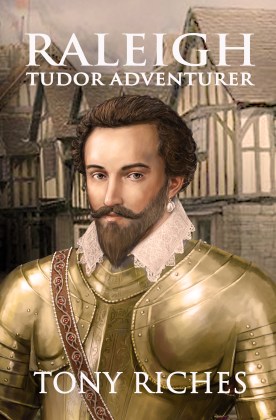
Raleigh coverRaleigh – Tudor Adventurer

(The Elizabethan Series, Book 3)

By Tony Riches

Blurb

Tudor adventurer, courtier, explorer, and poet Sir Walter Raleigh has been called the last true Elizabethan.

He didn’t dance or joust, didn’t come from a noble family, or marry into one. So how did an impoverished law student become a favorite of the queen and Captain of the Guard?

The story, which began with the best-selling Tudor trilogy, follows Walter Raleigh from his first days at the Elizabethan Court to the end of the Tudor dynasty.

Buy Links:

Available on #KindleUnlimited.

Universal Link: mybook. to/Raleigh

Amazon UK: https://www.amazon.co.uk/dp/B09Z98J183

Amazon US: https://www.amazon.com/dp/B09Z98J183

Amazon CA: https://www.amazon.ca/dp/B09Z98J183

Amazon AU: https://www.amazon.com.au/dp/B09Z98J183

Tony Riches Author (1)Author Bio:

Tony Riches

Tony Riches is a full-time UK author of best-selling historical fiction. He lives in Pembrokeshire, West Wales, and is a specialist in the lives of the Tudors. He also runs the popular Stories of the Tudors Podcast’ podcast and posts book reviews and guest posts at his blog, The Writing Desk. For more information, visit his website tonyriches.com and find him on Facebook and Twitter @tonyriches.

Social Media Links:

Blog: https://tonyriches.blogspot.com/

Website: https://www.tonyriches.com/

Podcast: https://tonyriches.podbean.com/

Twitter: https://twitter.com/tonyriches

Facebook: https://www.facebook.com/tonyriches.author

Instagram: https://www.instagram.com/tonyriches.author/

Amazon Author Page: https://www.amazon.com/author/tonyriches

Book Review: “Raleigh: Tudor Adventurer (Elizabethan Book #3)” by Tony Riches

61016647._SY475_A man who wants to get ahead in any royal court must have an impeccable background and a willingness to serve his monarch no matter the obstacles thrown their way. It takes an extraordinary man who doesn’t have a pristine background to make it in the ruthless world of a royal court, but some men made names for themselves. One such man was an adventurer, a poet, an explorer, and a courtier. He came from humble beginnings and rose to prominence to become known as one of the last true Elizabethans. The man was Sir Walter Raleigh, and his story is told in Tony Riches’ latest novel, “Raleigh: Tudor Adventurer.”

I want to thank Tony Riches for sending me a copy of this novel. I have enjoyed his previous books in his Elizabethan series on Sir Francis Drake and Robert Devereux Earl of Essex, so I was thrilled when a new story about Sir Walter Raleigh was announced. I previously read a novel about Sir Walter Raleigh’s mother this year, so I was looking forward to an adventure with her son.

Walter Raleigh began his career as a law student who was not passionate about the law. He is ambitious and eventually attracts the attention of Queen Elizabeth I herself; it is in her court that he becomes a courtier and, finally, her Captain of the Guard. His dream was to set sail on the open seas with his brother. He finally gets his chance to sail the high seas, but it is not as glamorous as he envisioned, but he is hooked on the thrill of the adventure.

Some look down on Raleigh because he is not part of a noble family, but he rose through the ranks to become one of the Queen’s favorites. His good looks and charisma attracted the attention of many young ladies, including Bess Throckmorton, who would later become his wife. However, the bulk of this novel focuses on the adventures and investments Raleigh was known for. From Ireland and Cadiz to the New World and the search for the legendary City of Gold, Riches takes his readers on swashbuckling journeys full of perilous battles and high rewards.

I thoroughly enjoyed seeing Raleigh’s relationships with everyone from Queen Elizabeth I to his wife, Bess Raleigh. The audience gets a chance to see the inner workings of Elizabeth’s court through the eyes of someone who knew what it meant to be on Elizabeth’s good side. I also enjoyed the poetry that Riches weaves into this narrative to give his audience a better understanding of what Raleigh might have felt during crucial moments in his life. My one issue with this novel was that some of the battles and scenes during Raleigh’s expeditions felt a tad rushed to me, and I wish Riches developed these scenes a bit more.

Overall, I found this novel satisfying to read and a real treat for any Tudor fan. If you have enjoyed the previous Elizabethan series books or are looking for a stand-alone story about Sir Walter Raleigh, I would propose you read “Raleigh: Tudor Adventurer” by Tony Riches.

Book Review: “A Woman of Noble Wit” by Rosemary Griggs

A Woman of Noble Wit Tour BannerFor a woman from the past to leave a mark in history books, she had to have lived an extraordinary life. Some have notorious reputations, or they were considered women of immaculate character. In Foxe’s Book of Martyrs, there was one who was “a woman of noble wit.” She was the daughter of an ancient gentry family who had connections with the court of Henry VIII. Her large family would navigate political turmoil and religious reformations to survive. The name of this wife and mother was Katherine Raleigh, and her tale is told in Rosemary Griggs’ debut novel, “A Woman of Noble Wit.”

I would like to thank The Coffee Pot Book Club and Rosemary Griggs for sending me a copy of this novel and allowing me to be part of this book tour. I did not know much about Katherine Raleigh before this novel, except that she was the mother of Sir Walter Raleigh, so I was looking forward to reading her story.

Katherine was a daughter of the Champernowne family who had a fiery passion for reading. As a girl, she was terrified of marrying an older man, but her family decided to marry Katherine to Otho Gilbert, a young man with a passion for firearms and adventures. As Katherine settles into her new life at Greenway Court, England experiences the reign of King Henry VIII through religious reforms, many marriages, and numerous executions. Although Katherine was not at court, she would receive gossip about court and her sister Kat, who we know today as Kat Ashley, the governess of Princess Elizabeth Tudor.

Katherine is a dutiful and loving wife to Otho, but her heart skips a beat when she meets the charming privateer Walter Raleigh Senior one day. I found Walter a much better match for Katherine than Otho, who seemed rather vain and jealous of his wife’s reputation. Katherine is free to be her educated self with Walter. They navigate the reigns of Edward VI, Mary I, and Elizabeth I while raising their family. We see how Katherine was known as “a woman of noble wit” through heartache, fear, and love.

As a debut novel, I found it a delightfully engaging read. Griggs has brought Katherine Raleigh from the shadows of her famous son’s fame and shined a light on her story. If I did have a complaint about this novel, it would be that I felt the ending was a bit rushed. Overall, I think it was an enchanting debut novel that illuminated the life of a fascinating woman who lived during the Tudor dynasty. I am excited to see what Rosemary Griggs will write about next. If you want a novel about a relatively hidden Tudor woman, I would highly suggest you read “A Woman of Noble Wit” by Rosemary Griggs.

59476111._SY475_A Woman of Noble Wit

By Rosemary Griggs

Few women of her time lived to see their name in print. But Katherine was no ordinary woman. She was Sir Walter Raleighs mother. This is her story.

Set against the turbulent background of a Devon rocked by the religious and social changes that shaped Tudor England; a Devon of privateers and pirates; a Devon riven by rebellions and plots, A Woman of Noble Wit tells how Katherine became the woman who would inspire her famous sons to follow their dreams. It is Tudor history seen though a womans eyes.

As the daughter of a gentry family with close connections to the glittering court of King Henry VIII, Katherines duty is clear. She must put aside her dreams and accept the husband chosen for her. Still a girl, she starts a new life at Greenway Court, overlooking the River Dart, relieved that her husband is not the ageing monster of her nightmares. She settles into the life of a dutiful wife and mother until a chance shipboard encounter with a handsome privateer, turns her world upside down.…..

Years later a courageous act will set Katherines name in print and her youngest son will fly high.

Trigger Warnings: Rape.

Buy Links:

Universal Link: https://books2read.com/u/47O1WE

Amazon UK: https://www.amazon.co.uk/Woman-Noble-Wit-Rosemary-Griggs-ebook/dp/B09FLVZKSK

Amazon US: https://www.amazon.com/Woman-Noble-Wit-Rosemary-Griggs-ebook/dp/B09FLVZKSK

Amazon CA: https://www.amazon.ca/Woman-Noble-Wit-Rosemary-Griggs-ebook/dp/B09FLVZKSK

Amazon AU: https://www.amazon.com.au/Woman-Noble-Wit-Rosemary-Griggs-ebook/dp/B09FLVZKSK

Barnes and Noble: https://www.barnesandnoble.com/w/a-woman-of-noble-wit-rosemary-griggs/1140139238

Waterstones: https://www.waterstones.com/book/a-woman-of-noble-wit/rosemary-griggs/9781800464599

iBooks: https://books.apple.com/gb/book/a-woman-of-noble-wit/id1584793135

WHSmith: https://www.whsmith.co.uk/products/a-woman-of-noble-wit/rosemary-griggs/paperback/9781800464599.html

Foyles: https://www.foyles.co.uk/witem/fiction-poetry/a-woman-of-noble-wit,rosemary-griggs-9781800464599

Rosemary GriggsAuthor Bio:

Rosemary Griggs is a retired Whitehall Senior Civil Servant with a lifelong passion for history. She is now a speaker on Devon’s sixteenth century history and costume. She leads heritage tours at Dartington Hall, has made regular costumed appearances at National Trust houses and helps local museums bring history to life.

Social Media Links:

Website: https://rosemarygriggs.co.uk/

Twitter: https://twitter.com/RAGriggsauthor

Facebook: https://www.facebook.com/ladykatherinesfarthingale

Instagram: https://www.instagram.com/griggs6176

Amazon Author Page: https://www.amazon.com/Rosemary-Griggs/e/B09GY6ZSYF

Goodreads: https://www.goodreads.com/author/show/21850977.Rosemary_Griggs

Book Review: “Essex: Tudor Rebel (Elizabethan, Book 2) by Tony Riches

Essex Tudor Rebel Tour BannerToday, I am pleased to share my book review of the latest Elizabethan novel by Tony Riches as my contribution to his “Essex: Tudor Rebel” blog tour. Thank you to Tony Riches for sending me a copy of his latest novel, and to The Coffee Pot Book Club for allowing me to take part in this tour. 
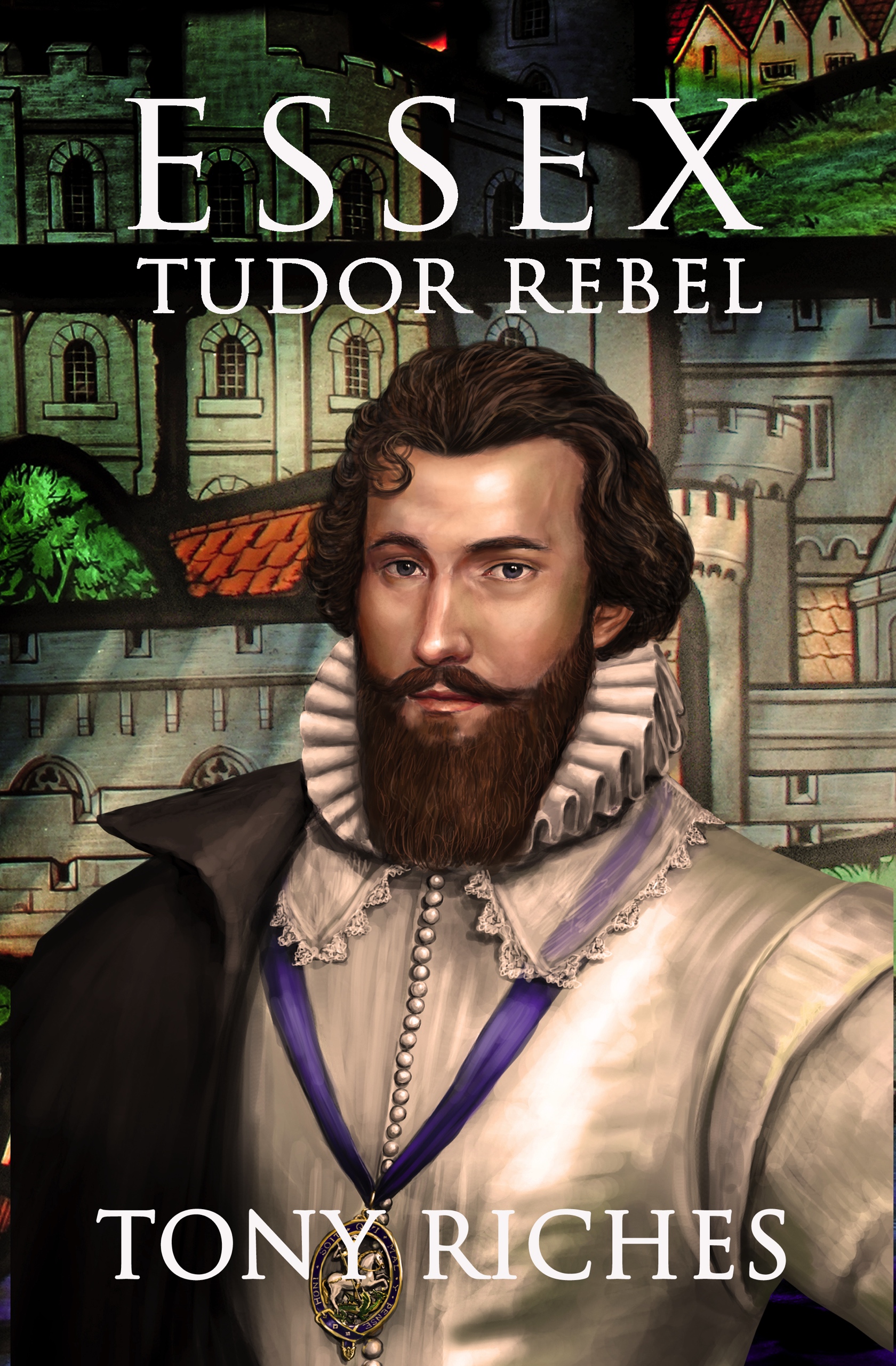
Being a favorite of a queen is not all glitter and fame. Take, for example, the men who were considered the favorites of Elizabeth I. They had to deal with a queen whose temper and praise were interchangeable. One of the most famous examples of a favorite enduring the wrath of the queen was Robert Devereux, Earl of Essex. A handsome rascal who had a mountain of debt to his name, Essex tries to follow his queen’s orders while staying true to his nature. His road from loyal man to Elizabeth I, his numerous adventures, and his ultimate rebellion are masterfully told in Tony Riches’ latest Elizabethan novel, “Essex: Tudor Rebel”.

I would like to thank Tony Riches for sending me a copy of his latest novel. I enjoyed his first venture into the Elizabethan era about Sir Francis Drake. When I heard about this novel, I was excited to dive in. Obviously, I knew about the Essex Rebellion and Essex’s fall from grace, but I really wanted to know about the man behind it all.

Robert Devereux was the son of Lettice Knollys and Walter Devereux, 1st Earl of Essex. Many recognize Robert’s rather remarkable mother Lettice Knollys as she would gain the ire of Queen Elizabeth when she married the Queen’s favorite, Robert Dudley. Essex’s father Walter would die with a mountain of debt when Essex was a boy. The fact that Essex grew up as a poor Earl does not make him stray away from the lavish lifestyle that he craves. In fact, he adds to his father’s debt with his own, making it nearly impossible to pay off.

What makes him so appealing to Queen Elizabeth I is his youthful bravado. Essex is like a son to Elizabeth I. They were so close that some assumed that they were lovers. Riches puts this myth to rest in this novel. That does not mean that Essex was single like his queen. In fact, he did marry the daughter of the famous spymaster Sir Francis Walsingham. His daughter, Frances, is extremely loyal to her children and is not afraid to speak her mind when she believes that Essex is in the wrong. Essex is not exactly the most loyal of husbands as he does have affairs and illegitimate children.

Essex did not shy away from battles. He was known for his ventures in France, Cadiz, and Ireland, but his reputation would be battered like the numerous storms he encountered. He wanted the glory to restore his reputation, but his naivete and anger towards the queen who treated him like a son would lead to his downfall.

There is something magical about a new novel by Tony Riches. He is able to capture the audience’s attention with realistic scenarios, characters that jump from the pages of the past, and dialogue that is entirely believable. Essex may seem like an outlandish character, but his desire to restore his honor and to pay back his debt is understandable. There were moments where I was getting frustrated with Essex because of his poor decision-making skills, but Riches really made me feel sympathetic for this naive young rogue by the end. If you want another brilliant escape into the late Tudor age, I highly recommend you read book two in Tony Riches’ enchanting Elizabethan series, “Essex: Tudor Rebel”.

Essex---Tudor-rebel-Kindle(Blurb)

Robert Devereux, Earl of Essex, is one of the most intriguing men of the Elizabethan period. Tall and handsome, he soon becomes a ‘favourite’ at court, so close to the queen many wonder if they are lovers.

The truth is far more complex, as each has what the other yearns for. Robert Devereux longs for recognition, wealth and influence. His flamboyant naïveté amuses the ageing Queen Elizabeth, like the son she never had, and his vitality makes her feel young.

Robert Devereux’s remarkable true story continues the epic tale of the rise of the Tudors, which began with the best-selling Tudor trilogy and concludes with the reign of Queen Elizabeth I.

Buy Links:

This novel is free to read with #KindleUnlimited subscription.

Universal Link: https://books2read.com/u/bwo16Y

Amazon UK: https://www.amazon.co.uk/dp/B09246T7ZT
Amazon US: https://www.amazon.com/dp/B09246T7ZT
Amazon CA: https://www.amazon.ca/dp/B09246T7ZT
Amazon AU: https://www.amazon.com.au/dp/B09246T7ZT


Tony Riches AuthorAuthor Bio

Tony Riches

Tony Riches is a full-time UK author of best-selling Tudor historical fiction. He lives in Pembrokeshire, West Wales and is a specialist in the history of the Wars of the Roses and the lives of the early Tudors. Tony’s other published historical fiction novels include: Owen – Book One Of The Tudor Trilogy, Jasper – Book Two Of The Tudor Trilogy, Henry – Book Three Of The Tudor Trilogy, Mary – Tudor Princess, Brandon – Tudor Knight and The Secret Diary Of Eleanor Cobham.

Social Media Links:

Website: https://www.tonyriches.com/
Twitter: https://twitter.com/tonyriches
Facebook: https://www.facebook.com/tonyriches.author/
LinkedIn: https://www.linkedin.com/in/tonyriches/
Instagram: https://www.instagram.com/tonyriches.author/
Amazon Author Page: https://www.amazon.com/Tony-Riches/e/B006UZWOXA
Goodreads: https://www.goodreads.com/author/show/5604088.Tony_Riches

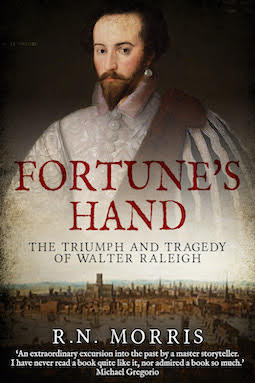
Guest Post: Walter Raleigh, The Self Made Myth- By R.N. Morris, author of Fortune’s Hand, a new novel about Walter Raleigh

unnamedI am not sure how I came to write a novel about Walter Raleigh. I think I can trace it back to visiting an exhibition on the myth of El Dorado at the British Museum in 2013. But thousands of people went to that exhibition and I dare say very few of them were foolish enough to start writing a 100,000 word novel under its influence. 

The dream of the fabled city of gold was one that obsessed Raleigh for decades. He pinned his political hopes on finding it and bringing home its treasure, first for Queen Elizabeth I, so that he could provide her with the funds she needed to defend herself against her great enemy Spain; and later for her successor James I, no longer at war with Spain, but still, like every sovereign in history, desperately short of finances.

In both instances, however, the dream proved to be illusory. 

Nonetheless, it was a dream that sustained him through periods of imprisonment and personal tragedy. A dream that he invested his reputation in, and one that he used to entice investors into his highly speculative voyages of discovery and predation. However, it surprised me to discover that Raleigh took part in surprisingly few of these voyages himself; he was an indifferent sailor who suffered badly from seasickness. 

Raleigh first heard about El Dorado from a captured conquistador called Pedro Sarmiento de Gamboa. It was just a rumour. A rumour carried on a warm breeze from a distant land. 

It seems ironic that a man who was so talented at creating his own mythology should fall victim to a myth. But perhaps that was why he was so drawn to the story, because he knew a great myth when he saw one, and understood more than most its power to inspire minds and influence behaviour. The myth of El Dorado was useful to Raleigh, not because he himself necessarily believed it to be true (there is evidence he didn’t) but because he knew that other men – and, most importantly, one woman – would. 

I fell under its spell too. 

When I started my research for the book, I knew very little about Walter Raleigh. The one thing I did know was the one thing that everyone knows: he spread his cloak across a puddle so that Elizabeth could walk across it without getting her feet wet. The more I progressed in my research, the less sure was I that this incident actually happened, at least not as it is depicted in countess children’s history books. 

It is a compelling idea imbued with meaning. There’s another word for compelling ideas imbued with meaning: myths. 

As a child, I thought the point of the story was simply to illustrate what a gentleman Raleigh was. Now I realize there was a bit more to it than that. Raleigh was positioning himself (to borrow a term from modern marketing) as the man who would safeguard his sovereign’s passage across a body of water. In other words, he would be the instigator of England’s colonial project on the other side of the Atlantic. 

Raleigh’s life seems to be filled with stories that, even if they fall short of mythical, have at the very least a strong whiff of the apocryphal about them. I don’t believe it’s an accident. Whatever else he was, Raleigh was a poet. His life was his greatest poem, even if it didn’t quite have the ending he might have planned.  

In my novel, I see him as a man of boundless imagination. There was nothing he could not envisage. And for him, imagining something was tantamount to accomplishing it. As he gets older, the lines between what he dreams and what he does blur. 

Of course, reality did not always play along. But that never seemed to deter him from putting even greater faith in the power of his imagination. 

This was the age of Dr John Dee, after all, the great conjuror of angels and demons. Raleigh consulted Dee on navigational matters as well astrological ones. You could say between them they conjured up the British Empire. 

In Fortune’s Hand, I imagine Raleigh reciting the names of the places in Guiana that lead to Manoa – the city identified with El Dorado – as if he is uttering the words of an incantation. He even uses this litany of exotic names to soothe Elizabeth when she is distressed. 

Raleigh wrote a long, unfinished epic poem in which Ocean addresses his love, Cynthia – AKA the moon. He was given the nickname ‘Water’ by Elizabeth, mocking his West Country pronunciation of his own name. He clearly identified himself with Ocean and Elizabeth with Cynthia, in other words he saw them both as mythic figures. I think it’s a very compelling image for their relationship. The moon is ever remote, changeable, presenting a cool, pale beauty. The ocean’s tides are subject to the lunar gravity, just as Raleigh was subject to Elizabeth’s commands, and whims. 

The problem with such self-mythologizing is that it tends to be self-aggrandizing too. And if you see yourself as a hero or a demi-god, it probably means you don’t have much empathy for others. Especially those who have to be defeated, displaced and destroyed to make your myth a reality. 

Empathy is not a quality much evident in the Raleigh of my novel. I said above that I saw him as a man of boundless imagination, but it is only boundless when it applies to himself and his interests. He has a curious imaginative blind spot when it comes to considering those whose interests are at odds with his, whether they are his rivals for Elizabeth’s favor, or the rebels he massacred in Ireland. 

That makes him a problematic figure in today’s world. But then, to be fair to Raleigh, he wasn’t living in today’s world. The attitudes and beliefs that were woven into the intellectual fabric of the Elizabethan age strike us now as at best baffling and at worst appalling. 

So why write a novel about this pre-eminent Elizabethan, at a time when others are petitioning to pull down his statue? The mythology that he created and others have added to has become entangled with England’s national story. I wanted to explore and try to understand the impulses that drove Raleigh through his remarkable life, in which he laid the groundwork for the British Empire. That is clearly a contested legacy now. To challenge and critique that legacy fully, I felt the need to confront one of its key originators – warts, myths and all. 

R.N. Morris Bio:

Roger (R. N.) Morris is the author of thirteen novels. The latest is Fortune’s Hand, a historical novel about Walter Raleigh.  He is also the author of the Silas Quinn series of historical crime novels and the St Petersburg Mysteries, featuring Porfiry Petrovich, the investigating magistrate from Crime and Punishment. 

His website is rogernmorris.co.uk. Roger has a Facebook page for his novels, which is https://www.facebook.com/RNMorrisauthor

He is on twitter as @rnmorris and on Instagram as rogermorris7988. He would love to hear from you so drop him an email at contact@rogernmorris.co.uk

Biography: Sir Walter Raleigh

(Born around 1552- Died October 29, 1618)220px-Sir_Walter_Ralegh_by_'H'_monogrammist
Son of Walter Raleigh and Catherine Champernowne
Married to Elizabeth Throckmorton.
Father of Damerei, Walter (also known as Wat), and Carew Raleigh.
Sir Walter Raleigh was a writer and an adventurer who helped establish a colony near Roanoke Island. He was imprisoned in the Tower of London a few times and was later executed for treason.

Sir Walter Raleigh was born around 1552, although some believe he was born in 1554, to Walter Raleigh and Catherine Champernowne in Devon. He was the youngest of five sons born to the couple. His half-brothers John Gilbert, Humphrey Gilbert, and Adrian Gilbert, and his full brother Carew Raleigh were also prominent during the reigns of Elizabeth I and James I. Catherine Champernowne was a niece of Kat Ashley, Elizabeth’s governess. The Raleigh family were very devout Protestants and they were persecuted during the reign of Mary I, especially Sir Walter Raleigh’s father who had to hide in the Tower of London to avoid execution. From a young age, Raleigh had a deep hatred for Roman Catholicism and was an extremely devout Protestant, even more than Elizabeth I herself.

In 1569, Raleigh went to France to help the Huguenots in the religious wars, at the age of seventeen. In 1572, he attended Oriel College, Oxford, but he left a year later without a degree. He would later attend the Middle Temple law college in 1575, but in his trial in 1603, he would deny that he studied law. It was during this time that Raleigh’s love for poetry is said to have started.

In 1578, Raleigh set out with his half-brother, Sir Humphrey Gilbert on a voyage to North America to find the Northwest Passage. They never reached their destination and the mission degenerated into a privateering foray against Spanish shipping. Raleigh’s actions were not well received by the Privy Council, the monarch’s advisors, and he was briefly imprisoned. Between 1579 and 1583, Raleigh took part in the suppression of the Desmond Rebellions. These rebellions were motivated to maintain the independence of feudal lords from their monarch, but also there was an element of religious antagonism between Catholic Geraldines and the Protestant English state. He was known for his ruthlessness at the siege of Smerwick and establishing English and Scottish Protestants in Munster. One of the people he met while in Munster was the English poet Edmund Spenser.

By 1582 he had become one of Elizabeth’s favourites, and he began to acquire monopolies, properties, and influential positions. In 1583 the queen secured him a lease of part of Durham House in the Strand, London, where he had a monopoly of wine licenses, in 1583, and of the export of broadcloth in 1585. In 1585, Raleigh was knighted and he became warden of the Cornish tin mines, lieutenant of Cornwall, and vice admiral of Devon and Cornwall and frequently sat as a member of Parliament.

In 1584, Queen Elizabeth granted Raleigh a royal charter authorising him to explore, colonise and rule any lands that were not under Christian rule, in return for one-fifth of all the gold and silver that might be mined there. This charter specified that Raleigh had seven years in which to establish a settlement, or else lose his right to do so. Instead, he sent others to found the Roanoke Colony, later known as the “Lost Colony”. In 1588, he did help

In 1591, Raleigh was secretly married to Elizabeth “Bess” Throckmorton. She was one of the Queen’s ladies-in-waiting, 11 years his junior, and was pregnant at the time. She gave birth to a son, believed to be named Damerei, but he died in October 1592 of plague. The following year, the unauthorised marriage was discovered and the Queen ordered Raleigh to be imprisoned and Bess dismissed from court. Both were imprisoned in the Tower of London in June 1592. He was released from prison in August 1592 to manage a recently returned expedition and attack on the Spanish coast. The fleet was recalled by the Queen, but not before it captured an incredibly rich prize off a merchant ship. He was sent back to the Tower, but by early 1593 had been released and become a member of Parliament. It was several years before Raleigh returned to favour, and he travelled extensively in this time. Walter and Elizabeth had two more sons, Walter (known as Wat) and Carew.

Raleigh himself never visited North America, although he led expeditions in 1595 and 1617 to the Orinoco River basin in South America in search of the golden city of El Dorado. In 1596, Raleigh took part in the Capture of Cadiz, where he was wounded. He also served as the rear admiral of the Islands Voyage to the Azores in 1597. On his return from the Azores, Raleigh faced the major threat of the 3rd Spanish Armada during the autumn of 1597.

Raleigh’s aggressive policies toward Spain did not recommend him to the pacific King James I His enemies worked to bring about his ruin, and in 1603 he and others were accused of plotting to dethrone the king and was consigned to the Tower. In 1616 he was released but not pardoned. With the king’s permission, he financed and led a second expedition to Venezuela , promising to open a gold mine without offending Spain. Raleigh’s son Walter died in the action. King James invoked the suspended sentence of 1603, and he remained imprisoned in the Tower until 1616. In 1617, Raleigh was pardoned by the King and granted permission to conduct a second expedition to Venezuela in search of El Dorado. During the expedition, a detachment of Raleigh’s men under the command of his long-time friend Lawrence Keymis attacked the Spanish outpost of Santo Tomé de Guayana on the Orinoco River, in violation of peace treaties with Spain, and against Raleigh’s orders. A condition of Raleigh’s pardon was avoidance of any hostility against Spanish colonies or shipping. On Raleigh’s return to England,Count Gondomar, the Spanish ambassador, demanded that Raleigh’s death sentence be reinstated by King James, who had little choice but to do so. On October 29, 1618, Sir Walter Raleigh was executed.

Sources:
https://en.wikipedia.org/wiki/Walter_Raleigh
http://www.bbc.co.uk/history/historic_figures/raleigh_walter.shtml
https://www.biography.com/people/walter-raleigh-9450901
https://www.britannica.com/biography/Walter-Raleigh-English-explorer