
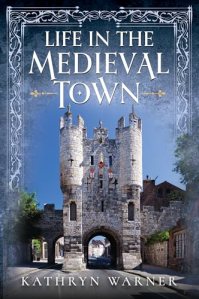
 Have you ever watched a movie, played a video game, or read a novel set in the Middle Ages and wondered if life was really like that? Was it super dirty, grimy, and deadly, or is this a fictional device to show how bad the past was compared to the present? Kathryn Warner has delved into the archives to uncover the truth about what life was like in an average medieval town for her latest book, “Life in the Medieval Town.”
I would like to thank Pen and Sword Books and Net Galley for sending me a copy of this book. I enjoyed the previous books that I have read by Warner about Medieval Europe, so when I saw this title available, it piqued my interest. I have read books about medieval life, so I wanted to see what new information she could provide to this area of social history.
As Warner explains at the beginning of this book, the modern world and the medieval world are opposites. While we in the modern era care about the latest gadgets and an excess of commodities, the medieval era cared about simplicity and owned very little. So, for those of us living in the modern world, Warner treats this book as a sort of time traveller’s guide to a medieval town. Warner chooses to highlight life in London, specifically between the reigns of Henry III and Henry VI, which is quite a range, but it shows how medieval England changed over time.
We start with how medieval people partied after a particular knighting ceremony, before moving throughout the streets of London and exploring the different occupations one could have. We then explore the brothels and the different types of people and languages one might hear on an average day. It shows the diversity of medieval England at this time. Warner also shows her audience the importance of cleanliness and how modern medieval homes could actually be with glass windows, cellars, and latrines. We get to see the different popular names and how job titles were altered in their spelling due to gender. You get to see what curfew meant, what kinds of legal punishments were available, what people ate, drank, and wore on a typical day, plus how medieval people told time, how they handled health, and how they took care of one another, even during the Black Death.
This is such a fantastic resource for medieval novices, writers, and medievalists alike. I knew quite a bit of the information in this book, but I still found some fascinating facts. Warner has an immense knowledge of the medieval era, and it shows throughout this book while maintaining an easy-to-follow writing style. If you are a medieval nerd who wants to learn more about the social history of a medieval town, I highly recommend you read “Life in the Medieval Town” by Kathryn Warner.
 When we think of old homes, we often think of the phrase, “If walls could talk,” because the true treasure of any home is not the floorboards or the walls, but rather the stories of those who lived inside its walls. Take, for example, Hampton Court Palace in England. A home for over 500 years that has seen many architectural and artistic changes in its hallowed halls, but it is the stories of those who stayed for brief periods that truly make this palace spectacular. Stories full of salacious scandals, religious implications, and revelations that would shake England to its core through revolutions. Hampton Court Palace has been the center of English court drama for centuries and finally, these tantalizing tales are being told in a truly remarkable book, “The Palace: From the Tudors to the Windsors, 500 Years of British History at Hampton Court” by Gareth Russell.
 Adventures of a Tudor Nerd