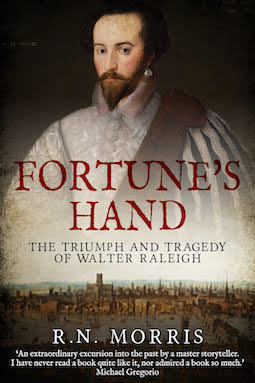
 I am not sure how I came to write a novel about Walter Raleigh. I think I can trace it back to visiting an exhibition on the myth of El Dorado at the British Museum in 2013. But thousands of people went to that exhibition and I dare say very few of them were foolish enough to start writing a 100,000 word novel under its influence.
The dream of the fabled city of gold was one that obsessed Raleigh for decades. He pinned his political hopes on finding it and bringing home its treasure, first for Queen Elizabeth I, so that he could provide her with the funds she needed to defend herself against her great enemy Spain; and later for her successor James I, no longer at war with Spain, but still, like every sovereign in history, desperately short of finances.
In both instances, however, the dream proved to be illusory.
Nonetheless, it was a dream that sustained him through periods of imprisonment and personal tragedy. A dream that he invested his reputation in, and one that he used to entice investors into his highly speculative voyages of discovery and predation. However, it surprised me to discover that Raleigh took part in surprisingly few of these voyages himself; he was an indifferent sailor who suffered badly from seasickness.
Raleigh first heard about El Dorado from a captured conquistador called Pedro Sarmiento de Gamboa. It was just a rumour. A rumour carried on a warm breeze from a distant land.
It seems ironic that a man who was so talented at creating his own mythology should fall victim to a myth. But perhaps that was why he was so drawn to the story, because he knew a great myth when he saw one, and understood more than most its power to inspire minds and influence behaviour. The myth of El Dorado was useful to Raleigh, not because he himself necessarily believed it to be true (there is evidence he didn’t) but because he knew that other men – and, most importantly, one woman – would.
I fell under its spell too.
When I started my research for the book, I knew very little about Walter Raleigh. The one thing I did know was the one thing that everyone knows: he spread his cloak across a puddle so that Elizabeth could walk across it without getting her feet wet. The more I progressed in my research, the less sure was I that this incident actually happened, at least not as it is depicted in countess children’s history books.
It is a compelling idea imbued with meaning. There’s another word for compelling ideas imbued with meaning: myths.
As a child, I thought the point of the story was simply to illustrate what a gentleman Raleigh was. Now I realize there was a bit more to it than that. Raleigh was positioning himself (to borrow a term from modern marketing) as the man who would safeguard his sovereign’s passage across a body of water. In other words, he would be the instigator of England’s colonial project on the other side of the Atlantic.
Raleigh’s life seems to be filled with stories that, even if they fall short of mythical, have at the very least a strong whiff of the apocryphal about them. I don’t believe it’s an accident. Whatever else he was, Raleigh was a poet. His life was his greatest poem, even if it didn’t quite have the ending he might have planned.
In my novel, I see him as a man of boundless imagination. There was nothing he could not envisage. And for him, imagining something was tantamount to accomplishing it. As he gets older, the lines between what he dreams and what he does blur.
Of course, reality did not always play along. But that never seemed to deter him from putting even greater faith in the power of his imagination.
This was the age of Dr John Dee, after all, the great conjuror of angels and demons. Raleigh consulted Dee on navigational matters as well astrological ones. You could say between them they conjured up the British Empire.
In Fortune’s Hand, I imagine Raleigh reciting the names of the places in Guiana that lead to Manoa – the city identified with El Dorado – as if he is uttering the words of an incantation. He even uses this litany of exotic names to soothe Elizabeth when she is distressed.
Raleigh wrote a long, unfinished epic poem in which Ocean addresses his love, Cynthia – AKA the moon. He was given the nickname ‘Water’ by Elizabeth, mocking his West Country pronunciation of his own name. He clearly identified himself with Ocean and Elizabeth with Cynthia, in other words he saw them both as mythic figures. I think it’s a very compelling image for their relationship. The moon is ever remote, changeable, presenting a cool, pale beauty. The ocean’s tides are subject to the lunar gravity, just as Raleigh was subject to Elizabeth’s commands, and whims.
The problem with such self-mythologizing is that it tends to be self-aggrandizing too. And if you see yourself as a hero or a demi-god, it probably means you don’t have much empathy for others. Especially those who have to be defeated, displaced and destroyed to make your myth a reality.
Empathy is not a quality much evident in the Raleigh of my novel. I said above that I saw him as a man of boundless imagination, but it is only boundless when it applies to himself and his interests. He has a curious imaginative blind spot when it comes to considering those whose interests are at odds with his, whether they are his rivals for Elizabeth’s favor, or the rebels he massacred in Ireland.
That makes him a problematic figure in today’s world. But then, to be fair to Raleigh, he wasn’t living in today’s world. The attitudes and beliefs that were woven into the intellectual fabric of the Elizabethan age strike us now as at best baffling and at worst appalling.
So why write a novel about this pre-eminent Elizabethan, at a time when others are petitioning to pull down his statue? The mythology that he created and others have added to has become entangled with England’s national story. I wanted to explore and try to understand the impulses that drove Raleigh through his remarkable life, in which he laid the groundwork for the British Empire. That is clearly a contested legacy now. To challenge and critique that legacy fully, I felt the need to confront one of its key originators – warts, myths and all.
R.N. Morris Bio:
Roger (R. N.) Morris is the author of thirteen novels. The latest is Fortune’s Hand, a historical novel about Walter Raleigh. He is also the author of the Silas Quinn series of historical crime novels and the St Petersburg Mysteries, featuring Porfiry Petrovich, the investigating magistrate from Crime and Punishment.
His website is rogernmorris.co.uk. Roger has a Facebook page for his novels, which is https://www.facebook.com/RNMorrisauthor
He is on twitter as @rnmorris and on Instagram as rogermorris7988. He would love to hear from you so drop him an email at contact@rogernmorris.co.uk

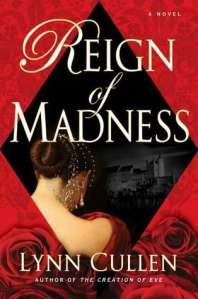 The daughters of Isabel of Castile and Ferdinand of Aragon lived very interesting lives. Of course, we know what happened to Katherine of Aragon, but her elder sister, Juana, has her own tragic tale. She was known as Juana the Mad because the rumors were that when her husband, Philip the Handsome, died, she carried her coffin around for months and would not let him be buried. Was Juana truly mad, or was it all a ruse by powerful men to steal her lands and titles? Lynn Cullen explores Juana of Castile’s life in her novel, “Reign of Madness.”
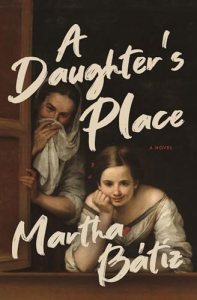 Miguel de Cervantes, the author of Don Quixote, lived quite an interesting life. He was a poet, soldier, war hero, prisoner, husband, brother, uncle, father, and author. His writing might portray a man of honor and dignity, but his home life was messy. You see, Miguel was married, but his daughter was not the daughter of his wife, Catalina de Salazar. His daughter, Isabel, was illegitimate, and when her mother died, Miguel decided the best possible solution was to invite Isabel to live with his sisters and his niece. What’s the worst that could happen? Martha Batiz explores the women’s lives connected to Miguel de Cervantes in her debut novel, “A Daughter’s Place.”
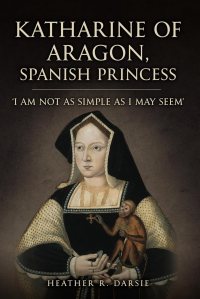 We all know the gist of the tragic tale of Katharine of Aragon. A Spanish princess who was brought to England to marry the heir of the Tudor throne, Prince Arthur Tudor. When the prince died mere months after their wedding day, Katharine was left in limbo and desolate as the Kings of Spain and England bickered over her dowry. Eventually, she would marry King Henry VIII, was his wife for over twenty years, and have numerous miscarriages before Henry decided to divorce her and marry Anne Boleyn. We know how Katharine’s story ends, but how did the stories of her Trastamara family influence her life and her reign as Queen of England? Heather R. Darsie explores Katharine’s Spanish origins in her latest book, “Katharine of Aragon, Spanish Princess: ‘I Am Not as Simple as I May Seem.’”
 Two independent women separated by time but united over two compelling portraits and the secrets hidden behind the paint. Mira (Miramonde) is a nun from a Renaissance convent in the Pyrenees who believes she is an orphan who wants to escape her small community and explore the world. Five hundred years later, Zari, an art scholar, begins the journey to discover who Mira is by using the clues she left behind in her works of art that will take her on a journey that will change her life forever. These two tales are woven together in the first book of the Miramonde series, “The Girl From Oto” by Amy Maroney.
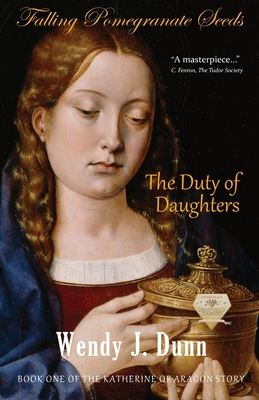 A young Spanish princess sits with her close friend, sisters, and brother as their beloved tutor, Dona Beatriz Galindo, tells them a story. As the children of Ferdinand of Aragon and Isabel of Castile, they must marry and create alliances to strengthen their kingdoms, while Beatriz must ensure they are ready for the challenge. Childhood ends rather quickly with a holy war against the Moors, the expulsion of the Jews from the kingdom, and death around every corner. In her novel, “Falling Pomegranate Seeds: The Duty of Daughters,” Wendy Dunn transports readers into a world of hope and sorrow, life and death.
 Two kings, two rivals from different countries defined the 16th century. One was the spare to his father’s crown, but when his eldest brother suddenly passed away, he became the next Tudor king. The other was the sole heir to his parent’s large kingdom and would become the Holy Roman Emperor. Wars, the Reformation, and family drama kept these two men, Henry VIII and Charles V, busy and at each other’s throats. They would sometimes join and fight for one another’s causes, showing the importance of international politics. With each new scenario, their relationship would shift, either for the best or the worst. Richard Heath has combined the stories of these two monarchs, these “frenemies,” into one joint biography, “Henry VIII and Charles V: Rival Monarchs, Uneasy Allies.”
 A man who was young and had charisma would attract the attention of the Virgin Queen herself, yet that attention came with a price. The young man could not do what he desired and was buried in debt. His anger could not be quenched and he would end up rebelling against the very queen who brought him so much glory and honor. This rebellion would lead to his execution. The man’s name was Robert Devereux, 2nd Earl of Essex, and his story is told in Sarah-Beth Watkins’ latest bite-size biography, “Elizabeth I’s Last Favourite: Robert Devereux, 2nd Earl of Essex”.
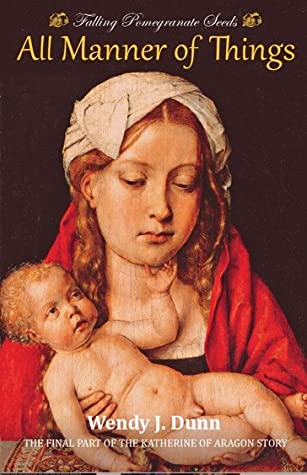 A journey to a foreign land for a long-promised marriage that will unite the royal families of Spain and England. Two friends caught in the middle far away from their beloved Spain. One is Princess Katherine of Aragon, who will marry Prince Arthur. The other is her cousin and close confidant, Maria de Salinas. Their journey like their friendship will last for decades, full of loyalty and love. Katherine’s story has been told many times in different ways, while Maria de Salinas has remained faithfully in the shadows. That is until now. In Wendy J. Dunn’s continuation of her Katherine of Aragon story, “Falling Pomegranate Seeds: All Manner of Things”, Maria de Salinas is the protagonist telling the tragic tale of love and heartache from her perspective.
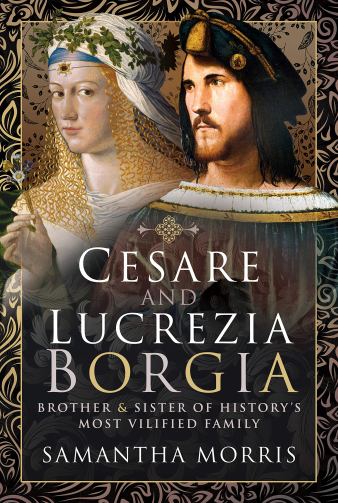 A family mired in myths and rumors of incest, murder, and intrigue for centuries. A brother and sister caught in the middle, attracting the attention of gossips and historians alike. No, I am not referring to a royal family in England. In fact, this story starts in Spain with Alonso de Borja, who moved to Italy and helped create the infamous Borgia family. Caught in the middle were the son and daughter of Rodrigo Borgia, Alonso’s nephew, and his mistress Vanozza Cattanei; Cesare and Lucrezia Borgia. How close were these famous siblings? What were their lives really like? In Samantha Morris’ latest biography, “Cesare and Lucrezia Borgia: Brother and Sister of History’s Vilified Family”, she dives deep into the archives to find out the truth about the legendary Borgia family.
 Adventures of a Tudor Nerd