Guest Post: “Gilded Power – The Jewelry Legacy of the Tudors” by Sam Mee

I am pleased to welcome Sam Mee, founder of the Antique Ring Boutique, to my blog today to share an article about Tudor jewelry.

Jewelry was predominantly religious in the austere Middle Ages, focusing on relics, devotional rings, and crosses. But the Tudor rulers developed it as a way to project their own royal power and authority. Clothing fashions of the time emphasized structure, and monarchs like Henry VIII and Elizabeth I integrated jewelry to proclaim their status and divine favor. 

This was the age of portraiture, when the elite commissioned likenesses as propaganda. Hans Holbein the Younger depicted Henry VIII in a way that showed off his jewels and chains of office as much as his formidable bulk (and codpiece). Holbein’s most famous image of Henry is a 1537 mural that, while destroyed by fire in 1698, is still known through copies. It shows the King with a powerful stance and wearing multiple chains and rings to further emphasized his authority and wealth.

Holbein portrait, public domain image: https://upload.wikimedia.org/wikipedia/commons/thumb/f/f9/After_Hans_Holbein_the_Younger_-_Portrait_of_Henry_VIII_-_Google_Art_Project.jpg/1024px-After_Hans_Holbein_the_Younger_-_Portrait_of_Henry_VIII_-_Google_Art_Project.jpg

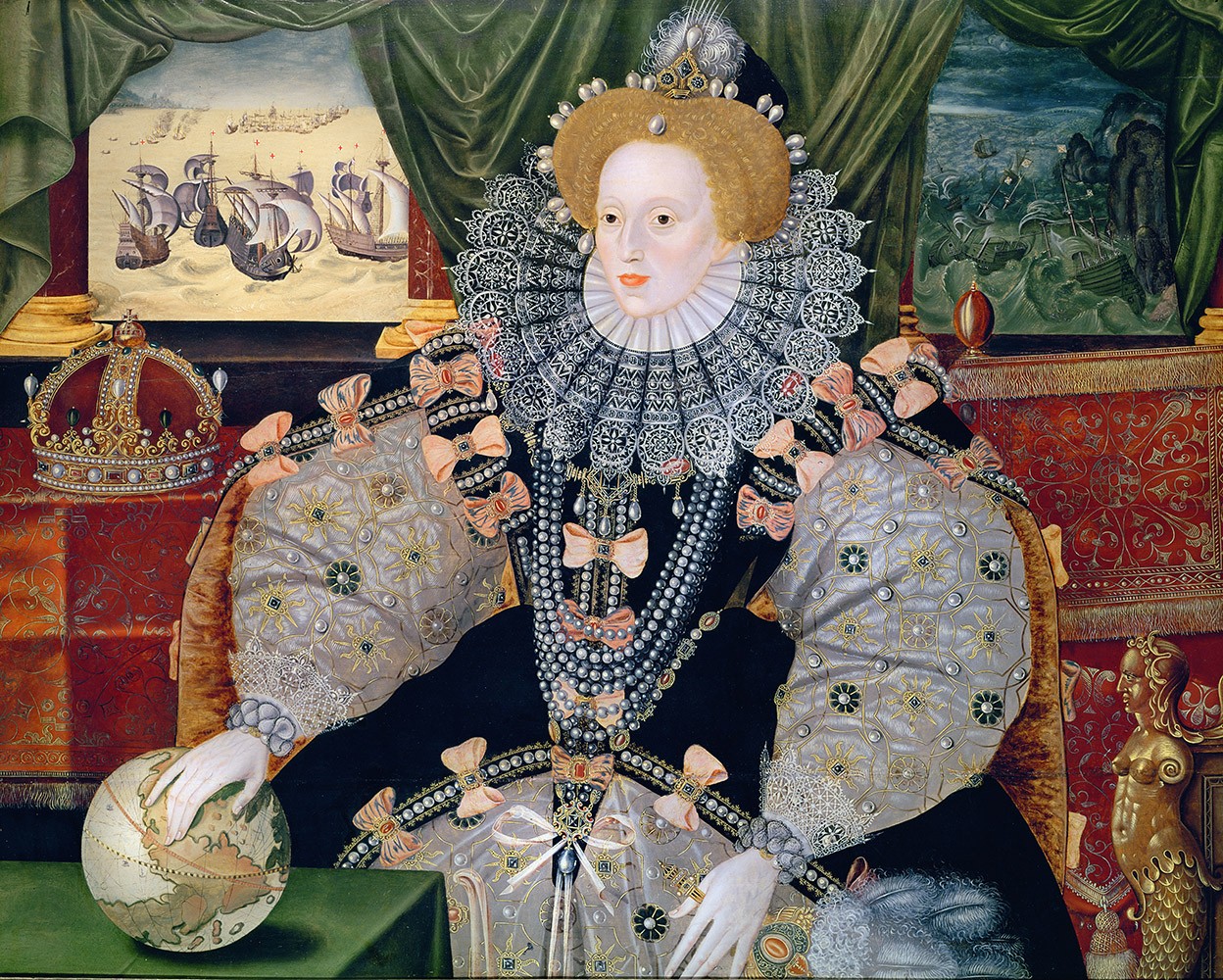
Three similar Armada portraits of Elizabeth I were painted after England defeated the Spanish Armada. They take allegory even further. The Queen is almost encased in pearls. Her gown is embroidered with them, they sit on her hair, and pearl ropes hang from her neck, all to symbolize chastity and divine protection. More explicitly, her hand rests on the globe as a symbol of empire. Her powerful warships are visible in the background behind her gem-encrusted crown, signifying divine authority. 
Armada portrait, public domain image: https://upload.wikimedia.org/wikipedia/commons/7/7b/Elizabeth_I_%28Armada_Portrait%29.jpg

In fact, Elizabeth I was rarely painted without pearls – other examples include the Darnley Portrait (c1575) and Rainbow Portrait (c1600). The pearls repeatedly symbolized the Virgin Queen’s chastity and wealth in bodily form.

The sumptuary laws

If gems and clothing signified power, then rulers needed to control who wore what. Medieval 15th-century sumptuary laws started to codify this across Europe. A 1463 English statute restricted who could wear “royal purple”, while a 1483 act restricted velvet to knights and lords and satin for gentry with a yearly income of £40.

Tudor England was an intensely hierarchical society, and so the laws were tightened further. Elizabeth’s 1574 Act of Apparel spelled out in detail who could wear what – her rules set which fabrics hats could be made of and dictated the length of swords, depending on the wearer’s standing. Check out the list here: https://midtudormanor.wordpress.com/sumptuary-laws/

Jewelry was also regulated with gold chains, heavy pearls, and precious stones reserved exclusively for the nobility. 

Enforcement was patchy but real, with surviving court records showing individuals tried for breaches and fined. These laws were somewhat symbolic, though. They were a way to make hierarchy visible rather than consistently enforced. Ambitious merchants and courtiers often flaunted jewels beyond their rank, with monarchs turning a blind eye.

Fashion at court

Jewelry was inseparable from clothing at court. Goldsmiths worked hand in hand with tailors, and jewels were sewn directly into doublets and headdresses.

We know Henry VIII wore vast gold chains and pendants and even occasionally jeweled codpieces. Courtiers followed suit with jeweled hat badges, enameled rings, and ornate girdle books (these were tiny, jeweled prayer books that hung from belts). They also wore gold pearl earrings. Women sported pearls, rubies, and diamonds on top of layered dresses made from richly embroidered fabrics. 

Anne Boleyn’s necklace – a large gold “B” with three drop-pearls dangling from it – is one of the period’s most famous jewels. It’s a very personal bit of jewelry that symbolized her individuality and status. (It survives only in portraits – its whereabouts after her 1536 beheading is not known).

Anne Boleyn’s B necklace, public domain image: https://upload.wikimedia.org/wikipedia/commons/f/f2/Anne_boleyn.jpg

Global trends and treasures

The rise in the prominence of jewelry was part of a wider trend of expanding horizons – culturally, societally, geographically, and economically. Spain’s influx of New World gold and silver boosted Europe’s wealth, with England claiming its own share through figures like Sir Walter Raleigh and Sir Francis Drake.

There’s extraordinary archaeological evidence of this, not just from the images of the time but from the Cheapside Hoard, discovered in 1912 beneath a London cellar. It’s a collection of more than 400 pieces. There are emerald rings, diamond pendants, and enameled chains with gems sourced from Colombia, India, Burma, and Brazil. The treasure shows that London goldsmiths had access to a global supply of jewels long before the height of the empire. 

Together with portraits, the Hoard is the richest record we have of Tudor jewelry, showing how jewels were actually made. You can read more about it here: https://www.londonmuseum.org.uk/collections/london-stories/jewels-cheapside-hoard/

Evolution of Tudor Jewelry

New fashions, new materials, and new freedoms (for some). Tudor jewelers developed new techniques to match these wider changes in society, combining medieval traditions with Renaissance artistry. Enameling reached new heights, and these techniques were carried forward into Georgian mourning jewelry and even into Victorian revival pieces.

Foil-backing was widely used in Tudor times to enhance jewels. Thin sheets of colored foil were placed behind gems like diamonds, rubies, or rock crystal to enhance their brilliance. This technique remained common until the 18th century, when more advanced diamond cutting began to produce inherent sparkle.

Gem cutting itself advanced in the Tudor period. Gemstones are rarely cut in bespoke shapes but tend to use standardized cuts designed to maximize brilliance or colour. This has been true since the Renaissance. Earlier medieval gems were typically worn as cabochons (smooth, polished domes), which enhanced colour but not brilliance. Then, from the late 15th century, jewelry began to experiment with faceting, where flat surfaces were cut at angles to reflect light, and Tudor lapidary work played a key role in the development and take-up of new techniques:

  • Cabochon: The oldest approach. A smooth, rounded dome without facets. Used in the medieval period for sapphires, garnets, and emeralds.
  • Point cut: This simple cut shaped a diamond into a pyramid with four sides. Mostly common in the 15th century.
  • Table cut: Developed in the late 15th century, this removed the top of the pyramid to create a flat “table” facet. It meant increased brilliance and became standard in Tudor jewelry.
  • Rose cut: Emerged in the 16th century as diamond saws and polishing technology improved. This had a flat base and a domed top covered in triangular facets to resemble a rosebud. The rose cut was popular until the 19th century.
  • Old mine cut: An 18th-century development. It’s a squarish cut combined with a high crown, deep pavilion, and large culet. It was the forerunner of the modern brilliant cut.

You can read more about the evolution from medieval jewelry techniques here. (https://historicalbritainblog.com/the-debt-antique-jewellery-owes-to-the-middle-ages-guest-post-by-samuel-mee/)

Settings in Tudor times typically enclosed the stone with gold, but Tudor jewelers began experimenting with more open settings to admit light. It was the Stuart era that really saw the development of the claw setting for diamonds, where the gem was held with tiny metal arms to allow much more light to pass through, dramatically increasing sparkle.

Tudor trends can be seen in subsequent centuries: 

  • Georgian jewelers turned enamel and foil into sentimental jewelry such as portrait miniatures (also common in Tudor times) and mourning rings.
  • Victorian designers enjoyed historical revival, and they often deliberately echoed Tudor styles, such as heavy Holbein-like gold chains and memento mori skulls.
  • Edwardian jewelers drove a revival of Elizabethan-style pears and combined them with lace-like platinum settings.
  • Art Deco designs were modernist in geometry but had a strong revivalist theme from Egyptian motifs to statement designs that matched 16th-century theatricality.

Surviving themes

Tudor jeweler was many things: regulated, global, technical, and symbolic. It was constrained by law, used as propaganda, and yet pushed at boundaries. It was part of the evolution of techniques and materials that developed over several hundred years as jeweler changed to become ever more personal. And even specific gem traditions persisted. The Tudor love of pearls was echoed in the Edwardian era. Tudor foiling foreshadowed Georgian brilliance. Tudor enameling was revived multiple times in the centuries that followed. Let’s just hope the codpiece doesn’t return. 

About the Author

Sam Mee is the founder of the Antique Ring Boutique (https://www.antiqueringboutique.com/), which sells rings from the Georgian, Victorian, Edwardian, and Art Deco eras. He has several guides on his website for buying rings from different historical periods. EG, you can learn more about ring cuts and foiling in the guide to Georgian rings: https://www.antiqueringboutique.com/en-us/pages/georgian. He is a member of both Lapada (https://lapada.org/dealers/antique-ring-boutique/) and BADA (https://www.bada.org/dealer/antique-ring-boutique). 

Book Review: “Mistress of Dartington Hall” by Rosemary Griggs

One of the greatest threats to England during the reign of Elizabeth I was the Spanish Armada, under the orders of King Philip II of Spain. In the year 1587, the Spanish ships were spotted off the coast of Devon. Fear grips the country, but one woman is up to the task of keeping her beloved Dartington Hall and its inhabitants from harm. Roberda Chapernowne knows what it means to fight for those she loves and is willing to do it again while her husband, Gawen, is away in Ireland fighting for the Queen after he almost divorced Roberda. Roberda’s life turns upside down when Gawen returns home. Can they rekindle their relationship, or will they fall into despair and ruin? Rosemary Griggs concludes Roberda and Gawen Chapernowne’s stories in her latest novel, “Mistress of Dartington Hall.”
I would like to thank Troubador Publishing and Net Galley for sending me a copy of this novel. I have enjoyed Griggs’ previous novels, so when I saw that she had another novel coming out to end Roberda Chapernowne’s story, I knew I had to read it to see how Roberda’s story ended.

We are thrust straight into the action with this novel. It’s 1587, and rumors of Spanish ships have been spotted off the English coast. Fear grips the inhabitants of Dartington Hall, but the mistress of the house, Roberda Chapernowne, is ready to take control of the situation. She has been in charge for the last three years, following her husband, Gawen, who left her and his family to fight in Ireland for Queen Elizabeth I. Now, Gawen has returned home, which makes things extremely awkward as Gawen tried to divorce Roberda. Now, he is back and wants to reconcile their relationship, but Roberda’s faithful maid Clotilde, who has stood by her side every step of the way, is hesitant.

Gawen and Roberda reconcile while raising their children while dealing with the threat of a Spanish invasion. Unfortunately, their brief return to normalcy is dashed when Gawen is injured while hunting and dies, leaving Roberda to take care of the children and the estate. But being a widow who has mostly daughters and only one son is difficult. We see how Roberda deals with her children’s inheritances, her family in France, and a budding romance for Roberda.

I found this an enjoyable conclusion to Roberda Chapernowne’s story. I liked how this book series and this novel in particular focused on lesser-known figures in the Tudor age, instead of the typical royals. If you are a fan of the previous novels in this series, I recommend you read “Mistress of Dartington Hall” by Rosemary Griggs.

Book Review: “Elizabeth I” by Margaret George

The stories of queens have been told in numerous ways for centuries, but one of the most famous queens in human history is the Virgin Queen, Elizabeth I. The daughter of Anne Boleyn and Henry VIII who famously decided not to marry any man and instead devout her entire life to serve England’s people. That does not mean she was subservient to others she demanded respect and adoration from her subjects. Most stories of Elizabeth I begin in her golden years, but what could a novel about the queen’s silver years tell us about her personality, her reign, and the people who choose to follow or rebel against the famous queen? Margaret George gives her readers an innovative look at the titular queen in her novel, “Elizabeth I.”
This is only the second novel I have read written by Margaret George, the first being the brilliant “The Autobiography of Henry VIII.” I knew that she had written a novel about Elizabeth I, but I had not had the chance to read it until I saw it at a used bookstore. It was an instant buy for me even before I read the description, but the blurb made me even more intrigued.

George does not begin with Elizabeth’s coronation in 1558, like many novels about Elizabeth, but in the year 1588, which was arguably the queen’s most difficult challenge, fending off the Spanish Armada. To start at this most pivotal moment in Elizabeth’s reign is a bold choice that pays off because it sets the tone for the rest of the novel. Nothing is stable for the queen even after victory is won. Shortly after the Armada is defeated, the love of Elizabeth’s life, Robert Dudley Earl of Leicester dies. It is a huge loss for the queen, but she is not the only one who loves Leicester. He leaves behind his wife and cousin to the queen, Lettice Knollys, however, the two women cannot share their grief as the queen banished her cousin from court after she heard about the marriage.

The only one who can connect the two women at this point is Lettice’s son the Earl of Essex, who desires to be a great man, so he becomes a favorite of Queen Elizabeth. The arrogant young up-starter soon finds out that court is not all that he dreamed it would be and that to be a great man, he has to follow every rule of his monarch, which goes as well as you would imagine. What I appreciate about this novel is that George does not gloss over Elizabeth’s reign and instead chooses to show how muddy the political landscape was during the late Elizabethan age. We also get to see events that are not often featured in other novels about the Elizabethan age, such as Roanoke, Grace O’Malley, the return of the Armada, diplomats from farther countries, and the connection between Lettice Knollys and William Shakespeare. She fought every second of every day to keep her crown because she never knew who was the threat and when they would strike next until her dying breath.

I think this novel does an excellent job of showing George’s readers what Elizabeth I was like further into her reign. It balanced both the harsh reality of the Tudor court with plenty of intrigue with Elizabeth the person who had her heart broken on more than one occasion and had to be harsh to fight for what she loved, the English people. If you want an unforgettable portrayal of the Virgin Queen and her court towards the end of her reign, I highly recommend you read, “Elizabeth I” by Margaret George.

Book Review: “Blood, Fire & Gold: The Story of Elizabeth I and Catherine de Medici” by Estelle Paranque

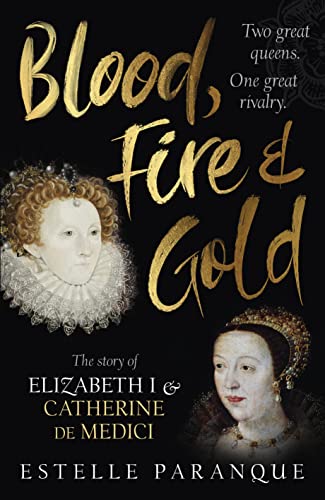
9781529109221-usTwo queens; one a wife and the mother of kings and the other a virgin who had to fight for the right to rule her country independently. Two women who found friendship and a rivalry between each other with only a sea that divided them and religious discord to drive them apart. Catherine de Medici and Elizabeth I would define what it meant to be female rulers in the 16th century for France and England, respectively. The tales of Elizabeth I and Catherine de Medici have been covered in numerous books, but a joint biography of these two powerhouses is a rarity until now. Estelle Paranque demonstrates how both queens greatly affected each other’s lives in her latest book, “Blood, Fire & Gold: The Story of Elizabeth I and Catherine de Medici.”

Paranque begins her book with a short story about an encounter between Elizabeth I’s English ambassador to France, Sir Nicholas Throckmorton, and Catherine de Medici, who acted as regent for her son Charles IX. It is an example of how each queen viewed diplomacy and the dance they had to do to keep their respective dynasties on the thrones of England and France.

Catherine de Medici was the daughter of Lorenzo II de Medici, Duke of Urbino, and Madeline de La Tour, d’Auvergne. Her parents died when Catherine was young, leaving her to be a wealthy heiress and a powerful pawn in the marriage market. Her husband would be King Henry II, known to have several mistresses, including Diane de Poitiers, who was her husband’s, true love. Despite issues with Diane, Henry and Catherine had a huge family, including several sons, including King Francis II, King Charles IX, King Henry III, and Francis, Duke of Anjou. After the death of her husband, Catherine worked hard to be the regent for her sons until they came of age to rule and continue the Valois dynasty.

In England, Elizabeth I was the daughter of Anne Boleyn and the notorious King Henry VIII; their relationship was the most infamous of the 16th century for obvious reasons. After the deaths of King Henry VIII, King Edward VI, and Queen Mary I, Elizabeth got her chance to rule England in her way. When the issue of Elizabeth’s marriage came into play, Catherine de Medici entered Elizabeth I’s life, starting a 30- year relationship that began as a friendship but changed into a rivalry in the end.

Over the thirty years, Catherine de Medici and Elizabeth I dealt with many obstacles in their relationship. Catherine had to deal with the antics of her children and her daughter-in-law, Mary Queen of Scots, who would become one of Elizabeth’s biggest rivals. The bond between the two queens started over a desire for one of Catherine’s sons to marry Elizabeth and become King of England and France, but alas, this was wishful thinking. Catherine and Elizabeth also had to deal with other nations, like Spain, getting in the way of their relationship, as well as the issue of religion; Catherine was a devout Catholic, and Elizabeth was more Protestant. Catherine had to deal with several wars of religions and the St. Bartholomew’s Day Massacre, while Elizabeth had to deal with the Spanish Armada and what to do with Mary Queen of Scots.

Catherine de Medici and Elizabeth I had to communicate through ambassadors and letters, which Paranque translated into modern English, making it easier for modern readers to understand. I cannot stress how much I loved this book and how Paranque was able to weave the stories of the two most powerful women in 16th-century Europe.

“Blood, Fire & Gold: The Story of Elizabeth I and Catherine de Medici’ by Estelle Paranque is a tour de force dual biography of two influential badass queens. This book is a must-read for anyone passionate about the 16th century.

Book Review: “Raleigh: Tudor Adventurer (Elizabethan Book #3)” by Tony Riches

61016647._SY475_A man who wants to get ahead in any royal court must have an impeccable background and a willingness to serve his monarch no matter the obstacles thrown their way. It takes an extraordinary man who doesn’t have a pristine background to make it in the ruthless world of a royal court, but some men made names for themselves. One such man was an adventurer, a poet, an explorer, and a courtier. He came from humble beginnings and rose to prominence to become known as one of the last true Elizabethans. The man was Sir Walter Raleigh, and his story is told in Tony Riches’ latest novel, “Raleigh: Tudor Adventurer.”

I want to thank Tony Riches for sending me a copy of this novel. I have enjoyed his previous books in his Elizabethan series on Sir Francis Drake and Robert Devereux Earl of Essex, so I was thrilled when a new story about Sir Walter Raleigh was announced. I previously read a novel about Sir Walter Raleigh’s mother this year, so I was looking forward to an adventure with her son.

Walter Raleigh began his career as a law student who was not passionate about the law. He is ambitious and eventually attracts the attention of Queen Elizabeth I herself; it is in her court that he becomes a courtier and, finally, her Captain of the Guard. His dream was to set sail on the open seas with his brother. He finally gets his chance to sail the high seas, but it is not as glamorous as he envisioned, but he is hooked on the thrill of the adventure.

Some look down on Raleigh because he is not part of a noble family, but he rose through the ranks to become one of the Queen’s favorites. His good looks and charisma attracted the attention of many young ladies, including Bess Throckmorton, who would later become his wife. However, the bulk of this novel focuses on the adventures and investments Raleigh was known for. From Ireland and Cadiz to the New World and the search for the legendary City of Gold, Riches takes his readers on swashbuckling journeys full of perilous battles and high rewards.

I thoroughly enjoyed seeing Raleigh’s relationships with everyone from Queen Elizabeth I to his wife, Bess Raleigh. The audience gets a chance to see the inner workings of Elizabeth’s court through the eyes of someone who knew what it meant to be on Elizabeth’s good side. I also enjoyed the poetry that Riches weaves into this narrative to give his audience a better understanding of what Raleigh might have felt during crucial moments in his life. My one issue with this novel was that some of the battles and scenes during Raleigh’s expeditions felt a tad rushed to me, and I wish Riches developed these scenes a bit more.

Overall, I found this novel satisfying to read and a real treat for any Tudor fan. If you have enjoyed the previous Elizabethan series books or are looking for a stand-alone story about Sir Walter Raleigh, I would propose you read “Raleigh: Tudor Adventurer” by Tony Riches.

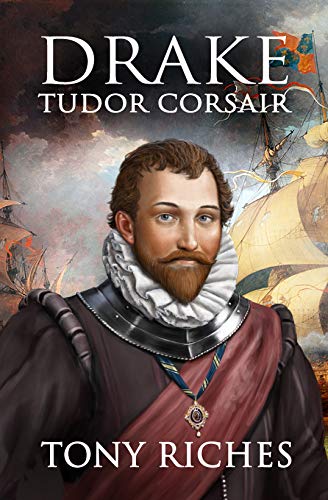
Book Review: “Drake -Tudor Corsair” by Tony Riches

54845924._SY475_When we think of pirates, we tend to think of Caribbean pirates that are popular in fiction and in movies. They are swashbuckling rogues who are only looking out for themselves, booze, and treasure. We tend to think about the 1600s-1800s as the height of piracy on the open seas, but there were pirates that existed even earlier than that. In England, they were known as corsairs, and one of the best during the reign of Queen Elizabeth I was the suave and debonair Sir Francis Drake. Although he did circumnavigate the world and helped the English defeat the Spanish Armada, his story is rarely told in novels. That is until now. In the first book in his Elizabethan series, Tony Riches takes on the challenge to explore what Drake’s life was like and what kinds of adventures he took in order to protect his beloved homeland. This is Tony Riches’ latest novel, “Drake- Tudor Corsair”.

I would like to thank Tony Riches for sending me a copy of his latest novel. I have enjoyed Tony’s novels in the past and when I found out that he was doing an Elizabethan series and had a new book about Sir Francis Drake, I knew I wanted to read it. I did not know much about Sir Francis Drake and his adventures, except that he traveled the world and helped defeat the Spanish Armada before I read this book so I was excited to learn more.

We are introduced to Francis Drake when he is a young lad, dreaming of adventure and far away lands. He wants to sail the high seas, but things are not as picture-perfect as he imagined. He is involved in the slave trade, which is something that he comes to deplore later in life. Drake tries to think about the well-being of the slaves and will become friends with a former slave named Diego. However, Drake does contradict his own beliefs when it comes to slavery and taking someone’s life when his beloved country England is in danger from the Spanish, who he finds diabolical and does not mind attacking them whenever he discovers the location of their ships. This complex dynamic makes him more of a believable, three-dimensional character.

At the heart of this novel is the countless adventures Drake and his crew of corsairs partake in on different ships, including the famous The Golden Hind. As a connoisseur of Tony Riches’ novels, I know that he doesn’t do a ton of action sequences in his novel as he tends to focus on the relationships between characters, yet he is able to transport the reader into high action battle scenes where you wonder if Drake and his crew will survive. Since many Tudor novels tend to focus on England and Europe during the reign of this infamous dynasty, it is a breath of fresh air to explore the world with Drake and his men. Whether it is fighting the Spanish sailors or fighting indigenous people from far away lands, there is always a perilous adventure for Drake and his crew to embark on. What never changes is Drake’s faith and how his religious views are a constant comfort to his even when things become dire.

If I did have a small area of concern it would be that Riches does include modern names for locations and items found around the world so that modern readers would understand what is going on. I am not sure if the factual Francis Drake and his crew knew the names of these locations and mysterious objects while they were traveling or if the names came afterward.

Like any stellar novel by Tony Riches, he does focus on Drake’s relationships with the people who are closest to him. Drake was married to two different women, Mary and Elizabeth, and it is quite interesting to see how both women react differently to his life full of risk and danger on the high seas. Then there are his relationships in the Elizabethan court. Of course, there is his relationship with Queen Elizabeth I, since he is considered to be one of her favorites at court, yet it is not always smooth sailing for Drake. He also interacts quite a bit with William Cecil and Sir Francis Walsingham to make sure England is secure. Drake wants to be included in court life, but although he looks the part, he knows that he will never be one of the colorful courtiers.

Francis Drake has always been a side character, never the gallant corsair hero. Tony Riches has changed all of that. He has thrown open the doors to a colorful and treacherous world of the seas with his first book in the Elizabethan series. Drake is so real and raw. You can understand why he made the decisions that he did to protect his crew and his homeland. This is an absolutely captivating read that will bring the adventures of this distinguished Elizabethan corsair to life. If you want an enthralling Tudor historical fiction novel that takes you to places unknown and where there are dangers galore with a caring and charismatic hero at the heart of all of the adventures, I highly recommend you read Tony Riches’ latest novel, “Drake- Tudor Corsair”. A true triumph and a brilliant way to start a brand new series. I cannot wait for the second novel in this Elizabethan series.


Guest Post: Understanding the Life of Francis Drake: by Tony Riches, Author of Drake – Tudor Corsair

Statue_of_Drake,_Plymouth_HoeTwo things I remember being taught about Francis Drake at school are he was the first British man to sail around the world, and that he nonchalantly played a game of bowls as the Spanish Armada sailed up the British Channel in 1588.

It’s true that Drake recreated the Portuguese explorer Ferdinand Magellan’s circumnavigation – although unlike Magellan, he survived being attacked by hostile islanders, and lived to tell the tale.

As for his game of bowls, there was a bowling green at his manor house, but the story first appeared thirty-seven years after the Armada. From what we know of the tide and weather on that day, Drake’s casual behaviour may well have been justified, but I believe it’s all part of the myth around Drake’s life, which he had good reason to encourage.

I’d been planning an Elizabethan series for some time, as my aim is to tell the stories of the Tudors from Owen Tudor’s first meeting with Queen Catherine of Valois through to the death of Queen Elizabeth.

I decided to show the fascinating world of the Elizabethan court through the eyes of the queen’s favourite courtiers, starting with Francis Drake. I’ve enjoyed tracking down primary sources to uncover the truth of Drake’s story – and discovering the complex man behind the myths.

The scale of his achievement was brought into focus for me when I visited the replica of the Golden Hinde – Drake’s flagship, and the only one to survive his circumnavigation. Made to the same measurements as the original, the replica is only 121 ft 4 in length, and must have seemed vulnerable in the many storms Drake encountered.

DrakeMonumentTavistockAnother popular belief is that Drake was the hero of the defeat of the Spanish Armada. Although he was made vice-admiral of the English fleet sent out to fight the Armada, Drake spotted a damaged galleon falling behind, and couldn’t resist boarding her. The first captured ship of the Armada, the Nuestra Señora del Rosario (Our Lady of the Rosary) was commanded by the Spanish Admiral General Don Pedro de Valdés, and was taken as a prize.
Francis Drake was a self-made man, who built his fortune by discovering the routes used by the Spanish to transport vast quantities of gold and silver. He had a special relationship with Queen Elizabeth, and they spent long hours in private meetings, yet was looked down on by the nobility even after he was knighted. His story is one of the great adventures of Tudor history.

DrakeDrake- Tudor Corsair
1564: Devon sailor Francis Drake sets out on a journey of adventure.

Drake learns of routes used to transport Spanish silver and gold, and risks his life in an audacious plan to steal a fortune.

Queen Elizabeth is intrigued by Drake and secretly encourages his piracy. Her unlikely champion becomes a national hero, sailing around the world in the Golden Hind and attacking the Spanish fleet.

King Philip of Spain has enough of Drake’s plunder and orders an armada to threaten the future of England.

Drake – Tudor Corsair continues the story of the Tudors, which began with Owen Tudor in book one of the Tudor trilogy.

Tony Riches

Tony Riches is a full-time UK author of best-selling historical fiction. He Tony Riches Author (1)lives in Pembrokeshire, West Wales and is a specialist in the history of the Tudors. For more information about Tony’s books please visit his website tonyriches.com and his blog, The Writing Desk and find him on Facebook and Twitter @tonyriches

Drake – Tudor Corsair is available in paperback and eBook editions from:

Amazon US https://www.amazon.com/dp/B08FCTYQF4
Amazon UK https://www.amazon.co.uk/dp/B08FCTYQF4
Amazon CA https://www.amazon.ca/dp/B08FCTYQF4
Amazon AU https://www.amazon.com.au/dp/B08FCTYQF4

Author Links:

Website: https://www.tonyriches.com
Writing blog: https://tonyriches.blogspot.com
Twitter: https://twitter.com/tonyriches
Facebook: https://www.facebook.com/tonyriches.author
Podcasts: https://tonyriches.podbean.com
Goodreads: https://www.goodreads.com/author/show/5604088.Tony_Riches

Book Review: “An Alternative History of Britain: The Tudors” by Timothy Venning

A1XRNNIWxkL.jpgThe study of history is all about asking questions about how and why events happened. We understand that history is very much a study of cause and effect; if a certain person causes something to happen, we study the effect of those actions. But what if the person changes what they do? What would happen to the course of history? These are considered the “what ifs” of history, which is something that history fans and students like to discuss with one another. These questions rarely are discussed in books, until now. Timothy Venning explores some of the “what ifs” of the Tudor Dynasty in his book, “An Alternative History of Britain: The Tudors”. 

I would like to thank Pen and Sword Books for sending me a copy of this book. This book was a rather interesting read and gave a different perspective to the Tudor dynasty as a whole.

 Instead of having an introduction to explain what he hopes to achieve with this book, Venning dives right into his discussion of some of the most famous “what if” questions about the Tudors. What if Prince Arthur lived to become King? What if Henry Fitzroy lived, could he have become King? What if Anne Boleyn survived? What if King Edward VI lived, who would he have married and what kind of King would he have been like? What if Lady Jane Grey stayed Queen of England, how would she have ruled England? What if Elizabeth I married Robert Dudley? What if the Spanish Armada succeeded in their plan to conquer England? Of course, Venning does include some of his own questions into the discussion as well to explore the entirety of the Tudor dynasty.

I honestly have mixed feelings about this book. I think Venning is very educated about the topics that he does discuss in this book. It is very much what I would call a “discussion starter” book. Venning gives his own opinions about these scenarios and gives readers something to think about. Some of the scenarios were relatively new ideas to me, which made me stop reading the book for a little bit to really think about what Venning is talking about and how history could have changed if one of the factors was changed.

Most of these topics are either political, martial, or military-related so we don’t really get to see how these events might have affected those who were not part of the royal family or the government. I wish Venning would have explored how these events would have impacted the country as a whole as well as how it might have impacted the culture of England. Venning does reference other events and figures in history in this book to make a point, which is fine, but I wish he didn’t compare the Tudors to modern figures that are seen as negative influences. It comes off as a bit distracting and I wish in these moments he would stick to talking about the Tudors.

Overall, I think this book was interesting. It really gives the reader a better understanding of how the Tudors survived during a very precarious time period in order to make England a better place for their people. Venning did present fascinating arguments for the reader to think about, but I wish he had written a bit better so that casual readers don’t get lost. If you want a book that makes you wonder about the “what ifs” of the Tudor dynasty, I would recommend you read, “An Alternative History of Britain: The Tudors” by Timothy Venning. 


Book Review: “A Column of Fire” by Ken Follett

9780451477996_p0_v1_s550x406After the death of Henry VIII and Edward VI, there was an explosion of religious intolerance, not just in England, but in Europe as a whole. Many believe that it was Mary I “Bloody Mary” who really started this trend, however, the fires of hatred between Protestants and Catholics extended further into the reigns of Elizabeth I and James I of England. We often focus on the monarchs and their inner circles during this time and how the religious persecutions affected the decisions that they made. That tells only part of the story, but how did this religious fighting between Protestants and Catholics affect the normal person? What were their lives like? Ken Follett explores this topic in his third book in his historical fiction series, the  Kingsbridge Series, “A Column of Fire”.

Every historical fiction book needs a great opening to engage the reader and Ken Follett delivers with his prologue:

We hanged him in front of Kingsbridge Cathedral. It is the usual place for executions. After all, if you can’t kill a man in front of God’s face you probably shouldn’t kill him at all. The sheriff brought him up from the dungeon below the guildhall, hands tied behind his back. He walked upright, his pale face defiant, fearless. The crowd jeered at him and cursed him. He seemed not to see them. But he saw me. Our eyes met, and in that momentary exchange of looks, there was a lifetime. I was responsible for his death, and he knew it. I had been hunting him for decades. He was a bomber who would have killed half the rulers of our country, including most of the royal family, all in one act of bloodthirsty savagery- if I had not stopped him. I have spent my life tracking such would-be murderers, and a lot of them have been executed- not just hanged but drawn and quartered, the more terrible death reserved for the worst offenders. Yes, I have done this many times: watched a man die knowing that I, more than anyone else, had brought him to his just but dreadful punishment. I did it for my country, which is dear to me; for my sovereign, whom I serve; and for something else, a principle, the belief that a person has the right to make up his own mind about God. He was the last of many men I sent to hell, but he made me think of the first…”(Follett, prologue).

This story follows the lives of several different people and their families, but the main story focuses on a man named Ned Willard. After he can’t marry the girl he loves, Margery Fitzgerald,  and his family is crushed by bad investments, he decides to work for a young Elizabeth Tudor, who would later become Elizabeth I. His works will lead him all over England and Europe to help thwart plots to kill Elizabeth and replace her with a Catholic ruler. One of his biggest opponents is the elusive Jean Langlais, a man who works in the shadows, yet he is closer than Ned thinks.

What Follett does so well is that he incorporates people from other countries into this story. Sylvie Palot from France, the young Protestant bookseller, who is not afraid to sell Bibles to those who wish to own a Bible. Pierre Aumande, the man who will do anything in order to gain power. Alison McKay, the fictitious best friend of Mary Queen of Scots, who would do anything for her queen. Ebrima Dabo, a slave who will do anything to be free. Barney Willard, Ned’s brother, who wants nothing in life, except to sail the high seas looking for adventure.

Follett’s cast of original characters adds a depth to an already tumultuous time in European history. Follett is able to blend the fictitious characters with real historical figures and actual events like the St. Bartholomew’s Day Massacre, the death of Mary Queen of Scots, and the Spanish Armada.

This is my first book by Ken Follett and I have to say I thoroughly enjoyed it. There were so many twists and turns in this story that I was not expecting that I really could not stop reading this book. I found it rather engaging and exciting. I found it interesting that Follett decided to end the book during the reign of James I and that he called King Philip II of Spain by his other less common Spanish name Felipe. These are more stylistic choices instead of historical choices.

Overall as a historical fiction book about the religious persecution in the Elizabethan era, I found this book dynamic and thrilling. Although this is the third book in a series, I believe it can stand on its own.  After reading this book, I really want to go back and read the first two books of the series. If you want a great historical fiction book that you can easily get lost in, I enthusiastically recommend you read “A Column of Fire” by Ken Follett.

Biography: Sir Walter Raleigh

(Born around 1552- Died October 29, 1618)220px-Sir_Walter_Ralegh_by_'H'_monogrammist
Son of Walter Raleigh and Catherine Champernowne
Married to Elizabeth Throckmorton.
Father of Damerei, Walter (also known as Wat), and Carew Raleigh.
Sir Walter Raleigh was a writer and an adventurer who helped establish a colony near Roanoke Island. He was imprisoned in the Tower of London a few times and was later executed for treason.

Sir Walter Raleigh was born around 1552, although some believe he was born in 1554, to Walter Raleigh and Catherine Champernowne in Devon. He was the youngest of five sons born to the couple. His half-brothers John Gilbert, Humphrey Gilbert, and Adrian Gilbert, and his full brother Carew Raleigh were also prominent during the reigns of Elizabeth I and James I. Catherine Champernowne was a niece of Kat Ashley, Elizabeth’s governess. The Raleigh family were very devout Protestants and they were persecuted during the reign of Mary I, especially Sir Walter Raleigh’s father who had to hide in the Tower of London to avoid execution. From a young age, Raleigh had a deep hatred for Roman Catholicism and was an extremely devout Protestant, even more than Elizabeth I herself.

In 1569, Raleigh went to France to help the Huguenots in the religious wars, at the age of seventeen. In 1572, he attended Oriel College, Oxford, but he left a year later without a degree. He would later attend the Middle Temple law college in 1575, but in his trial in 1603, he would deny that he studied law. It was during this time that Raleigh’s love for poetry is said to have started.

In 1578, Raleigh set out with his half-brother, Sir Humphrey Gilbert on a voyage to North America to find the Northwest Passage. They never reached their destination and the mission degenerated into a privateering foray against Spanish shipping. Raleigh’s actions were not well received by the Privy Council, the monarch’s advisors, and he was briefly imprisoned. Between 1579 and 1583, Raleigh took part in the suppression of the Desmond Rebellions. These rebellions were motivated to maintain the independence of feudal lords from their monarch, but also there was an element of religious antagonism between Catholic Geraldines and the Protestant English state. He was known for his ruthlessness at the siege of Smerwick and establishing English and Scottish Protestants in Munster. One of the people he met while in Munster was the English poet Edmund Spenser.

By 1582 he had become one of Elizabeth’s favourites, and he began to acquire monopolies, properties, and influential positions. In 1583 the queen secured him a lease of part of Durham House in the Strand, London, where he had a monopoly of wine licenses, in 1583, and of the export of broadcloth in 1585. In 1585, Raleigh was knighted and he became warden of the Cornish tin mines, lieutenant of Cornwall, and vice admiral of Devon and Cornwall and frequently sat as a member of Parliament.

In 1584, Queen Elizabeth granted Raleigh a royal charter authorising him to explore, colonise and rule any lands that were not under Christian rule, in return for one-fifth of all the gold and silver that might be mined there. This charter specified that Raleigh had seven years in which to establish a settlement, or else lose his right to do so. Instead, he sent others to found the Roanoke Colony, later known as the “Lost Colony”. In 1588, he did help

In 1591, Raleigh was secretly married to Elizabeth “Bess” Throckmorton. She was one of the Queen’s ladies-in-waiting, 11 years his junior, and was pregnant at the time. She gave birth to a son, believed to be named Damerei, but he died in October 1592 of plague. The following year, the unauthorised marriage was discovered and the Queen ordered Raleigh to be imprisoned and Bess dismissed from court. Both were imprisoned in the Tower of London in June 1592. He was released from prison in August 1592 to manage a recently returned expedition and attack on the Spanish coast. The fleet was recalled by the Queen, but not before it captured an incredibly rich prize off a merchant ship. He was sent back to the Tower, but by early 1593 had been released and become a member of Parliament. It was several years before Raleigh returned to favour, and he travelled extensively in this time. Walter and Elizabeth had two more sons, Walter (known as Wat) and Carew.

Raleigh himself never visited North America, although he led expeditions in 1595 and 1617 to the Orinoco River basin in South America in search of the golden city of El Dorado. In 1596, Raleigh took part in the Capture of Cadiz, where he was wounded. He also served as the rear admiral of the Islands Voyage to the Azores in 1597. On his return from the Azores, Raleigh faced the major threat of the 3rd Spanish Armada during the autumn of 1597.

Raleigh’s aggressive policies toward Spain did not recommend him to the pacific King James I His enemies worked to bring about his ruin, and in 1603 he and others were accused of plotting to dethrone the king and was consigned to the Tower. In 1616 he was released but not pardoned. With the king’s permission, he financed and led a second expedition to Venezuela , promising to open a gold mine without offending Spain. Raleigh’s son Walter died in the action. King James invoked the suspended sentence of 1603, and he remained imprisoned in the Tower until 1616. In 1617, Raleigh was pardoned by the King and granted permission to conduct a second expedition to Venezuela in search of El Dorado. During the expedition, a detachment of Raleigh’s men under the command of his long-time friend Lawrence Keymis attacked the Spanish outpost of Santo Tomé de Guayana on the Orinoco River, in violation of peace treaties with Spain, and against Raleigh’s orders. A condition of Raleigh’s pardon was avoidance of any hostility against Spanish colonies or shipping. On Raleigh’s return to England,Count Gondomar, the Spanish ambassador, demanded that Raleigh’s death sentence be reinstated by King James, who had little choice but to do so. On October 29, 1618, Sir Walter Raleigh was executed.

Sources:
https://en.wikipedia.org/wiki/Walter_Raleigh
http://www.bbc.co.uk/history/historic_figures/raleigh_walter.shtml
https://www.biography.com/people/walter-raleigh-9450901
https://www.britannica.com/biography/Walter-Raleigh-English-explorer