Book Review: “Dark Renaissance: The Dangerous Times and Fatal Genius of Shakespeare’s Greatest Rival” by Stephen Greenblatt

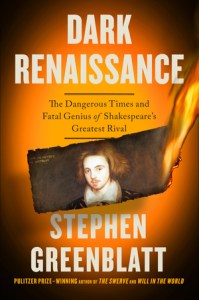
Sixteenth-century England was a time of great change. There were religious changes as the crown passed from one member of the Tudor family to another. Wars and illnesses like the plague and the sweating sickness were rampant. However, this was also a time of an explosion of the arts, particularly of the theatre. We see men like William Shakespeare and Ben Jonson rise from obscurity to write plays that would propel them to become phenomena. There was a third playwright who should be included in this list. He was the son of a cobbler who was educated at Cambridge University. A brilliant man who wrote groundbreaking plays while he was a spy for her majesty Queen Elizabeth I, his cause of death when he was only in his twenties would remain a mystery for centuries. Christopher (Kit) Marlowe’s story is told in Stephen Greenblatt’s latest book, “Dark Renaissance: The Dangerous Times and Fatal Genius of Shakespeare’s Greatest Rival.”

I would like to thank W. W. Norton & Company and Net Galley for sending me a copy of this book. I will be honest. Although I do spend a lot of time studying the 16th century, I don’t read a lot of plays by Shakespeare or Marlowe. So, when I saw this book and its premise, it piqued my curiosity. I knew that Marlowe was a famous playwright, he was a spy, and that he died young, but that’s all I knew before reading this book. I wanted to know more about Kit Marlowe and his world.

Christopher Kit Marlowe was the son of John Marlowe, an immigrant shoemaker, and his wife, Katherine Arthur. As their only son, it was believed that Kit would become a cobbler, but he had different skills that were more academically inclined. The cobbler’s son would study the classical writers of Ancient Greece and Rome, while learning Latin and debating theology. Kit would find himself at Cambridge University, and he paid for his education on a scholarship. While the main focus of these chapters is Marlowe, Greenblatt does show the lives of the scholars and fellow students who would shape Marlowe’s writings and his path in life.

Just as Marlowe was about to complete his Master of the Arts degree, his attendance dropped, and he was seen in Rheims in France. He was beginning to establish connections to the Elizabethan spy network with William Cecil, Lord Burghley, and Sir Francis Walsingham. This is the stage of life where we not only see Marlowe get in trouble with the law, but we also get to see Marlowe become a playwright who would rival Shakespeare himself. Greenblatt takes his time to analyze Marlowe’s works, including Tamburlaine the Great, Edward II, The Jew of Malta, and Doctor Faustus. Finally, Greenblatt examines Marlowe’s death on May 30, 1593, and who might have been responsible for his murder.

I found this book extremely informative, not only when it comes to the life of Christopher Kit Marlowe, but also the worlds of Elizabethan higher education, the theatrical community, the divides on religious beliefs, and the spy world. Marlowe is one of those figures who challenged what it meant to be a playwright through his rather controversial works, which inspired others like William Shakespeare. If you want a book about a playwright with a tragic end who doesn’t get a lot of attention, I highly recommend you read “Dark Renaissance: The Dangerous Times and Fatal Genius of Shakespeare’s Greatest Rival” by Stephen Greenblatt.

Guest Post: “John Foxe in State of Treason” by Paul Walker

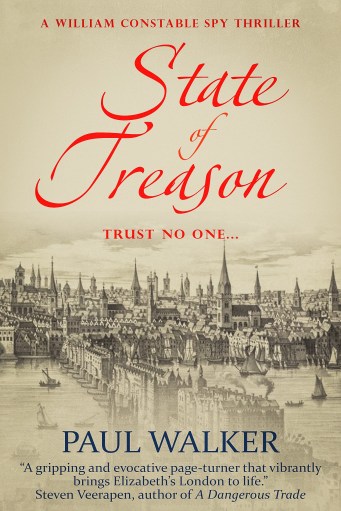
State of Treason Tour BannerToday, I am pleased to welcome Paul Walker, the author of “State of Treason” Book one of the William Constable Spy Thriller series, to my blog as part of his book tour with The Coffee Pot Book Club. Paul Walker will be discussing one of his characters, John Foxe. 
One of the delights in writing historical fiction is discovering real characters from the past, translating bare facts recorded about them into thoughts and actions, then weaving these into your story. When I started researching the reign of Elizabeth I for State of Treason, the first book in the William Constable series, I came across Doctor John Foxe. Until then, I knew little about Foxe; having only a vague notion of him as an author and scholar in the sixteenth century. Delving deeper, it soon became apparent that Foxe was a celebrated figure and his Book of Martyrs was a bestseller in its time, second only to the Bible, and an important tool of Protestant propaganda.

Foxe was born around the year 1516 in Lincolnshire to a prosperous yeoman family and entered Oxford University when he was 18. He became a supporter of Martin Luther and was active in condemning the practice of selling pardons by the Catholic Church. While at Oxford he witnessed the burning of William Crowbridge for his role in publishing the Bible in English. During the reign of Henry VIII, he was critical of the church and when Mary came to the throne he fled to Europe with his wife where he befriended several continental Protestant scholars.  It was in Basel that he wrote and published the first edition of his Book of Martyrs in Latin. 

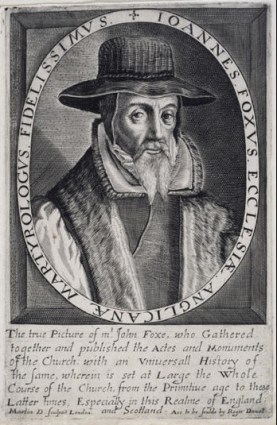
The full title runs to a long paragraph and could be considered a work of flash fiction itself. The book contains many gruesome illustrations of the executions of Protestant martyrs. This, and an understanding that Foxe was fiercely anti-Catholic, gave the initial impression of a stern, unbending religious fanatic. I was surprised, therefore, when I came upon an engraving, which, to my mind, showed a thoughtful and gentleman. In particular, he had a kind twinkle in his eyes. Reading more, I discovered he had a benign and forgiving nature and abhorred cruelty, even for those whose views he strongly opposed. He favoured the use of logical and theological arguments rather than maltreatment and execution to persuade those of different faiths.

J Foxe

An instance that demonstrates his compassion and humour was when he advised against the execution of an Anabaptist, Joan Boucher, in the reign of Edward VI. Boucher was examined by a man named James Rogers, who insisted she should die by burning. Instead of burning, Foxe pleaded, “at least let another kind of death be chosen, answering better to the mildness of the Gospel.” When Rogers answered that in his opinion burning alive was gentler than many other forms of execution, Foxe said to Rogers, “… maybe the day will come when you yourself will have your hands full of the same gentle burning.” 

In 1559, with Elizabeth on the throne, Foxe returned to England where he continued his scholarly work. I decided to incorporate Foxe as a character in State of Treason, which is set in London in 1578. The protagonist is William Constable, a fictitious physician, and scholar of mathematics and astronomy. Foxe’s faith becomes a foil for Constable’s man of science and logic. Together they form an unlikely friendship and formidable partnership in the fight to protect the English state against foreign and domestic intrigue. 

Four editions of his Book of Martyrs were printed in Foxe’s lifetime with the fourth published in 1583 and derived works were published after his death. The first English edition was published in 1563 and contained 1,700 pages and 1.5 million words. These statistics were surpassed by the fourth edition which was four times the length of the Bible and described as the most physically imposing, complicated, and technically demanding book of its era.

Francis Walsingham, William Cecil, and other Protestant statesmen decided that Foxe’s Book of Martyrs could be used in the anti-Catholic propaganda campaign deployed against Mary, Queen of Scots, and her supporters. A copy was placed in almost every church and wealthy household and it was required onboard all ships that sailed to the New Lands or fought against Spain. It has been argued that it was one of the most influential books in the English language. Despite its renown and popularity, it is said that Foxe never earned a penny from any of the editions. He was an unworldly man who largely depended on the benevolence of wealthy patrons.

John Foxe died peacefully at his home in Grub Street, London in 1587.

State_of_Treason

London, 1578

William Constable is a scholar of mathematics, astrology, and practices as a physician. He receives an unexpected summons to the Queen’s spymaster, Sir Francis Walsingham in the middle of the night. He fears for his life when he spies the tortured body of an old friend in the palace precincts.

His meeting with Walsingham takes an unexpected turn when he is charged to assist a renowned Puritan, John Foxe, in uncovering the secrets of a mysterious cabinet containing an astrological chart and coded message. Together, these claim Elizabeth has a hidden, illegitimate child (an “unknowing maid”) who will be declared to the masses and serve as the focus for an invasion.

Constable is swept up in the chase to uncover the identity of the plotters, unaware that he is also under suspicion. He schemes to gain the confidence of the adventurer John Hawkins and a rich merchant. Pressured into taking a role as court physician to pick up unguarded comments from nobles and others, he has become a reluctant intelligencer for Walsingham.

Do the stars and cipher speak true, or is there some other malign intent in the complex web of scheming?

Constable must race to unravel the threads of political manoeuvring for power before a new-found love and perhaps his own life is forfeit.

Amazon

Audio: Amazon UKAmazon US  

Paul Walker

Paul Walker

Paul is married and lives in a village 30 miles north of London. Having worked in universities and run his own business, he is now a full-time writer of fiction and part-time director of an education trust. His writing in a garden shed is regularly disrupted by children and a growing number of grandchildren and dogs.

Paul writes historical fiction. He inherited his love of British history and historical fiction from his mother, who was an avid member of Richard III Society. The William Constable series of historical thrillers is based around real characters and events in the late sixteenth century. The first three books in the series are State of Treason; A Necessary Killing; and The Queen’s Devil. He promises more will follow.

Social Media Links:

WebsiteTwitterFacebook

Biography: Christopher Marlowe

Christopher_Marlowe(Born around February 26, 1564( the date he was baptized)- Died May 30, 1593)
Son of John Marlowe and his wife Catherine.
Marlowe never married and did not have any children.
Christopher Marlowe was an Elizabethan poet, playwright and translator. His work influenced William Shakespeare, who was born in the same year, and others. Marlowe’s works are known for their blank verse and their overreaching protagonists. He would tragically be stabbed to death at the young age of 29.

Christopher Marlowe was born in Canterbury to a shoemaker named John Marlowe and his wife Catherine. We do not know the exact date of his birth, but we do know that he was baptized on February 26, 1564, so it is safe to assume that he was born a few days before. When he was old enough, he attended The King’s School in Canterbury and then received a Matthew Parker scholarship, which allowed him to study at Corpus Christi College, Cambridge. He received his Bachelor of Arts degree in 1584. In 1587, he received his Master of Arts degree on time after the school was hesitant to award him his degree since there was a rumor that he intended to go to the English college at Rheims, presumably to prepare for ordination as a Roman Catholic priest.

After Marlowe graduated, it is believed that Marlowe may have been a spy for Sir Francis Walsingham. Marlowe was known to have spend a lot of money on food and drink while he was in college, more than what his scholarship would have allowed, which has led many to question where he was getting the extra money for his expensive eating habit. There is no concrete evidence that he was in fact a spy, but there was a letter from the Privy Council that stated that Marlowe did serve the government in some way.

Christopher Marlowe is known for his literary career, which lasted from 1587 until his death in 1593. Some of his works include: Dido, Queen of Carthage, Tamburlaine the Great, The Jew of Malta, Edward the Second, The Massacre at Paris, Doctor Faustus, Hero and Leander, and The Passionate Shepherd to His Love.

Marlowe had a reputation for “atheism,” but this could, in Elizabeth I’s time, indicate merely unorthodox religious opinions. There is further evidence of his unorthodoxy, notably in the denunciation of him written by the spy Richard Baines and in the letter of Thomas Kyd to the lord keeper in 1593 after Marlowe’s death. Both Baines and Kyd suggested on Marlowe’s part atheism in the stricter sense and a persistent delight in blasphemy. On May 18, 1593, the Privy Council issued an order for Marlowe’s arrest. On May 30, however, Marlowe was stabbed to death by Ingram Frizer, at a lodging house in Deptford, where they had spent most of the day and where, it was alleged, a fight broke out between them over the bill. We do not know what was the cause of the fight. Marlowe was only 29 years old when he died.

Sources:
https://en.wikipedia.org/wiki/Christopher_Marlowe
https://www.britannica.com/biography/Christopher-Marlowe

Marlowe’s Life


https://www.biography.com/people/christopher-marlowe-9399572
https://www.poetryfoundation.org/poets/christopher-marlowe