
 The 16th century was known for its dramatic changes in religious issues. None more so than during the late Tudor dynasty especially during the reign of Elizabeth I. However, France also saw the religious pendulum swing between Protestantism and Catholicism. Many families from all walks of life were caught in religious squabbles, like the Montgomery family. Lady Gabrielle Roberda Montgomery found herself in the middle of the drama and was forced to marry into a prominent Devon family in Elizabethan England, far from her native France. Roberda’s extraordinary story is told masterfully in Rosemary Griggs’ latest novel, “The Dartington Bride.”
I would like to thank Rosemary Griggs and The Coffee Pot Book Club for allowing me to take part in this blog tour with a book review. I thoroughly enjoyed Griggs’ debut novel, “ A Woman of Noble Wit,” so when I heard that she was writing a new novel, it was intriguing to me. I had never heard of Lady Gabrielle Roberda Montgomery before reading this novel, so I was excited to learn more about her life.
Lady Gabrielle Roberda Montgomery was the daughter of Gabriel de Lorges, Count of Montgomery, Lord of Lorges and Ducey, and his wife Isabeau de la Touche. Her father was the captain of the Scots Guard during the reign of King Henri II of France, but everything changed in 1559, when he accidentally struck the king in the eye with a lance, killing the king. The Montgomery family must make tough choices to survive and fight with Louis I de Bourbon, Prince de Conde in the French Wars of Religion and survive the St. Bartholomew’s Day Massacre.
To make sure Roberda is safe and secure, her parents arrange a marriage alliance with Sir Arthur Champernowne. Roberda marries Gawen Champernowne, a rough brute of a man, who is jealous of not only his young wife and how she looks at other men but is jealous of men like Sir Francis Drake who can get all the glory while he stays in the shadows as a spy for Walsingham. Roberda has a difficult marriage, but she gets along with her father-in-law Sir Arthur Champernowne, and her friend Anne Cecil at Dartington Hall. Roberda is a great mother to her growing family and helps Huguenot refugees start again in England. However perfect her life may look on the outside, Gawen remains jealous and decides that the only way to quell his anger is through divorcing his faithful wife.
This is another brilliant novel by Rosemary Griggs highlighting a woman from the Elizabethan age who has for centuries lived in the shadows of the past. I loved how Griggs was able to take a woman who has been a footnote in history and give her a beautiful yet heartbreaking tale of love and tragedy. I cannot wait to see who Rosemary Griggs will write about next. If you want a gripping novel about a lesser-known lady living in the Elizabethan age, you should check out, “The Darington Bride” by Rosemary Griggs.
 Blurb:
1571, and the beautiful, headstrong daughter of a French Count marries the son of the Vice Admiral of the Fleet of the West in Queen Elizabeth’s chapel at Greenwich. It sounds like a marriage made in heaven…
Roberda’s father, the Count of Montgomery, is a prominent Huguenot leader in the French Wars of Religion. When her formidable mother follows him into battle, she takes all her children with her.
After a traumatic childhood in war-torn France, Roberda arrives in England full of hope for her wedding. But her ambitious bridegroom, Gawen, has little interest in taking a wife.
Received with suspicion by the servants at her new home, Dartington Hall in Devon, Roberda works hard to prove herself as mistress of the household and to be a good wife. But there are some who will never accept her as a true daughter of Devon.
After the St Bartholomew’s Day Massacre, Gawen’s father welcomes Roberda’s family to Dartington as refugees. Compassionate Roberda is determined to help other French women left destitute by the wars. But her husband does not approve. Their differences will set them on an extraordinary path…
Buy Links:
Universal Buy Link: https://rosemarygriggs.co.uk/books/2/The%20Dartington%20Bride/
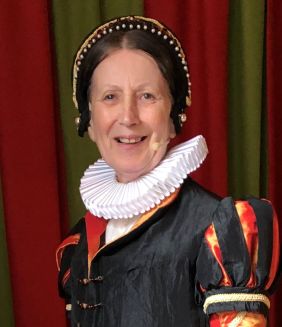 Author Bio:
Author and speaker Rosemary Griggs has been researching Devon’s sixteenth-century history for years. She has discovered a cast of fascinating characters and an intriguing network of families whose influence stretches far beyond the West Country and loves telling the stories of the forgotten women of history – the women beyond the royal court; wives, sisters, daughters, and mothers who played their part during those tumultuous Tudor years: the Daughters of Devon.
Her novel A Woman of Noble Wit tells the story of Katherine Champernowne, Sir Walter Raleigh’s mother, and features many of the county’s well-loved places.
Rosemary creates and wears sixteenth-century clothing, a passion that complements her love for bringing the past to life through a unique blend of theatre, history, and re-enactment. Her appearances and talks for museums and community groups all over the West Country draw on her extensive research into sixteenth-century Devon, Tudor life, and Tudor dress, particularly Elizabethan.
Out of costume, Rosemary leads heritage tours of the gardens at Dartington Hall, a fourteenth-century manor house and now a visitor destination and charity supporting learning in arts, ecology, and social justice.
Author Links:
Website:https://rosemarygriggs.co.uk/
Twitter: https://twitter.com/RAGriggsauthor
Facebook: https://www.facebook.com/ladykatherinesfarthingale
Instagram: https://www.instagram.com/griggs6176/
Threads: https://www.threads.net/@griggs6176
Bluesky: https://bsky.app/profile/ragriggsauthor.bsky.social
Amazon Author Page: https://www.amazon.com/stores/Rosemary-Griggs/author/B09GY6ZSYF
Goodreads: https://www.goodreads.com/author/show/21850977.Rosemary_Griggs
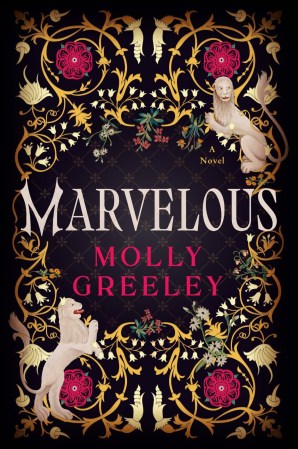 The tale is as old as time, of beauty and the beast. We know the story from either Disney or retellings. A peasant girl finds herself locked in a castle with a prince who is transformed into a hideous beast. He can only change back into a human if he can learn to love another person. Like many fairy tales, we often ask ourselves whether this story can be based on historical facts. Molly Greeley believes that Beauty and the Beast’s origins could be found in the true story of Pedro and Catherine Gonzales, who lived in the court of Catherine de Medici. She has chosen to tell their love story in her latest novel, “Marvelous.”
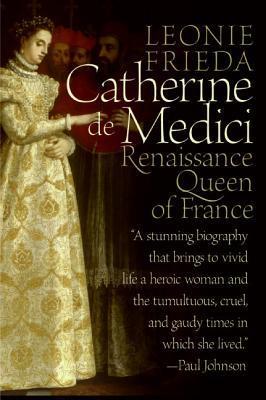 When we think about women rulers in the 16th century, some names, like Queen Mary I, Queen Elizabeth I, and Mary Queen of Scots, come to mind. However, another woman should be included in this list as her life helped keep the Valois dynasty alive and well in France, even though she was Italian by birth. Her name has been tainted with dark legends of poisoning, deadly incidents, and the infamous St. Bartholomew’s Day Massacre. This notorious queen was Catherine de Medici, and Leonie Frieda has chosen to shed some light on the myths and mysteries surrounding this misunderstood woman in her biography, “Catherine de Medici: Renaissance Queen of France.”
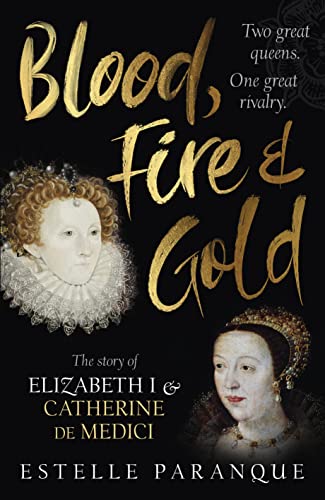 Two queens; one a wife and the mother of kings and the other a virgin who had to fight for the right to rule her country independently. Two women who found friendship and a rivalry between each other with only a sea that divided them and religious discord to drive them apart. Catherine de Medici and Elizabeth I would define what it meant to be female rulers in the 16th century for France and England, respectively. The tales of Elizabeth I and Catherine de Medici have been covered in numerous books, but a joint biography of these two powerhouses is a rarity until now. Estelle Paranque demonstrates how both queens greatly affected each other’s lives in her latest book, “Blood, Fire & Gold: The Story of Elizabeth I and Catherine de Medici.”
 After the death of Henry VIII and Edward VI, there was an explosion of religious intolerance, not just in England, but in Europe as a whole. Many believe that it was Mary I “Bloody Mary” who really started this trend, however, the fires of hatred between Protestants and Catholics extended further into the reigns of Elizabeth I and James I of England. We often focus on the monarchs and their inner circles during this time and how the religious persecutions affected the decisions that they made. That tells only part of the story, but how did this religious fighting between Protestants and Catholics affect the normal person? What were their lives like? Ken Follett explores this topic in his third book in his historical fiction series, the Kingsbridge Series, “A Column of Fire”.
 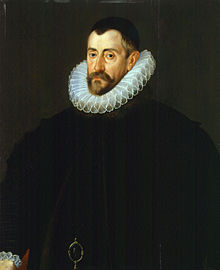 (Born around 1532- Died April 6, 1590)
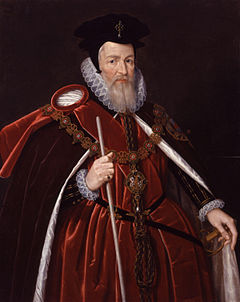 (Born September 13, 1520- Died August 4, 1598)
 Elizabeth I was perhaps the most influential monarch in English history. There are episodes in her life that became legendary. From her tumultuous childhood to her reign where everyone either wanted her to marry or put someone else on the throne, Elizabeth’s life was hardly easy. Even though much is known about her public life as queen, we really do not know a lot about her private life. In Alison Weir’s book, “The Life of Elizabeth I”, the gap between the public Elizabeth and the private Elizabeth is bridged in order to give a more complete biography of this fascinating English queen.
 learning and discoveries. While that is true, like any age, there were good elements and bad elements. We tend to overlook the bad elements with Elizabeth’s “Golden Age” and move on to the good elements. However, we cannot get a full image of the age if we only look at the good elements. That is why A.N. Wilson wrote the book “The Elizabethans”:
 Adventures of a Tudor Nerd