
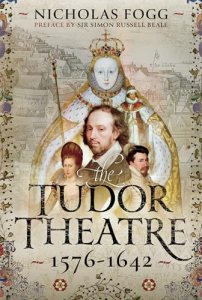
When we think about the world of the Tudor theatre, we often think about the greatest playwrights of the age. Kit Marlowe, Ben Jonson, Thomas Kyd, and of course, William Shakespeare. We think of the Globe Theatre and the grand plays and masques that were performed for the rich and the poor alike. But this is only a small glimpse into the world of the Tudor theatre scene. Nicholas Fogg explores the beginnings and the end of this period in theatrical history in his book, “The Tudor Theatre: 1576-1642.”
I would like to thank Pen & Sword Books and NetGalley for providing me with a copy of this book. I am not very well-versed in theatre history, so I was hoping for something that would be easy for me to follow along, yet also very informative.
Fogg begins in the year 1576 with the opening of The Theatre, which was a passion project of James Burbage. It was the first location dedicated solely to plays and acting, but it will not be the last. Over sixty years, we see the explosion of the theatrical arts from the great playwrights to lesser-known figures. Fogg takes the time to analyze the popular plays and those that don’t get enough attention. We also get to see how politics, the Puritans, and the plague affected the theatre scene. We witness the rise and fall of actors, playwrights, and theatres until the Puritans finally decided to close theatres for good in 1642, once the Stuarts fell for a time.
Fogg is an expert in this field of study, and he shows it on each page, but sometimes, as a novice, I felt a bit lost. The amount of information in this book was a bit overwhelming for someone like me, who is not too familiar with the theatre world. However, if you are someone who loves the Tudor theatre and wants an in-depth look at this period of theatrical history, you might enjoy “The Tudor Theatre: 1576-1642” by Nicholas Fogg.
 Throughout English history, a colorful cast of queens has left their marks in their distinct ways. While the Plantagenet and Tudor queens are more well-known, the Stuart queens and the mistresses of the Stuart kings were dynamic in their unique ways. One of the lesser-known queens was the wife of King Charles II. Though Charles II is known for his numerous mistresses, his wife Catherine of Braganza is not discussed much in England, but in her native Portugal, she is famous. So who was Catherine of Braganza, and what is her legacy in England and Portugal? Susan Abernethy tells the story of this almost forgotten queen in her book, “Charles II’s Portuguese Queen: The Legacy of Catherine of Braganza.”
 England’s history is centuries old, full of colorful characters and change galore. What truly defines the history of England is the monarchy, which has lasted over a thousand years. Over 40 kings and queens left their distinct marks on the history of this proud island nation. While some could maintain the crown with no issues, others had to fight to earn the crown, and a few even died for the crown. While there has been a plethora of books and novels written about individual monarchs and their impacts on the history of England, only a select few have chosen to take the arduous task of telling the story of the British Monarchy from its origins to the modern-day. One such historian who has chosen the latter is Tracy Borman in her book, “Crown and Sceptre: A New History of the British Monarchy from William the Conqueror to Elizabeth II.”
 The field of history for centuries has been focused on men and the struggles that mankind has had to endure for society to survive. We tend to get only a mere glimpse at the lives of women when they are next to powerful men. Some will write about women, mostly royal women, who lead extraordinary lives and left an imprint on the past. But what about those who lived ordinary lives? What about the women who lived daily, fighting to survive every obstacle? What can we learn about history through the eyes of ordinary women? Philippa Gregory has taken on the mammoth task of trying to answer these questions and more with her tome, “Normal Women: Nine Hundred Years of Making History.”
 Adventures of a Tudor Nerd